
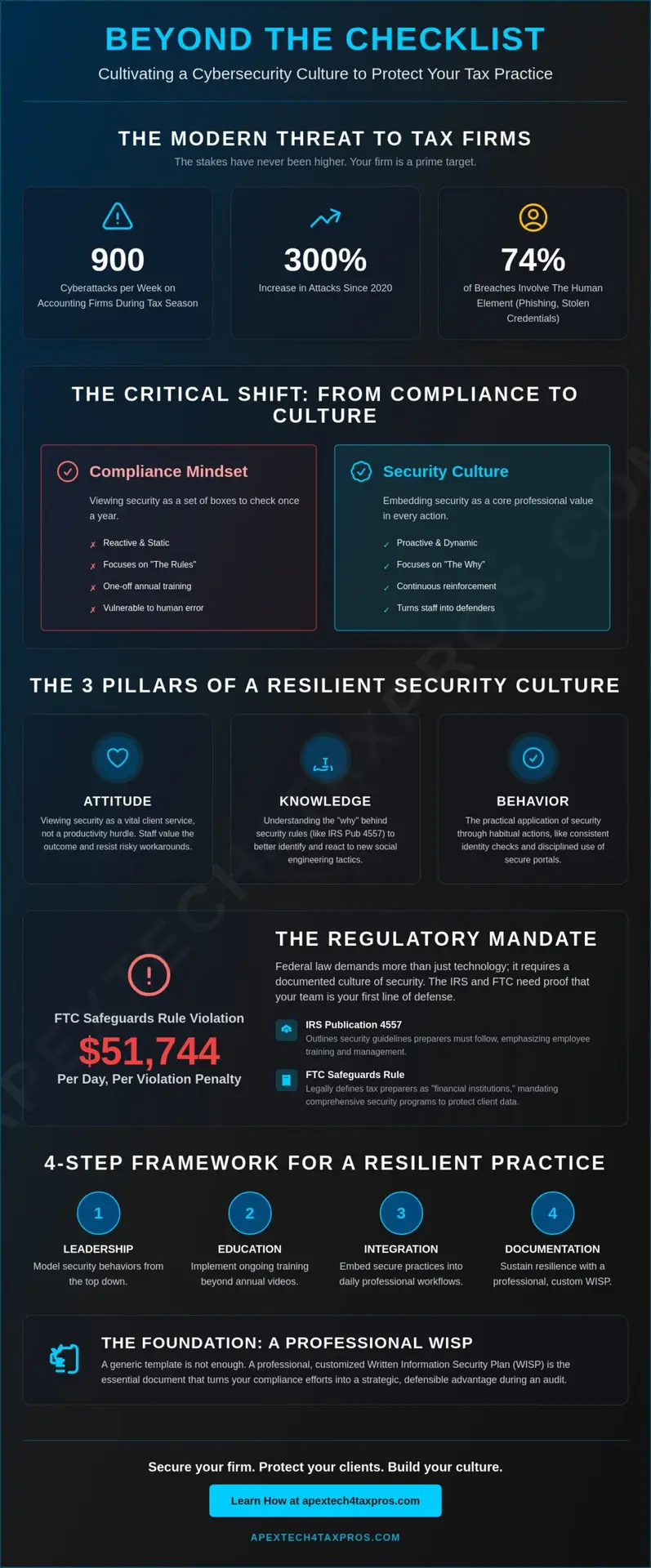
During the height of tax season, accounting firms now face an average of 900 cyberattacks every single week; a staggering 300% increase since 2020. While technical safeguards are vital, 74% of all data breaches still involve a human element such as phishing or stolen credentials. This reality proves that checking boxes for IRS Publication 4557 isn’t enough to protect your legacy. To truly secure your practice, you must cultivate a robust cybersecurity culture that turns every employee into a proactive defender rather than a point of vulnerability.
You’ve likely felt the mounting exhaustion of tax season lead to avoidable security lapses, or perhaps you’ve spent late nights worrying about the $51,744 per day civil penalty for FTC Safeguards Rule violations. It’s a heavy burden to carry alone. This guide will help you transform your firm from a state of constant risk into a high-resilience practice where data protection is a core professional value. We’ll examine how to move beyond a stagnant Written Information Security Plan (WISP) to create a workplace where peace of mind during IRS audits is the standard, not the exception.
Key Takeaways
- Understand how to move beyond basic regulatory compliance to establish a resilient cybersecurity culture that protects your firm’s reputation and high-value client data.
- Identify the specific federal mandates under the FTC Safeguards Rule and IRS Publication 4557 that require documented employee training and ongoing oversight.
- Discover how to navigate the “Tax Season Trap” by identifying the human factors that compromise security when workloads increase and deadlines loom.
- Implement a structured four-step framework that empowers leadership to model security behaviors and integrate protection into every professional workflow.
- Learn why transitioning from a generic template to a professional, customized WISP is the essential step for turning compliance into a strategic advantage.
What is Cybersecurity Culture in a Tax Practice?
In the high-stakes environment of a tax practice, cybersecurity culture is the collective mindset where data protection is prioritized over speed and convenience. It’s the internal compass that guides every staff member to pause before clicking an attachment, even during the frantic peak of April. For the seasoned professional, this culture represents a shift from viewing security as a technical burden to seeing it as an essential component of client service. It’s the difference between a firm that merely follows rules and one that embodies the principles of data stewardship.
Tax firms are distinct from general businesses because they are classified as financial institutions under the Gramm-Leach-Bliley Act. You handle high-value Personally Identifiable Information (PII) that makes your office a primary target for specialized, tax-themed phishing campaigns. These attacks are not generic; they are engineered to mimic IRS correspondence or software update prompts. When your team views data protection as a shared professional value, they move beyond the mindset that security is “the IT person’s problem.” Instead, they embrace a collective responsibility rooted in professional ethics and empathy for the clients whose financial lives they protect.
The Three Pillars of Financial Security Culture
Building a resilient environment requires a focus on three fundamental areas:
- Attitude: This involves viewing security protocols as a vital service to the client rather than a hurdle to productivity. When staff members value the outcome of a secure firm, they are less likely to seek “workarounds” that create vulnerabilities.
- Knowledge: True resilience comes from understanding the “Why” behind IRS Publication 4557 and other federal security protocols. Staff who understand the mechanics of a threat are better equipped to identify novel social engineering tactics.
- Behavior: This is the practical application of security through habitual verification. It includes consistent identity checks for clients and the disciplined use of secure document portals for every exchange of sensitive data.
Culture vs. Awareness Training
Many firms mistake a once-a-year compliance video for a comprehensive security strategy. While Information Security Awareness is a necessary starting point, it often fails to change long-term behavior because it treats security as an isolated event. There is a profound difference between “knowing” a rule exists and “valuing” the protection that rule provides. Training provides the facts, but culture provides the motivation to apply those facts when no one is watching. Culture is the bridge that transforms abstract knowledge into the instinctive, daily habits that shield your practice from human error. By integrating these values into your daily workflows, you ensure that security remains a constant presence rather than a seasonal afterthought.
The Regulatory Mandate: Why the IRS and FTC Demand a Security Culture
Compliance is often viewed as a stationary target; a set of checkboxes to be cleared once a year. However, for the modern tax professional, federal regulators have shifted the goalposts toward a more dynamic standard. The IRS and FTC no longer just look for technical tools; they demand evidence of a functional cybersecurity culture. This shift acknowledges that even the most expensive firewall cannot stop a breach if a staff member is pressured by deadlines to bypass security protocols. When an auditor arrives, they aren’t just looking at your software versions. They’re looking for proof that your team understands their role as the first line of defense.
Federal law now codifies the human element through rigorous standards. Under the Gramm-Leach-Bliley Act, tax preparers are legally defined as financial institutions. This classification subjects your firm to the FTC Safeguards Rule, which carries significant weight. As of May 2026, the civil penalty for violations of this rule has reached up to $51,744 per violation per day. These aren’t just suggestions. They’re mandatory requirements that focus heavily on how you manage your people and their access to sensitive data. A documented culture of vigilance serves as your strongest defense during a regulatory audit, proving that you’ve taken “reasonable” steps to protect taxpayer information.
Decoding IRS Publication 4557 Requirements
The framework for these expectations is detailed in IRS Publication 4557, which outlines the “Security Six” controls. Beyond technical settings, the IRS requires you to designate at least one employee to coordinate your security program. This individual is responsible for ensuring that safeguarding taxpayer data isn’t a secondary task but a firm-wide mandate. You can learn more about IRS compliance requirements to see how these roles fit into your specific practice size. This designated oversight ensures that your firm’s culture remains active, even during the peak of tax season when fatigue often leads to critical errors.
The FTC Safeguards Rule and Employee Oversight
The FTC Safeguards Rule mandates that firms provide regular, effective training for all staff members. This isn’t a “one and done” exercise. It requires periodic risk assessments that specifically include human vulnerabilities. Your Written Information Security Plan (WISP) acts as the “Constitution” of your firm’s cybersecurity culture, documenting exactly how you train, monitor, and hold staff accountable. If a breach occurs, a “negligent” culture; one where training was ignored or the WISP was a dormant document; can lead to catastrophic legal liabilities. By establishing a professional WISP, you create a roadmap for ongoing resilience. If you’re starting from scratch, you can begin by reviewing a customized security planning guide to align your firm with these federal expectations.
Human Risk vs. Technical Controls: The Tax Season Vulnerability
Technical safeguards like firewalls and encryption are essential, but they provide a false sense of security if the human element is ignored. According to research from January 2026, 74% of all data breaches involve a human element, such as phishing or the misuse of credentials. This statistic highlights a critical reality: your technical perimeter is only as strong as the person operating the keyboard. In a high-pressure cybersecurity culture, the focus must shift from solely maintaining software to managing the psychological and behavioral risks that lead to data exposure.
The “Tax Season Trap” is a period of heightened vulnerability where the intersection of extreme fatigue and rigid deadlines creates a perfect storm for attackers. When staff members are working 60-hour weeks, their cognitive defenses naturally erode. Cybercriminals exploit this exhaustion by using psychological triggers such as urgency, authority, and fear. A spoofed email that appears to be from a senior partner or the IRS demanding an immediate response can bypass a tired employee’s better judgment. Even the most robust firewall cannot stop a staff member from voluntarily providing login credentials to a site they believe is legitimate.
The Anatomy of a Seasonal Phishing Attack
Attackers frequently use sophisticated “IRS-style” branding to deceive professionals into bypassing their critical thinking. These emails often mimic official portals or document request notifications, designed to look identical to the platforms your firm uses daily. Seasonal hires present an additional layer of risk, as they often haven’t been fully acculturated to your firm’s specific security standards or the nuances of your Written Information Security Plan (WISP). A resilient cybersecurity culture encourages a “pause and verify” mindset, empowering staff to stop and validate a request even when the filing deadline is only hours away.
Shadow IT in the Accounting Office
During the busy season, “getting it done” often takes precedence over “doing it securely.” This mindset leads to the rise of Shadow IT, where employees use personal devices, unapproved cloud storage, or private email accounts to bypass perceived bottlenecks. While these shortcuts might save a few minutes, they create permanent security gaps that fall outside your firm’s visibility and control. Understanding these internal threats is vital for long-term protection. The importance of professional risk assessments cannot be overstated, as these evaluations identify where human behavior and technical limitations collide. By addressing these shortcuts before they become entrenched habits, you maintain the integrity of your professional standards and client trust.
Building Your Culture: A 4-Step Framework for Tax Firms
Transforming your firm requires more than a software update; it requires a structural shift in how your team perceives risk. Technical defenses only succeed when they are supported by a resilient cybersecurity culture. This framework moves beyond the static “Security Six” checklist to create a living defense system. By following these four steps, you ensure that data protection becomes a permanent professional value rather than a seasonal chore.
Step one begins with leadership buy-in. Owners and partners must model the exact behaviors they expect from their staff. If leadership bypasses Multi-Factor Authentication (MFA) for convenience, the team will perceive security as optional. Step two involves treating your Written Information Security Plan (WISP) as a living document. Rather than letting it sit on a shelf, integrate its rules into your daily workflows. This ensures that every document exchange and client interaction aligns with federal standards. To ensure your plan meets these rigorous demands, you can access our professional WISP development services to build a foundation that lasts.
Step three replaces the “annual training dump” with continuous, micro-learning. Short, monthly security tips are far more effective at preventing the 74% of breaches that involve a human element. Finally, step four establishes a “no-blame” reporting culture. Because the FTC requires notification within 30 days of discovering a data breach involving 500 or more customers, your staff must feel safe reporting a mistake immediately. A culture of fear leads to concealment; a culture of resilience leads to rapid mitigation.
Modeling Behavior from the Top
Partners carry the weight of setting the firm’s ethical tone. You must use secure portals and MFA for every transaction, signaling that client privacy is non-negotiable. Discussing security shouldn’t be reserved for IT meetings. Including a brief security update in every staff meeting keeps vigilance at the forefront of the team’s mind. This consistent messaging reinforces our cybersecurity awareness training for tax staff, turning abstract concepts into daily professional habits.
Incentivizing Security Vigilance
Traditional security models often rely on punishment, but resilience is built through positive reinforcement. Shift your focus from punishing mistakes to rewarding “catches,” such as an employee identifying a sophisticated phishing attempt. You can make security a key performance indicator (KPI) for all roles, ensuring it carries the same weight as billable hours or accuracy. Designating “Security Champions” within your tax prep team creates internal mentors who can guide seasonal hires. This peer-to-peer support system ensures that your cybersecurity culture remains strong even when leadership is occupied with high-level tax planning.
Sustaining Resilience: The Role of the Professional WISP
A generic template might satisfy a cursory glance from an auditor, but it rarely fosters a genuine cybersecurity culture. These off-the-shelf documents often contain broad language that doesn’t reflect the unique operational realities of your tax practice. When policies aren’t tailored to your specific team and technology stack, they remain ignored on a digital shelf. A professional, customized Written Information Security Plan (WISP) serves as more than a compliance shield; it functions as the operational roadmap for your firm’s long-term resilience. It bridges the gap between high-level federal mandates and the daily habits of your staff.
Professional risk assessments are the only way to identify the “human gaps” that software often misses. While a firewall can block a known malicious IP address, it cannot detect when a staff member feels pressured to share a password or use an unencrypted thumb drive. By documenting these specific risks within your WISP, you create a framework for targeted training. This level of detail transforms your security posture from a reactive state into a proactive defense. Beyond internal protection, a robust security culture serves as a significant marketing advantage. High-net-worth clients are increasingly aware of the $6.08 million average cost of a data breach in the financial sector. Demonstrating that your firm treats their PII with the highest level of professional stewardship builds a level of trust that generic practices cannot match.
From Documentation to Habituation
A customized WISP translates vague cultural goals into specific, repeatable actions that your team can follow. It outlines exactly how to handle client onboarding, document transmission, and remote access without compromising safety. This document acts as the anchor for all firm security decisions, ensuring that as IRS standards evolve, your practice remains aligned with best practices. Professional guidance ensures your plan isn’t just a list of rules but a reflection of your firm’s commitment to professional ethics. When security protocols are woven into the fabric of your daily operations, they cease to be “extra work” and instead become the standard way your firm conducts business.
Next Steps for Your Practice
Sustaining a resilient cybersecurity culture requires consistent evaluation and a willingness to adapt to new threats. You should begin by conducting an initial risk assessment to benchmark your current environment and identify where your team is most vulnerable. Review your current training program to ensure it remains engaging and relevant to the specific tax-themed phishing attacks your staff faces daily. Once you have identified these gaps, the most critical step is to formalize your defenses. You can secure your firm’s future with a customized WISP from Apex Tech 4 Tax Pros. This professional foundation ensures that your practice remains a safe harbor for client data, allowing you to focus on your professional success with complete peace of mind.
Strengthening Your Firm’s Human Firewall
Resilience in the tax industry is not a destination but a continuous state of readiness. By moving beyond a passive compliance mindset, you transform your practice into a high-resilience firm where data protection is a shared professional value. We’ve explored how a robust cybersecurity culture serves as the ultimate defense against the human errors that lead to 74% of all data breaches. Whether it’s through leadership modeling or integrating the WISP into daily workflows, your commitment to these standards protects both your reputation and your clients’ sensitive financial lives.
You don’t have to navigate these complex regulatory waters alone. With decades of experience in tax-specific cybersecurity and specialized expertise in IRS Publication 4557, we provide the expert-led risk assessments and training your team needs to thrive. Protect your clients and your practice—get your customized WISP today. Taking this step ensures that your firm remains secure, compliant, and prepared for the challenges of every tax season to come. It’s a journey toward peace of mind that starts with a single, professional decision.
Frequently Asked Questions
Is cybersecurity culture really a requirement for IRS compliance?
Yes, the IRS and FTC mandate specific behavioral controls that can only be met through a functional cybersecurity culture. IRS Publication 4557 requires a designated employee to coordinate security, while the FTC Safeguards Rule demands ongoing training and oversight for all staff. These regulations transition security from a technical option to a legal necessity for every tax professional. Failing to demonstrate this culture can result in civil penalties of up to $51,744 per violation per day.
How can I build a security culture with a small, remote team of tax preparers?
Building a culture in a remote environment requires standardized communication and the mandatory use of secure document portals. You must ensure that remote preparers are not using personal devices or unapproved cloud storage to handle sensitive taxpayer data. Regular, short video check-ins focused on security updates can bridge the physical gap between team members. This consistency ensures that every preparer, regardless of location, follows the protocols outlined in your firm’s Written Information Security Plan.
What is the biggest cultural mistake accounting firms make during tax season?
The most significant mistake is allowing the pressure of deadlines to justify security shortcuts, often referred to as the “Tax Season Trap.” When speed is prioritized over safety, staff may bypass Multi-Factor Authentication or use unencrypted email for convenience. This cultural erosion creates permanent vulnerabilities that attackers exploit. A resilient firm maintains its security discipline even during peak filing periods, ensuring that protection remains a non-negotiable professional standard for all employees and seasonal contractors.
Do I need a WISP if I already have cybersecurity insurance?
Yes, a Written Information Security Plan (WISP) is a federal requirement that exists independently of your insurance coverage. Most cyber insurance carriers now scrutinize compliance with the FTC Safeguards Rule before paying out a claim. If a breach occurs and you don’t have a documented WISP, your carrier may deny coverage based on a lack of “reasonable” safeguards. Having a professional WISP ensures you meet legal mandates while protecting your firm’s financial interests.
How often should I conduct cybersecurity awareness training for my staff?
You should transition from annual sessions to continuous, monthly micro-learning to keep vigilance high. Research indicates that 74% of breaches involve human error; a statistic that highlights the need for frequent reinforcement. Monthly security tips or short training modules are more effective at changing long-term habits than a single yearly video. Consistent training keeps evolving threats, like AI-powered phishing, at the forefront of your team’s awareness throughout the entire year.
What should I do if an employee admits to clicking a suspicious link?
You must encourage a “no-blame” reporting environment where the employee feels safe admitting the mistake immediately. Rapid reporting allows your technical team to isolate the affected device and change compromised credentials before the attacker can move laterally through your network. Follow the incident response steps outlined in your WISP and conduct a post-incident review. This approach treats the event as a learning opportunity rather than a reason for punishment, strengthening your overall resilience.
Can a strong security culture actually help me grow my tax practice?
A strong cybersecurity culture serves as a powerful marketing tool that distinguishes your practice from less secure competitors. High-net-worth clients and businesses are increasingly concerned about data privacy and the rising cost of breaches in the financial sector. By demonstrating that your firm has expert-led risk assessments and a professional WISP, you provide a level of protective reassurance that wins long-term loyalty. Security becomes a value-add that justifies your professional fees and builds trust.
How do I involve seasonal staff in our firm’s security culture?
Seasonal staff must be integrated into your security protocols from their first day of onboarding. They should receive the same cybersecurity awareness training as permanent employees and be assigned a “Security Champion” as a mentor. Since seasonal hires are often targeted by specialized phishing attacks, they must understand that your firm’s security rules are non-negotiable. Including them in the WISP culture ensures your firm’s defense remains uniform during your highest-risk periods of the year.