
Title Tag: Client Data Protection Policy for Accounting Firm: 2026
Key Takeaways
- Understand how a client data protection policy for accounting firm operations is legally formalized through a Written Information Security Plan (WISP) to meet 2026 federal standards.
- Identify the essential elements of an IRS-compliant WISP, including the designation of a security coordinator and a complete inventory of your firm’s hardware and cloud software.
- Learn how to bridge the gap between policy and practice by conducting a professional IT assessment and implementing mandatory technical controls like Multi-Factor Authentication.
- Discover why generic templates often fail during audits and how a customized security plan provides relief from the burden of regulatory anxiety.
- Ensure your practice is fully prepared to satisfy IRS Publication 4557 and FTC Safeguards Rule requirements while securing sensitive taxpayer data against modern threats.
What is a client data protection policy for an accounting firm?
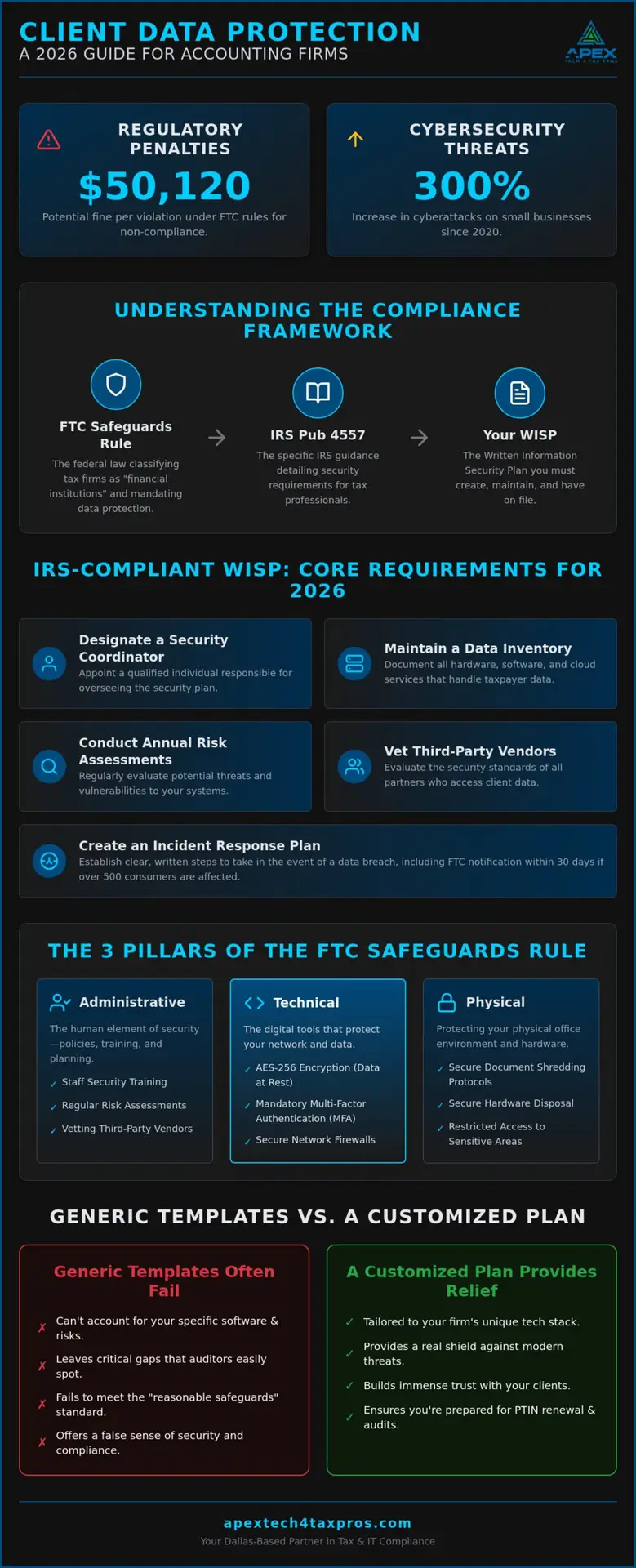
A client data protection policy for accounting firm operations is much more than a list of “do’s and don’ts.” It’s a comprehensive framework that dictates how your practice collects, stores, and eventually destroys sensitive taxpayer data. By 2026, federal regulators have moved past verbal agreements and handshake policies. Today, this policy must be formalized as a Written Information Security Plan (WISP). While you might hear these terms used interchangeably, it helps to understand the hierarchy. The FTC Safeguards Rule is the federal law, IRS Publication 4557 provides the specific guidance for our industry, and the WISP is the actual document you keep on file.
You might be tempted to download a basic template and call it a day. However, the FTC requires “reasonable safeguards” that are specific to your firm’s unique risks. A generic document can’t account for your specific cloud software or local server setup. To truly understand what is data security in a professional context, your policy needs to be as unique as your tax practice. Relying on an unedited WISP template often leaves critical gaps that auditors will spot immediately.
Why is a formal security policy mandatory for tax professionals?
The IRS has made it clear that data security isn’t optional. When you renew your Preparer Tax Identification Number (PTIN) each year, you’re required to attest on Form W-12 that you have a WISP in place. This isn’t just bureaucratic red tape. Under the Gramm-Leach-Bliley Act (GLBA), accounting firms are legally classified as “financial institutions.” This classification puts you in the same regulatory category as banks. It subjects you to strict FTC oversight and potential penalties of up to $50,120 per violation as of January 2025.
How does a data protection policy protect your practice beyond compliance?
A solid policy does more than check a box for the IRS; it acts as a shield against the 300% increase in cyberattacks we’ve seen since 2020. Ransomware is now present in 88% of breaches at small businesses. Having a clear plan helps you identify vulnerabilities before a hacker does. Beyond the technical side, being a secure custodian builds immense trust. When clients see you take their financial privacy seriously, they feel confident referring others to your practice. If you aren’t sure where your current plan stands, a professional IT assessment can help bridge the gap between your current policy and federal reality.
What must an IRS-compliant Written Information Security Plan (WISP) include in 2026?
Your WISP is the operational heartbeat of your client data protection policy for accounting firm security. By 2026, the IRS and FTC expect more than just vague promises; you must designate a qualified individual as your security coordinator. This person is responsible for maintaining a complete inventory of every system that touches taxpayer data. This includes your tax software, local servers, and even the mobile devices your team uses for work email. Having a designated point of contact ensures that security remains a consistent priority rather than an afterthought during the busy season.
The three pillars of the FTC Safeguards Rule
The FTC organizes your responsibilities into three distinct areas. Administrative safeguards focus on the human element, such as staff training and regular risk assessments. Technical safeguards involve the digital tools that protect your perimeter. These include AES-256 encryption for data at rest and mandatory Multi-Factor Authentication (MFA) for every user. Finally, physical safeguards cover your office environment. You need protocols for document shredding, hardware disposal, and restricted access to areas where sensitive files are kept.
Your plan must also address how you vet third-party vendors. Since breaches involving outside partners doubled last year, you’re required to evaluate their security standards before sharing client data. This aligns with the latest IRS guidelines for professional tax preparers. Additionally, you must have a written Incident Response Plan. If a breach occurs, you need clear steps to contain the threat and notify the FTC within 30 days if more than 500 consumers are affected. If you’re feeling overwhelmed, our team at Apex Tech 4 Tax Pros can help you navigate these requirements.
Why you must update your WISP annually
Cyber threats evolve too quickly for a “set it and forget it” approach. You’re required to perform an annual risk assessment to spot new vulnerabilities. This is also a perfect time to ensure your policy reflects any changes in your tech stack or staff. Keeping your client data protection policy for accounting firm compliance current ensures you stay ready when it’s time for PTIN renewal. If this feels like a heavy lift, you can learn more about our customized WISP templates that simplify this entire process.
How do I put these data protection policies into practice?
Moving from a written plan to daily operations is where many firms struggle. You can’t secure what you haven’t identified. Start by conducting a thorough IT assessment to find gaps between your current office setup and federal reality. This process helps you see exactly where your client data protection policy for accounting firm workflows might be vulnerable. For instance, implementing Multi-Factor Authentication (MFA) across all professional software is no longer a suggestion. It’s a mandatory control for any system accessing sensitive taxpayer data.
Training your team on the “knowledgeable colleague” standard
Your staff is your first line of defense. Since the majority of data breaches involve a human element, you must establish a cybersecurity awareness training schedule for both seasonal and permanent employees. This is especially vital during tax season. Cyberattacks on accounting firms can increase to over 900 per week during peak filing months. Teach your team to spot sophisticated AI-powered phishing attempts. You should also enforce strict “acceptable use” policies for firm-owned laptops and mobile devices. Following official IRS guidance on Written Information Security Plans ensures your training meets federal expectations.
Automating compliance with secure cloud solutions
Centralizing your data is the most effective way to protect it. Moving away from local storage to a secure virtual desktop allows you to control access and encryption from a single point. This setup naturally integrates with secure cloud backup services. Encrypted off-site storage is a critical component of your disaster recovery plan. It ensures that even if local hardware fails, your client data remains safe and recoverable. If you’re ready to secure your practice, book a WISP assessment today to identify your specific needs and start closing your security gaps.
How can a customized security plan provide relief from the compliance burden?
It’s tempting to grab a generic template online and simply fill in the blanks. However, a “copy-paste” client data protection policy for accounting firm use is often worse than having no policy at all. The FTC Safeguards Rule explicitly requires your plan to be based on a risk assessment of your specific tech stack. If an auditor sees a document that mentions hardware you don’t own or software you don’t use, it’s a clear signal that you haven’t actually implemented the safeguards you’ve claimed. Professional assistance ensures your WISP is an accurate reflection of your practice, providing true relief from the fear of an IRS or FTC audit.
Our Dallas-based team brings over 20 years of combined tax and IT experience to your side. We understand the high-stakes environment of tax season and the specific pressures you face. By tailoring your client data protection policy for accounting firm needs, we turn complex federal mandates into a manageable, living framework. This specialized approach doesn’t just satisfy regulators; it builds a protective wall around your practice and your clients’ most sensitive information.
Comparing Seasonal vs. Yearly compliance support
- Seasonal ($649.99): This option is perfect for independent preparers who need an immediate, customized WISP to satisfy PTIN renewal requirements. It provides the essential documentation you need to stay compliant during the busiest months of the year.
- Yearly ($1,099.99): Designed for growing firms, this subscription offers ongoing protection. It includes the required annual risk assessments, staff training, and continuous updates as the threat landscape evolves.
Both subscriptions include a free customized WISP, which means you don’t have to spend your valuable time drafting technical documentation from scratch.
Taking the next step toward a secure practice
2026 is the year to move from “adequate” to “advanced” security. With cybercriminals using more sophisticated tools, a proactive stance is your best defense. We provide bilingual support to ensure your entire team understands their role in protecting taxpayer data. You don’t have to carry this regulatory weight alone. Get your customized WISP today and secure your firm’s future. To get started, you can Book a WISP Assessment or email our team at info@at4tp.com.
Securing Your Firm’s Future in 2026 and Beyond
Building a robust client data protection policy for accounting firm operations is an investment in your practice’s longevity. By now, you know that a formalized Written Information Security Plan (WISP) isn’t just a suggestion; it’s a federal requirement for PTIN renewal and a critical defense against evolving cyber threats. You’ve also seen how moving from a “copy-paste” template to a customized solution provides genuine relief from regulatory anxiety.
At Apex Tech 4 Tax Pros, we combine over 20 years of tax and IT expertise to deliver solutions that are fully compliant with IRS Publication 4557. Whether you need a seasonal check-up or year-round protection, our bilingual team is ready to support your firm’s unique needs. You don’t have to navigate these complex FTC Safeguards alone.
Taking that first step toward a secure office is easier than you think. Book a WISP Assessment with Apex Tech 4 Tax Pros today to ensure your practice remains a safe haven for client data. We’re proud to help you turn compliance into a competitive advantage while you focus on what you do best: serving your clients.
Frequently Asked Questions
Is a data protection policy the same as a WISP?
A Written Information Security Plan (WISP) is the legally required, formalized version of your client data protection policy for accounting firm operations. While a general policy might outline your intentions, the WISP is the specific, structured document that the IRS and FTC require you to have on file. It translates your security goals into actionable steps that protect taxpayer data according to federal standards.
What are the penalties for not having a WISP in 2026?
The financial stakes for non-compliance are significant. As of January 2025, the FTC can impose penalties of up to $50,120 per violation for failing to meet Safeguards Rule requirements. Beyond these fines, you must attest to having a WISP to renew your PTIN each year. A lack of documentation could jeopardize your ability to practice legally and leave you vulnerable to devastating lawsuits if a breach occurs.
Does the FTC Safeguards Rule apply to small accounting firms with only one person?
Yes, the rule applies to every tax professional, even if you’re a solo practitioner working from a home office. Under the Gramm-Leach-Bliley Act, all tax preparers are classified as financial institutions. This means you have the same legal obligation to protect client information as a large national firm. Size doesn’t exempt you from the requirement to maintain a written security plan.
How often do I need to perform a risk assessment for my tax office?
You’re required to conduct a formal risk assessment at least once a year. It’s also necessary to update your assessment whenever you make a major change to your business, such as hiring new seasonal staff or switching to a new cloud software provider. This practice ensures your client data protection policy for accounting firm security stays current against new cyber threats like AI-powered phishing.
Can I use a free WISP template for IRS compliance?
You can use a template as a starting point, but it won’t satisfy the IRS or FTC on its own. Federal law requires your WISP to be tailored to your specific office environment, hardware, and software. A generic “copy-paste” plan that doesn’t reflect your actual daily operations will likely be rejected during a professional audit because it fails to address your firm’s unique vulnerabilities.