
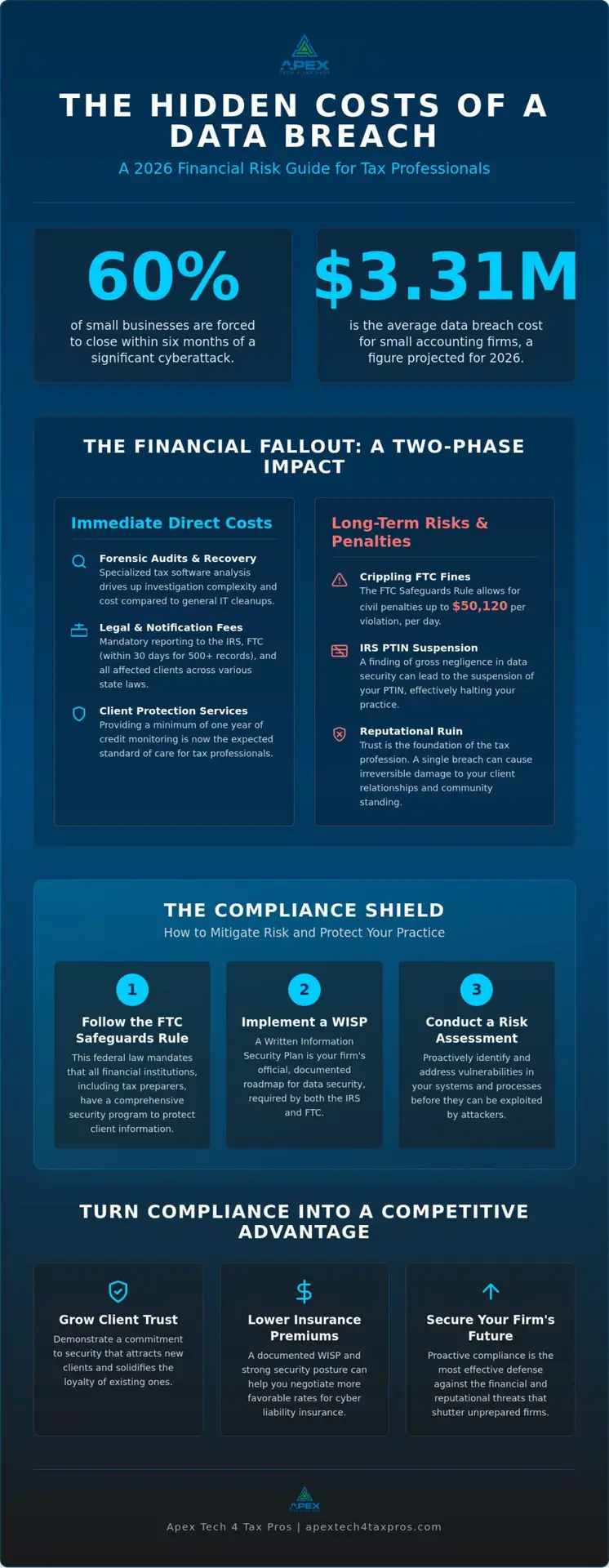
Did you know that 60% of small businesses that suffer a cyberattack are forced to close their doors within six months? In 2026, the average data breach costs for small accounting firms have reached $3.31 million, while FTC penalties can hit $50,120 per violation per day. For a tax professional, these figures are a direct threat to the practice you’ve spent years building. We understand that during the tax season rush, you don’t have time for technical jargon or complex federal mandates. You likely already feel the weight of protecting client trust while worrying about the next IRS audit or federal enforcement action.
As a Dallas-based team with over 20 years of combined tax and IT experience, we’re here to help you move from a state of vulnerability to secure compliance. In this guide, you’ll discover the hidden financial, regulatory, and reputational costs that could jeopardize your PTIN and professional standing. We’ll break down the latest FTC Safeguards Rule requirements and show you how a structured Written Information Security Plan (WISP) provides relief from these burdens. You’ll learn exactly how to shield your firm’s future while maintaining the reputation you’ve worked so hard to establish.
Key Takeaways
- Understand why forensic investigations for specialized tax software carry a higher price tag than general IT cleanups and how to prepare for these specific expenses.
- Discover the regulatory ripple effects that can lead to PTIN suspension and how to navigate the updated 2026 IRS and FTC penalty structures.
- Learn how a tailored WISP and formal Risk Assessment can significantly reduce the total data breach costs for small accounting firms while simplifying your compliance journey.
- See how demonstrating high-level security standards can actually grow your practice by attracting client trust and helping you negotiate lower cyber insurance premiums.
What Are the Direct Data Breach Costs for Small Accounting Firms?
A Data breach isn’t just a technical glitch; it’s a financial drain that begins the moment unauthorized access is detected. For a tax office, the clock starts ticking immediately, and the initial expenses often catch owners off guard. While general IT firms might quote standard cleanup rates, the data breach costs for small accounting firms are significantly higher because of the complexity of tax-specific software and the extreme sensitivity of the PII involved. You aren’t just cleaning a hard drive; you’re attempting to restore a reputation while the IRS and FTC watch your every move.
How do forensic audits and technical recovery impact my budget?
When a breach occurs, you must hire forensic investigators to identify “patient zero,” which is the specific device or user account where the intrusion began. These experts don’t just look for viruses. They dig through specialized tax software logs to ensure no client returns were altered or exported. If this happens during the peak of tax season, the cost of downtime is catastrophic. Every hour your team spends locked out of their workstations equals lost billable revenue and missed filing deadlines. Conducting a proactive IT assessment can help identify these weak points before they lead to an expensive forensic cleanup.
What are my legal and notification obligations after a breach?
The legal maze following a leak is complex and time-consuming. You’re required to contact your local IRS Stakeholder Liaison immediately to flag compromised EFINs and protect your clients from fraudulent filings. Under the updated FTC Safeguards Rule, you must notify the FTC as soon as possible, and no later than 30 days after discovering a breach involving at least 500 consumers. This isn’t optional, and the administrative burden of tracking down every affected client can paralyze a small office.
Beyond the government mandates, you’ll likely face these additional immediate costs:
- Client Credit Monitoring: Providing at least one year of credit monitoring is the expected standard of care for tax professionals today.
- Crisis Communication: You may need to hire a public relations professional to manage the narrative before the news reaches your local community or social media.
- Legal Counsel: Specialized attorneys are often required to ensure you’re meeting specific state-level notification laws, which vary significantly across the country.
What Are the Long-Term Regulatory and Reputational Risks of a Data Breach?
The forensic bills we discussed earlier are only the start of the financial impact. The real data breach costs for small accounting firms often show up later as long-term regulatory friction and a permanent loss of client trust. In 2026, the Federal Trade Commission has entered an aggressive enforcement cycle. Under the FTC Safeguards Rule, civil penalties can reach $50,120 per violation, per day. For a small practice, these fines alone can exceed annual gross revenue in a matter of weeks.
Perhaps more devastating is the threat to your professional credentials. A significant breach triggers a notification to the IRS, which can lead to an investigation of your internal controls. If the IRS determines your security was grossly negligent, you face the very real possibility of having your Preparer Tax Identification Number (PTIN) suspended. Without a PTIN, your ability to sign returns and generate income vanishes instantly. Even your professional liability insurance might fail you; many carriers now deny claims if a firm lacks a documented security plan at the time of the incident.
How do IRS Publication 4557 audit failures impact my practice?
A data security incident acts as an automatic trigger for a review of your firm’s adherence to federal standards. If you can’t produce a current security plan during this audit, you’re in violation of IRS mandates. You can review the WISP IRS Requirements to see the specific framework needed to pass these reviews and protect your practice from administrative ruin.
What is the true cost of lost reputation for a tax firm?
Trust is the foundation of the tax profession, but it’s fragile. Research shows that 60% of small businesses that experience a cyberattack go out of business within six months. This isn’t just because of the fines; it’s the “trust tax.” There’s often a profound empathy gap between a firm owner trying to recover and a victimized taxpayer who now fears identity theft for years to come. Rebuilding that bond is far more expensive than preventing the leak. If you’re concerned about your current exposure, you might consider scheduling a professional IT assessment to identify gaps before they become public knowledge.
How Do I Comply with the FTC Safeguards Rule to Mitigate Financial Risk?
If the previous sections felt heavy, here is the good news: compliance is a manageable process that provides immediate relief. Meeting the FTC Safeguards Rule requirements isn’t just a legal chore. It’s the most effective way to lower the potential data breach costs for small accounting firms. When you have a structured plan, you’re no longer reacting in a panic. You’re following a professional blueprint that protects your livelihood.
To secure your practice, follow these four foundational steps:
- Step 1: Conduct a formal Risk Assessment to identify exactly where your sensitive data lives and who has access to it.
- Step 2: Implement a Written Information Security Plan (WISP) that reflects your specific office size and workflow.
- Step 3: Deploy multi-factor authentication (MFA) and full-disk encryption across all tax preparation devices.
- Step 4: Establish a Cybersecurity Awareness Training schedule. Your seasonal staff must be just as vigilant as your year-round team.
The Central Role of the WISP
A Custom WISP Template is far superior to a generic, one-size-fits-all download. Generic plans often miss the nuances of tax-specific software and the unique way small firms handle PII. There is a profound sense of relief in having a structured response plan ready. If a regulator ever knocks on your door, you can confidently hand them a document that proves your commitment to federal standards.
Technical Safeguards for the Modern Tax Office
Modern protection requires more than just a basic firewall. While a firewall acts as a gate, active monitoring functions like a security guard watching that gate 24/7. For firms with remote staff, a Secure Virtual Desktop is a game-changer. It ensures that sensitive client data never actually sits on a local hard drive, significantly reducing your physical theft risk. If you’re ready to move from worry to certainty, you can book a WISP assessment with our Dallas-based team today.
How can I turn cybersecurity compliance into a competitive advantage for my tax practice?
While we’ve focused on how data breach costs for small accounting firms can be ruinous, it’s equally important to see the flip side of the coin. Implementing high-level security isn’t just a defensive shield; it’s a powerful way to stand out in a crowded market. In 2026, taxpayers are more selective than ever about who they trust with their financial lives. When you can confidently prove your firm meets or exceeds federal standards, you move from being a commodity service provider to an elite, trusted guardian of client data.
Beyond the marketing edge, you’ll see tangible business benefits. Documented security plans are becoming a prerequisite for favorable cyber insurance rates, helping you negotiate lower premiums. Additionally, the same secure cloud backups that protect you from hackers also safeguard your office against local hardware failures or physical disasters during the April rush. There’s also the profound psychological relief of being “audit-ready.” You can walk into every tax season with confidence, knowing that if the FTC or IRS ever asks for your documentation, you’re already prepared.
How do I use data security as a value proposition to attract new clients?
Clients in 2026 expect digital privacy as a baseline requirement. You can capitalize on this shift by including security badges on your website and adding specific language to your engagement letters that explains your protection protocols. Tell your clients exactly how you safeguard their information. This level of transparency justifies your professional fees and builds a bridge of loyalty that a “budget” preparer simply can’t match.
Why is Apex Tech 4 Tax Pros the right compliance partner for my firm?
We’re a Dallas-based team with over 20 years of combined experience in both the tax industry and information technology. We understand the unique pressures of tax season because we’ve lived them. Our subscription models are built to provide the “knowledgeable colleague” support you need without the technical overwhelm:
- Seasonal Subscription ($649.99): Ideal for offices that need targeted protection and support during the peak filing months.
- Yearly Subscription ($1,099.99): Comprehensive, year-round security that includes a free customized WISP.
We also work closely with our sister company, APEX Tax Solutions, to ensure your technical security aligns perfectly with professional tax standards. Don’t let compliance be a weight around your neck. Book a WISP Assessment today or email us at info@at4tp.com to start your journey toward secure, confident growth.
Protecting Your Practice and Professional Legacy
Understanding the potential data breach costs for small accounting firms is the first step toward true security. We’ve explored how the price of a leak goes far beyond immediate forensic bills, reaching into the heart of your firm’s reputation and your standing with the IRS. By implementing a structured compliance plan today, you aren’t just checking a regulatory box. You’re building a resilient practice that can withstand the technical and legal challenges of 2026 while protecting your hard-earned PTIN.
Our Dallas-based team brings over 20 years of combined tax and IT experience to help you navigate these requirements with ease. We provide bilingual support and plans specifically engineered to meet IRS Publication 4557 standards, ensuring your sensitive data remains in safe, capable hands. You don’t have to face these complex mandates alone. Let us turn your compliance obligations into a badge of honor that attracts and retains loyal clients. You’ve worked hard to build your practice; let’s work together to make sure it’s protected for the long haul.
Ready to secure your office? Book a WISP Assessment with Apex Tech 4 Tax Pros today and gain the peace of mind you deserve.
Frequently Asked Questions
How much does the average data breach cost a small accounting firm?
The average cost of a data breach for businesses with fewer than 500 employees has reached $3.31 million in 2026. This total includes the price of forensic investigations, legal fees, and mandatory client notifications. For tax professionals, the data breach costs for small accounting firms are often higher because the sensitivity of tax data requires more rigorous and expensive forensic handling compared to general retail or service businesses.
Is a WISP legally required for one-person tax offices?
Yes, a Written Information Security Plan (WISP) is a federal requirement for every tax professional, even if you are a solo practitioner. IRS Publication 4557 and the FTC Safeguards Rule don’t offer exemptions based on firm size. Having a documented plan is also a mandatory part of the process for obtaining or renewing your Electronic Filing Identification Number (EFIN) each year.
What are the penalties for FTC Safeguards Rule non-compliance in 2026?
The Federal Trade Commission can impose civil penalties of up to $50,120 per violation, per day for failing to comply with the Safeguards Rule. These fines can escalate quickly if multiple violations are found during an audit. Beyond the monetary penalties, the IRS may also suspend your PTIN or EFIN, which effectively prevents you from practicing or signing returns for your clients.
Does my general business insurance cover data breach forensic costs?
Most standard general liability insurance policies don’t cover the specialized forensic audits or credit monitoring services required after a leak. You typically need a specific cyber liability policy to cover these high-dollar expenses. It’s important to check your policy details, as many carriers now require proof of a functional WISP before they will honor a claim related to a cybersecurity incident.
How often do I need to update my tax office risk assessment?
You should update your formal risk assessment at least once a year or whenever you make a significant change to your firm’s operations. Significant changes include hiring new seasonal staff, moving to a new office location, or switching your primary tax preparation software. Regularly reviewing your risks helps keep the data breach costs for small accounting firms low by identifying vulnerabilities before hackers can exploit them.
What is the first step I should take if I suspect a data breach?
Your immediate priority is to contain the threat by disconnecting any affected devices from the internet and following the incident response steps in your WISP. Once the initial leak is contained, you must contact your local IRS Stakeholder Liaison right away. They’ll help you flag compromised EFINs and guide you through the process of protecting your clients from fraudulent tax filings.