
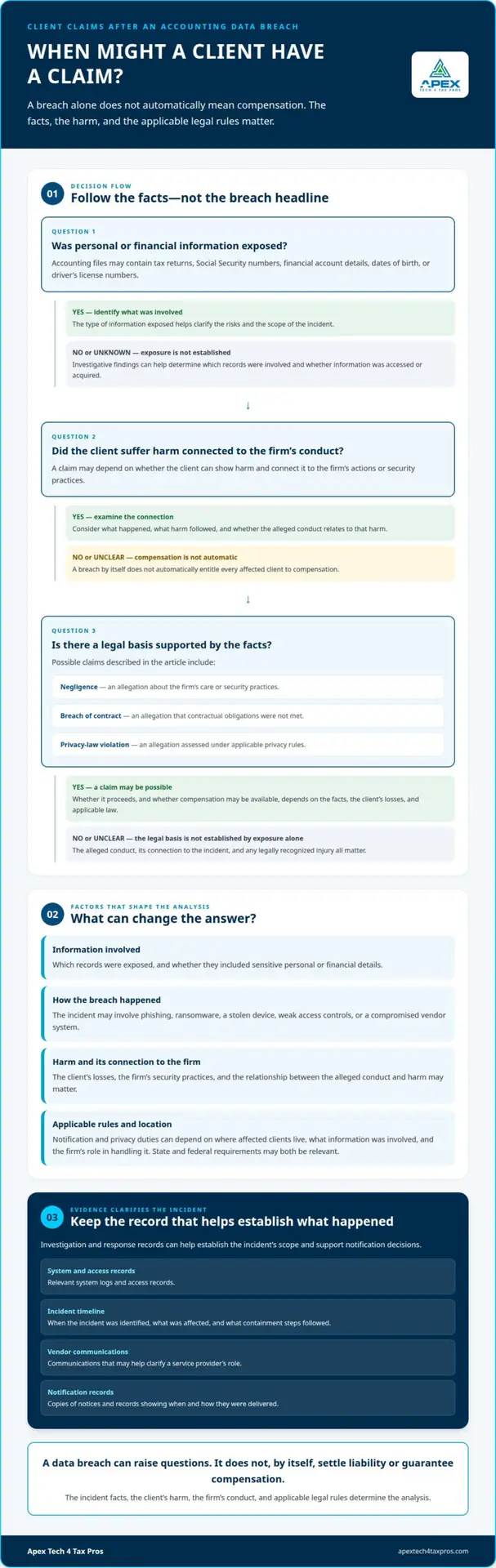
A data breach at an accounting firm does not automatically entitle every affected client to compensation. A client lawsuit due to an accountant’s data breach may be possible if the facts support claims such as negligence, breach of contract, or privacy-law violations. The client’s losses and the applicable legal rules matter.
Clients reasonably expect accountants to keep tax and financial records confidential. But breaches can start with phishing, ransomware, stolen devices, or gaps in information security. The legal consequences depend on what happened and what harm followed.
This article covers common breach scenarios, U.S. notification and security duties, and how courts assess injury, liability, and possible compensation or statutory damages. It also explains what affected clients can document and how accounting firms can strengthen data protection.
Key Takeaways
- Recognize how phishing, ransomware, and gaps in data protection can expose sensitive accounting records.
- Understand why breach notification duties depend on the applicable state and federal requirements.
- Learn what factors can shape a client’s claim, including the harm suffered and the legal basis for seeking compensation.
- See how a written security plan, risk assessments, staff training, and secure cloud backup can help accounting firms strengthen their data protection practices.
How Could An Accounting Data Breach Happen?
Accounting firms hold tax returns, Social Security numbers, financial account details, and other sensitive information. A breach may start with ransomware, phishing, stolen devices, weak access controls, or a compromised vendor system. For tax firms, an incident can disrupt operations, expose taxpayer data, and require a coordinated response.
Clients may bring claims after a ransomware or vendor breach, alleging negligence, breach of contract, or privacy-law violations. A vendor’s role does not automatically shield the accounting firm from scrutiny. The firm’s security practices and the alleged harm may also matter.
Wojeski & Company illustrates how exposure can occur. Employees discovered a ransomware attack on July 28, 2023, affecting 5,881 people, including 4,726 New York residents. A second breach affected 351 people, including 267 New York residents, in 2024. Information involved in one or both incidents included names, birth dates, Social Security numbers, driver’s license numbers, and financial account numbers. The New York settlement requires the firm to encrypt personal information it collects, stores, transmits, or maintains.
Reducing risk takes coordinated security improvements, not just one tool. Encryption protects stored or transmitted data, while multifactor authentication helps verify identity and firewalls control network access. Staff training can help employees spot phishing before a clicked link exposes credentials. A written security plan documents how the firm protects taxpayer information and responds to incidents.
If a breach occurs, forensic analysis can help establish what happened. Investigators review system logs, affected devices, access records, and data movement to identify entry points, determine which records were involved, and preserve evidence. Those findings can guide required notifications and clarify the incident’s scope. Tax firms should also assess the risk to affected taxpayers and coordinate appropriate follow-up. Credit monitoring may be one consideration in a response, but it does not replace investigating or containing the breach.
A client lawsuit due to an accountant’s data breach may depend on what information was exposed, how the incident happened, and whether claimants can show harm connected to the firm’s conduct. For tax firms, documenting security controls and response steps supports more disciplined decisions before and after an incident.
State and federal breach notification requirements
An accountant data breach may trigger state notification laws, federal privacy and security rules, or both. The duties that apply depend on the records involved, where affected individuals live, and the firm’s role in handling the information.
Applicable Breach Notification Rules
Start by identifying where affected clients live, what personal information was involved, and whether a service provider held the records. State breach-notification rules can differ in their definitions, timing, and required notice content. Federal privacy and security requirements may also apply, depending on the organization and information involved. One incident can require separate decisions for clients in different states.
Notifications and Supporting Evidence
Preserve evidence to support reliable notification decisions. Keep relevant system logs, access records, vendor communications, and a timeline of the incident and containment steps. Record how the firm identified affected files and whether information was accessed or acquired. This documentation clarifies the event’s scope and supports consistent communications. Retain copies of notices and records showing when and how they were delivered.
Notifying Affected Clients
Client notices should clearly describe the information involved, the incident, and practical steps recipients can take to protect their identity. Required timing and content depend on the applicable rules and facts. Coordinate communications with the investigation so details stay accurate as findings develop. Cybersecurity awareness training can help staff recognize sensitive information and follow established communication procedures during an incident.
A documented response process can connect evidence preservation, containment, and client communications. Accounting firms can strengthen staff readiness through cybersecurity awareness training tailored to handling sensitive records and security incidents.
Accountants’ duties to protect confidential information
Accountants handle personal and financial records, so protecting client confidentiality is a central responsibility. A breach can raise questions about reasonable care, contractual obligations, and applicable privacy rules.
Yes, a client can sue an accountant after a data breach, including by alleging negligence or breach of contract. Whether a claim proceeds can depend on the alleged conduct, its connection to the breach, and whether the client suffered a legally recognized injury.
Personal Information Held by Accountants
Tax and accounting files may contain personally identifiable information, sensitive financial details, and Social Security numbers. Firms may also hold dates of birth, driver’s license numbers, email addresses, phone numbers, and account information. The records vary with the services provided. Identifying what information the firm holds, where it is stored, and who can access it helps define confidentiality risks.
Information Exposed in a Breach
A breach can expose one record type or several connected details. A name combined with a Social Security number may create identity-theft risks, while account numbers can expose financial information. Accounting records may also contain medical benefits or entitlement information. Assessing the actual data involved helps distinguish general concern from concrete risks, such as fraudulent account use or attempts to misuse someone’s identity.
Client Claims Against Accountants
Clients may allege negligence, breach of contract, or an intentional wrongful act involving confidential information. An accountant may also face a claim for financial losses from someone who did not hire the firm directly. Courts assess whether the claimant shows an injury linked to the defendant’s conduct and whether a favorable decision could address it.
Federal courts have taken different approaches to injury after a breach. In Krottner v. Starbucks, the Ninth Circuit found standing where stolen personal information had not been misused. In Reilly v. Ceridian, the Third Circuit found that possible identity theft alone did not establish injury-in-fact. These cases show why the specific harm alleged and its connection to the breach matter.
Data breach compensation and statutory damages
Compensation depends on the legal claim, proven harm, and applicable statute. Exposure alone does not establish a payment amount. When an accountant’s firm experiences a data breach, the firm’s response may include preserving breach notices and records of suspicious transactions, and addressing the security of affected accounts. Tax firms should confirm their legal and notification obligations with counsel.
Compensation for Financial Losses
Financial-loss claims can focus on documented harm connected to the breach, such as fraudulent charges or expenses incurred in addressing identity misuse. For tax firms, records such as account statements, receipts, credit reports, and communications may help establish when losses occurred. Social Security numbers exposed alongside names may create different risks than contact information alone, so both the type of data and evidence of misuse matter.
Some privacy laws provide statutory damages ranging from $100 to $5,000, depending on the statute and circumstances. That range is not a standard award for every accounting breach. The Equifax settlement over its 2017 breach totaled $700 million, with individual payments of up to $20,000 for documented losses. Large settlements involve their own facts and do not predict compensation in another claim.
Legal Deadlines and Potential Awards
Filing deadlines depend on the legal basis and jurisdiction. A specific Internal Revenue Code remedy for unauthorized inspection or disclosure has a two-year period from the date the taxpayer discovered the breach. That is not the deadline for every claim against an accountant. The applicable rules depend on the claim asserted, and tax firms should consult counsel about legal specifics.
Psychological harm may also be raised in privacy claims, but the available remedy depends on the governing law and evidence of injury. In New York, Wojeski & Company’s settlement required $60,000 in penalties, an enforcement outcome rather than a measure of client compensation.
For tax firms, a customized written security plan can document protective procedures and response responsibilities before an incident occurs.
Apex Tech 4 Tax Pros
Apex Tech 4 Tax Pros helps accounting and tax firms strengthen data protection before an incident becomes a client concern. Its support can help firms assess security gaps, document safeguards, train staff to recognize phishing, and protect records through secure cloud backup.
A Customized Written Information Security Plan (WISP) organizes a firm’s security procedures and response responsibilities. Risk Assessments can identify areas needing attention, while Cybersecurity Awareness Training helps employees handle sensitive client information carefully. Secure Cloud Backup supports the protection and recovery of stored business data.
These cybersecurity measures do not determine legal liability or replace legal counsel after a breach. They give firms practical ways to improve preparedness and maintain a clearer record of security practices. To discuss data protection needs for your accounting firm, contact Apex Tech 4 Tax Pros at info@at4tp.com.
Make Preparedness Part of Your Next Business Decision
Make security planning part of routine business decisions so procedures keep pace as your firm and its data practices change. A documented approach can help your team protect client trust and respond clearly.
A client lawsuit after an accountant’s data breach can raise questions about security practices and client harm. Apex Tech 4 Tax Pros supports tax professionals with bilingual service, a Dallas-based team, and 20+ years of combined tax and IT experience.
To discuss cybersecurity support for your firm, contact Apex Tech 4 Tax Pros. A thoughtful next step can help your team protect sensitive records with confidence.
Frequently Asked Questions
What responsibilities do tax professionals have to protect taxpayer data?
Tax professionals should protect taxpayer confidentiality and follow the privacy and security requirements that apply to their firm and the records it handles. Firms can limit access to sensitive files, use safeguards suited to the information, and document procedures for employees and vendors. The precise requirements depend on the applicable law and professional relationship. Confirm how they apply to your firm with qualified legal counsel.
What should a tax professional do after discovering a taxpayer data breach?
After discovering a possible breach, a tax professional can work with qualified incident-response and legal professionals to contain the incident, preserve relevant records, and determine which systems and taxpayer files may be affected. Avoid deleting logs or resetting devices before evidence is preserved. Assign responsibility for coordinating the investigation, legal review, and any required communications. Keep a timeline of decisions and actions, including vendor contact, to support the response and help ensure affected clients receive accurate information.
What records may help a tax professional respond to a data breach claim?
Relevant records may include engagement agreements, emails, breach notices, and documentation showing how the firm handled taxpayer information. Records supporting reported losses, such as account statements or fraud reports, and a timeline connecting those losses to the incident may also be relevant. Technical findings can help explain how information was accessed. The records needed depend on the claim and alleged harm; consult legal counsel about your specific situation.
How might negligence and breach of contract claims relate to a tax office data breach?
A negligence claim generally concerns whether a tax professional failed to use reasonable care and whether that failure caused harm. A contract claim focuses on the duties in the engagement agreement and whether the firm failed to meet them. For example, a client might point to a confidentiality commitment and allege that inadequate handling exposed records. The claim’s terms and evidence shape the analysis, so tax professionals should consult legal counsel about specific allegations.
What is the statute of limitations for a tax office data breach claim by state?
There is no single deadline for every state and claim. A two-to-four-year period may be cited for some accounting malpractice claims, but it is not a general rule and may not apply to a particular data breach claim. Deadlines can differ by jurisdiction and claim type. Tax professionals should promptly ask qualified legal counsel to assess the applicable deadline and how it may be calculated.
How much might a tax office data breach lawsuit or settlement cost?
There is no dependable typical settlement amount for a tax office data breach lawsuit. Potential recovery and case expenses depend on provable losses, the number and type of claims, available statutory remedies, and whether the matter settles or goes to court. A settlement involving a large organization does not predict a tax professional’s outcome. Keep records of reported out-of-pocket losses and case-related expenses, and consult legal counsel about your circumstances.