
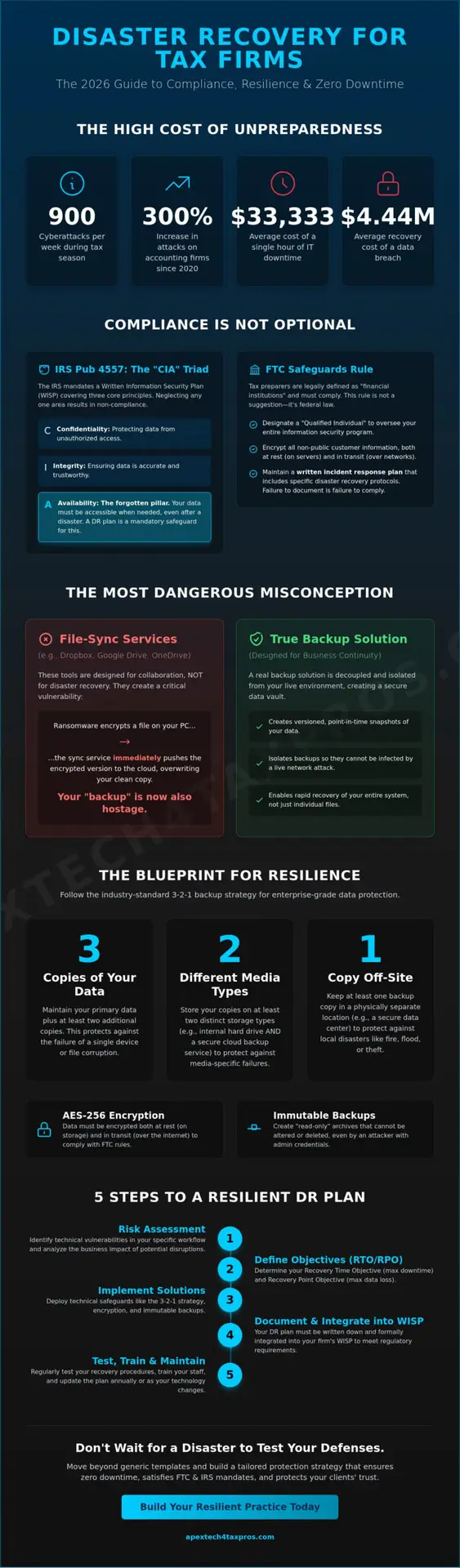
Accounting firms currently face an average of 900 cyberattacks per week during the peak of tax season, which is a 300% increase since 2020. You likely recognize that a single hour of IT downtime can cost your practice an average of $33,333 in operational losses, yet the distinction between a basic cloud backup and a complete disaster recovery plan for tax firms remains a source of significant anxiety. It’s a high-stakes environment where a single missed deadline or a data breach, which now averages $4.44 million in recovery costs, can jeopardize decades of hard-earned client trust and professional standing.
We understand the pressure of balancing rigorous IRS expectations with the daily demands of tax preparation. This 2026 guide provides the clarity you need to bridge the gap between technical vulnerability and secure compliance. You’ll learn how to construct a resilient strategy that satisfies the FTC Safeguards Rule and ensures your firm maintains zero downtime, even during the most intense filing periods. We provide a direct checklist for your Written Information Security Plan (WISP) to give you total peace of mind that your client data is encrypted, recoverable, and fully protected from regulatory penalties.
Key Takeaways
- Understand how the FTC Safeguards Rule transforms data availability from an IT preference into a mandatory legal requirement for your practice.
- Learn why consumer file-sync services fail during ransomware attacks and how to implement a resilient 3-2-1 backup strategy for sensitive financial records.
- Discover how to prioritize critical operations to ensure your firm remains functional and meets every filing deadline during the peak of tax season.
- Follow a structured five-step process to build a comprehensive disaster recovery plan for tax firms that is fully integrated into your customized WISP.
- Identify the specific technical vulnerabilities within your unique workflow to move beyond generic security templates toward a tailored protection strategy.
Why the IRS Mandates a Disaster Recovery Plan for Tax Firms
Many tax professionals view IT infrastructure as a utility, but federal regulators in 2026 treat it as a legal fortress. The standard for “best efforts” has been replaced by strict mandates that require firms to prove they can protect and recover data under any circumstances. While a simple backup might save your files, it won’t save your practice from the operational paralysis that costs an average of $33,333 per minute during an outage. A comprehensive Disaster Recovery Plan is the documented strategy that bridges the gap between having a copy of your data and actually being able to use it to meet a filing deadline.
In the current landscape, accounting firms face over 900 cyberattacks per week during tax season. This 300% increase since 2020 has forced the IRS and FTC to move beyond suggestions toward hard requirements. You cannot simply claim you were “hacked” to avoid penalties anymore; you must demonstrate that you had a proactive disaster recovery plan for tax firms integrated into your security culture before the incident occurred.
Regulatory Standards: IRS Pub 4557 and 5293
IRS Publication 4557 outlines the “CIA” triad of data security: Confidentiality, Integrity, and Availability. Most firms focus on confidentiality, yet they neglect availability. If a ransomware attack locks your servers on April 10th, you’ve failed the availability requirement of your Written Information Security Plan (WISP). A disaster recovery plan for tax firms is a mandatory administrative safeguard designed to ensure the continuous availability of sensitive taxpayer data during any operational disruption. Without this plan, your WISP is incomplete, leaving you vulnerable during an IRS audit and potentially leading to the suspension of your Electronic Filing Identification Number (EFIN).
The FTC Safeguards Rule Impact
Under the Gramm-Leach-Bliley Act (GLBA), tax preparers are classified as financial institutions, making the FTC Safeguards Rule your primary legal benchmark. This rule mandates that you designate a “Qualified Individual” to oversee your information security program. This person is responsible for ensuring that all non-public customer information is encrypted at rest and in transit. More importantly, they must maintain a written incident response plan that includes specific recovery protocols. Failing to document these steps doesn’t just risk a data breach; it invites federal fines and the permanent loss of client trust. In 2026, security is no longer a backend IT concern; it’s a core component of your professional compliance and a primary expectation of the clients you serve.
Technical Foundations: Secure Cloud Backup vs. File Sync
Many practitioners mistakenly believe that using OneDrive, Google Drive, or Dropbox constitutes a sufficient backup strategy. This is a dangerous misconception. These services are file-synchronization tools, not backup solutions. If ransomware encrypts a document on your local workstation, the sync service immediately pushes that corrupted version to the cloud, overwriting your clean data in seconds. A true disaster recovery plan for tax firms requires a decoupled system where backups are isolated from the primary production environment. Following the IRS mandates for data security means moving beyond simple file sharing toward enterprise-grade protection.
To achieve high-level data integrity, we recommend the 3-2-1 backup strategy. This involves maintaining three copies of your data on two different media types, with at least one copy stored off-site. For tax practitioners, all data must be protected using AES-256 encryption both at rest and during transit. Additionally, you should utilize immutable backups. These are “read-only” archives that cannot be deleted or modified for a specific duration, providing a final line of defense against hackers who attempt to wipe your recovery points. Implementing a secure cloud backup engineered for the financial sector ensures these technical safeguards are handled automatically.
Establishing RTO and RPO for Your Firm
You must define your Recovery Time Objective (RTO) and Recovery Point Objective (RPO) to measure the effectiveness of your resilience. RTO is the maximum duration your firm can remain offline before the damage becomes irreversible. During the peak of tax season, your RTO might be as low as four hours to avoid missing April 15th deadlines. RPO determines how much data you can afford to lose, measured in time. If you only back up once every 24 hours, an afternoon crash could result in the loss of an entire day’s worth of complex returns. We suggest setting more aggressive benchmarks during filing periods to account for high document volume.
The Role of Secure Cloud Infrastructure
Your backup provider must meet rigorous regulatory standards to be considered a viable safeguard. Specifically, look for SOC 2 Type II compliance, which verifies that the provider has strict controls over security, availability, and processing integrity. Automated verification is also essential. Manual checks are prone to human error, especially when your team is exhausted by 60-hour workweeks. A professional disaster recovery plan for tax firms includes automated “heartbeat” checks that test the viability of your backups daily. This proactive approach ensures that when a local disaster strikes, your recovery process is a proven certainty rather than a hopeful guess.
Business Continuity: Maintaining Operations During Tax Season
During the peak of tax season, time is your most valuable asset. A technical failure on April 10th isn’t just an inconvenience; it’s a threat to your firm’s survival. While previous sections focused on data integrity, business continuity ensures your team remains productive when the primary office is inaccessible. A robust disaster recovery plan for tax firms must account for the “Tax Season Stress Test,” where every minute of downtime translates to missed filings and potential penalties. You need a strategy that prioritizes uptime above all else.
Establishing a contingency matrix allows you to triage your resources effectively. Tier 1 functions include your tax preparation software and e-filing portals. These must remain operational at all costs. Tier 2 functions, such as internal marketing tools or non-essential chat applications, can wait. Redundancy is the key to this resilience. If your primary ISP fails, a secondary fiber or high-speed cellular connection should trigger automatically. This level of preparedness aligns with the NIST Contingency Planning Guide, which provides the technical framework for maintaining critical systems during a crisis.
Maintaining client trust during a 24-hour system outage requires immediate, transparent communication that reassures them their sensitive data remains encrypted and their filing deadlines are still being prioritized.
The Tax Season Contingency Matrix
Identify your critical path. If your tax software is cloud-based, your dependency shifts from local hardware to internet stability. Implementing a “Dual-WAN” router ensures that if one provider goes down, your staff won’t even notice the transition. This isn’t just an IT preference; it’s a safeguard against the 86 outages organizations typically experience per year. You don’t want to be part of the 20% of organizations that are caught unprepared.
Remote Access and Security
When an emergency forces your team to work from home, the “Virtual Firm” transition must be seamless and secure. Your disaster recovery plan for tax firms should include a pre-verified hardware inventory. Every employee needs a firm-managed laptop with pre-installed security software. Using personal “home PCs” is a major compliance risk. MFA remains a non-negotiable tool during this transition; it’s the single most effective way to prevent unauthorized access during a chaotic relocation. By securing the home office with the same rigor as your primary site, you protect the integrity of every return you process.
5 Steps to Building Your Tax Firm Disaster Recovery Plan
Building a disaster recovery plan for tax firms isn’t a one-time IT project; it’s an ongoing commitment to your clients’ financial safety. You shouldn’t wait for a system failure to discover that your recovery protocols are insufficient. By following a structured five-step process, you can transform your firm from a state of potential vulnerability to a state of disciplined compliance. This systematic approach ensures that your technical safeguards are aligned with your operational realities, providing a clear path forward when a crisis strikes.
Step 1-2: Risk Assessment and Data Mapping
The first phase involves a deep dive into your current IT stack to identify every single point of failure. You must inventory not only your local servers and cloud applications but also your physical paper files and off-site storage locations. This data mapping exercise ensures you know exactly where every byte of sensitive taxpayer information resides. By linking these findings to IRS Publication 4557 requirements, you establish a legal baseline for your security measures. This stage allows you to uncover hidden risks, such as a reliance on a single staff member’s login credentials or an unverified third-party software integration that could jeopardize your entire workflow. Only 20% of organizations currently describe themselves as fully prepared for outages, and a thorough assessment is the only way to ensure your firm is part of that resilient minority.
Step 3-5: Documentation and Testing
Once you’ve mapped your data, you must assign clear roles to your Recovery Team. This group should know exactly who handles the Emergency Contact Tree to notify vendors, staff, and authorities. These protocols must be drafted as a formal document and included as a mandatory appendix to your Written Information Security Plan (WISP). A plan that exists only in your head is a liability; it must be written, stored in multiple locations, and accessible even when your primary systems are down. To ensure your disaster recovery plan for tax firms actually works, you must execute an annual Tabletop Exercise. This mock disaster drill allows your team to walk through a ransomware scenario or a hardware failure without disrupting live client work. Use the results of these drills to update your software inventory and refine your recovery timelines based on real-world performance. If your current infrastructure hasn’t been evaluated against these 2026 standards, you should schedule a professional risk assessment to identify your firm’s most critical gaps.
Bridging the Gap: Integrating DR into a Customized WISP
Generic templates are a common starting point, but they often lack the specificity needed to withstand a rigorous 2026 audit. While the IRS provides basic outlines, these documents don’t account for the unique nuances of your specific IT stack or the varied data privacy mandates across different states. Integrating a disaster recovery plan for tax firms into a Written Information Security Plan (WISP) requires more than just filling in the blanks. It demands a deep understanding of how your data moves through your practice. A plan that isn’t tailored to your firm’s specific software, whether you use ProConnect, Drake, or UltraTax, is merely a suggestion of security rather than a functional safeguard.
At Apex Tech 4 Tax Pros, we focus on “bridging the gap” between your daily tax preparation duties and the complex world of cybersecurity compliance. By treating your disaster recovery protocols as a living component of your WISP, you ensure that your firm isn’t just compliant on paper, but resilient in practice. This integration ensures that your secure cloud backup serves as more than just a storage bin; it becomes the verified foundation that supports your entire regulatory framework.
The Value of a Tailored Security Framework
A specialized framework aligns your recovery objectives with the technical requirements of your tax software and the specific sensitivity of your client base. For example, the recovery process for a firm using cloud-hosted ProConnect differs significantly from a firm maintaining local Drake installations. Your plan must also navigate the intersection of federal FTC Safeguards and state-level privacy laws, which often have stricter notification requirements. Leveraging Apex Tech 4 Tax Pros for a professional risk assessment allows you to identify these specific regulatory overlaps. This ensures that your technical foundations are actively fulfilling the “Availability” requirement of your WISP as defined by IRS Publication 4557.
Next Steps for Your Practice
Moving from a theoretical plan to active protection is a process that begins with a solid foundation. You can start by downloading a free WISP template to understand the basic requirements, but you shouldn’t stop there. A template is a skeleton; it needs the details of your specific workflows and vendor contacts to be effective. Once your customized plan is in place, your staff becomes your first line of defense. Training them to recognize the early signs of a system compromise can prevent a minor glitch from turning into a full-scale disaster. This human element is just as critical as your technical encryption. To ensure your practice is fully protected and compliant with current standards, Schedule your 2026 Risk Assessment today. We’ll help you finalize a disaster recovery plan for tax firms that brings peace of mind to your team and your clients alike.
Securing Your Practice for the High-Stakes 2026 Season
Operational resilience in the tax industry is no longer a luxury; it’s a fundamental regulatory requirement. You’ve learned that a true disaster recovery plan for tax firms must move beyond simple file synchronization to include immutable backups and clear RTO benchmarks. By integrating these protocols directly into your Written Information Security Plan, you ensure your practice is prepared for both technical failures and rigorous federal audits. Relying on generic templates often leaves dangerous gaps in your security posture that only a tailored approach can close.
With 20 years of experience in high-security compliance, Apex Tech 4 Tax Pros specializes in bridging the gap between tax preparation and IT security. We provide the technical precision required for IRS Publication 4557 audit readiness, ensuring your sensitive client data remains a protected asset rather than a liability. Don’t leave your firm’s continuity to chance during the most critical months of the year. Secure your firm’s future with a Customized WISP and Disaster Recovery Plan. We’re here to provide the vigilant support your practice deserves; we want you to focus on serving your clients with total confidence.
Frequently Asked Questions
Is a disaster recovery plan the same as a WISP?
No, a disaster recovery plan is a specific technical component of your broader Written Information Security Plan (WISP). While your WISP outlines the overall policies for data protection mandated by the June 2023 FTC Safeguards Rule, the recovery plan provides the step by step instructions for restoring operations after an incident. Think of the WISP as your firm’s security constitution and the recovery plan as the emergency response manual.
Does the IRS require a disaster recovery plan for sole practitioners?
Yes, because the IRS and FTC classify all tax preparers as “financial institutions” regardless of their staff size. Under the Gramm-Leach-Bliley Act (GLBA), sole practitioners must maintain a written information security program that includes a strategy for data availability. Failing to document these recovery protocols can result in audit failures and the potential loss of your Electronic Filing Identification Number (EFIN).
Can I use a physical hard drive for my tax firm backups?
You can use a physical drive only as one element of a comprehensive 3-2-1 backup strategy. Relying solely on a local hard drive is dangerous because it’s vulnerable to the same fire, theft, or ransomware that affects your primary computer. To meet federal standards, you must have at least one encrypted, off-site copy of your data that is isolated from your local network.
How often should I test my disaster recovery plan?
You should execute a full test of your disaster recovery plan for tax firms at least once a year. A 2025 industry survey revealed that only 20% of organizations feel fully prepared for an IT outage. Regular testing ensures that your staff knows their roles and that your backup files are actually viable before the high-pressure deadlines of tax season arrive.
What happens if my EFIN is suspended due to a data breach?
A suspended EFIN immediately stops your ability to e-file tax returns, effectively halting your practice’s revenue. The IRS may revoke your filing privileges if an investigation reveals that you lacked a mandatory WISP or failed to follow basic security safeguards. Recovery requires a rigorous re-application process and proof that you’ve corrected all technical and administrative vulnerabilities in your firm.
Does professional liability insurance cover data recovery costs?
Standard professional liability insurance often excludes cyber events unless you have a specific cyber liability rider. With the average cost of ransomware recovery reaching $1.53 million in 2025, a basic policy is rarely enough to cover the specialized forensics and data restoration required. You must verify that your policy specifically covers the costs of rebuilding your IT infrastructure after a breach.
What are the most common causes of data loss in tax firms?
Ransomware and business email compromise (BEC) are the leading causes of data loss for accounting professionals. Firms currently face an average of 900 cyberattacks per week during tax season, which is a 300% increase since 2020. Most of these incidents are triggered by human error, such as an employee clicking a sophisticated phishing link that bypasses traditional antivirus software.
Is cloud storage (like Google Drive) sufficient for IRS compliance?
No, consumer-grade cloud storage lacks the immutable backups and AES-256 encryption required for federal compliance. You need a disaster recovery plan for tax firms that utilizes SOC 2 Type II compliant storage to ensure that your data is protected from unauthorized modification. These professional-grade solutions provide the audit trails and security controls that basic file-syncing services simply don’t offer.