
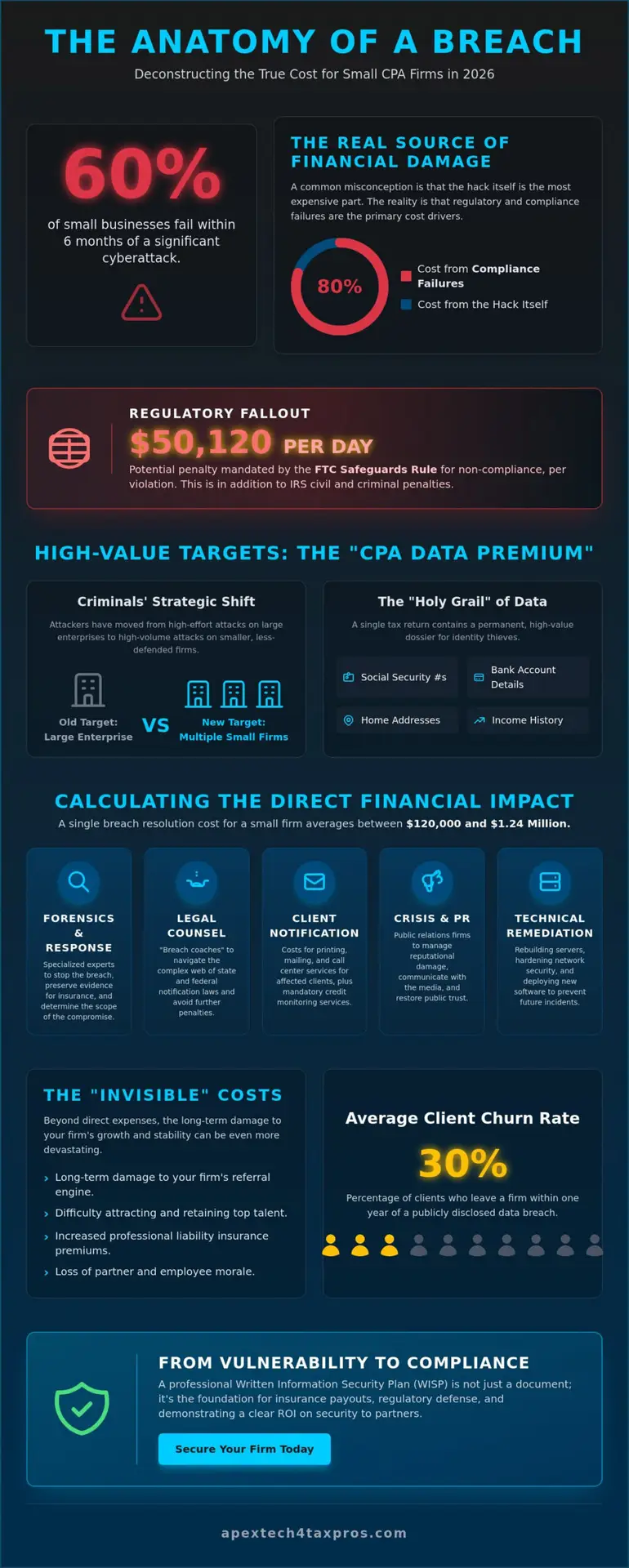
Did you know that 60% of small businesses that suffer a significant cyberattack cease operations within six months? For tax professionals, a security incident isn’t just a technical glitch; it’s a balance-sheet event where 80% of the cost of a data breach for a small cpa firm stems from documented compliance failures rather than the hack itself. You’ve likely felt the pressure of rising professional liability insurance premiums and the dense requirements of IRS Publication 4557. It’s natural to worry that a lifetime of building your book of business could vanish due to one unencrypted file or a single ransomware attack.
This article provides the clarity you need to move from vulnerability to secure compliance. You’ll discover the precise financial, regulatory, and reputational liabilities your firm faces in 2026, including the $50,120 per day penalties mandated by the FTC Safeguards Rule. We’ll examine a clear breakdown of breach line-items, a framework to present security ROI to your partners, and a checklist to verify if your current Written Information Security Plan (WISP) is actually sufficient to protect your legacy.
Key Takeaways
- Identify why cybercriminals prioritize smaller practices to capture high-value tax records and how this risk profile has shifted for the 2026 filing season.
- Analyze the five primary financial buckets that dictate the total cost of a data breach for a small cpa firm, including forensic response and specialized legal fees.
- Understand the “Invisible Costs” of a security incident, such as the 30% client churn rate and the long-term damage to your firm’s referral engine.
- Navigate the 2026 regulatory environment by understanding the specific documentation standards required by the IRS to avoid civil and criminal penalties.
- Learn how a professional WISP serves as the necessary foundation for insurance payouts and provides a clear framework for presenting security ROI to partners.
Why Small CPA Firms Are High-Value Targets in 2026
Many practitioners believe their firm is too small to be a target. This logic is a dangerous fallacy in 2026. Cybercriminals have shifted their strategy from high-effort attacks on large enterprises to high-volume attacks on boutique firms. By targeting ten small practices, attackers can harvest the same volume of sensitive data with a fraction of the technical resistance. This shift significantly increases the potential cost of a data breach for a small cpa firm, as the recovery process often reveals systemic vulnerabilities that were previously ignored and left unaddressed for years.
The “CPA Data Premium” makes your server the “Holy Grail” for identity thieves. A single tax return contains a perfect dossier for fraud: Social Security numbers, bank account details, home addresses, and income history. Unlike a credit card number that can be canceled, the PII found in your client files is permanent. This permanence makes your data a liquid asset on the dark web. To understand the gravity of these incidents, one must first look at what is a data breach and how it specifically compromises the integrity of financial records. Automated bots now scan the web specifically for unpatched tax software, making “low-hanging fruit” out of firms that delay their technical updates.
The Anatomy of a Tax Firm Breach
Entry points usually involve phishing, unsecured remote desktops, or vulnerabilities in third-party tax software. Attackers often utilize a “Quiet Period.” They infiltrate a system in November or December and lurk silently. They wait for the peak of tax season to deploy ransomware, knowing the pressure to meet filing deadlines will force a payout. They understand your business rhythm better than you might think. Data Density is the ratio of sensitive records to your firm’s total security spend. When this ratio is high, your liability increases exponentially.
Projecting the 2026 Threat Landscape
The 2026 landscape is defined by AI-driven social engineering. Attackers now use deepfake audio to impersonate clients or partners, making 2024-era training obsolete. Ransomware-as-a-Service (RaaS) has also matured, allowing low-level criminals to deploy sophisticated encryption tools against boutique practices. Additionally, state-sponsored actors are increasingly targeting U.S. financial infrastructure to harvest economic data. You aren’t just protecting against “hackers”; you’re defending against a professionalized, global industry that views your client list as a high-margin inventory.
Calculating the Direct Financial Impact: The Five Cost Buckets
Quantifying the cost of a data breach for a small cpa firm requires looking past the immediate ransom demand. In 2026, the financial fallout is categorized into five distinct “cost buckets” that impact your firm’s liquidity and long-term viability. These include Digital Forensics and Incident Response (DFIR) to stop the unauthorized access, legal counsel to manage compliance, notification services for affected clients, crisis management to protect your reputation, and technical remediation to rebuild your infrastructure. IBM’s 2025 research indicates that small businesses can expect to pay between $120,000 and $1.24 million to resolve a single security incident.
Forensics and Legal: The Front-Loaded Costs
You can’t rely on your general IT provider to handle a breach response. Forensic experts are required to maintain a legal chain of custody, ensuring that evidence is preserved for insurance claims and potential litigation. In 2026, specialized “breach coaches” often require significant retainers to navigate the conflicting notification laws of all 50 states. This is especially critical because FTC Safeguards Rule penalties can reach up to $50,120 per violation, per day. Failing to document your response properly can lead to a “State Notification Trap,” where administrative costs spiral as you attempt to comply with varying jurisdictional deadlines.
The Cost-Per-Record Breakdown
For financial services, the projected 2026 baseline for breach costs has risen to $180-$250 per individual record. This includes both the direct expenses of credit monitoring and the indirect costs of operational downtime. Evaluating your current risk through a professional risk assessment can help you quantify these buckets before a crisis occurs. For a firm managing 500 clients, the breakdown often looks like this:
- Direct Costs: Forensics, legal retainers, and client credit monitoring ($75,000 – $150,000).
- Indirect Costs: Lost billable hours, employee overtime, and emergency hardware replacement ($45,000 – $100,000).
- Regulatory Fines: Potential IRS and FTC assessments for documented negligence ($10,000 – $50,000+).
In 2026, the psychological burden of “notification fatigue” means clients are quicker to terminate relationships than to read through your detailed recovery plan. Rebuilding a secure network from scratch after a total system wipe is no longer a worst-case scenario; it’s the standard recovery protocol. These technical remediation costs often exceed the original value of the hardware being replaced, as you must implement new security layers to prevent a secondary “echo breach” from the same attackers.
The ‘Invisible’ Costs: Client Churn and Brand Devaluation
While the direct financial penalties are daunting, the most significant component of the total cost of a data breach for a small cpa firm often remains hidden from the initial balance sheet. This invisible tax manifests as a profound trust deficit. Industry observations indicate that approximately 30% of clients terminate their relationship within the first 12 months following a security incident. In a profession where the “book of business” is the primary asset, this churn represents a permanent loss of recurring revenue that few boutique practices can absorb. This loss is compounded by the “Referral Death Spiral.” Since most small firms grow through word-of-mouth, a single public disclosure effectively kills your primary growth engine for years.
Adherence to a formal IRS data security plan is not just a regulatory hurdle; it’s a vital tool for client retention. It allows you to demonstrate to your clients that their sensitive PII was protected by industry-standard protocols, even in the event of an attack. Without this documentation, you’re left with no defense when clients ask why their data wasn’t better protected. The opportunity cost of a total business shutdown, which typically lasts between two and four weeks, further erodes your annual margins and prevents you from taking on new high-value engagements during critical filing windows.
Measuring Long-Term Reputational Damage
The “Google Search” factor presents a persistent challenge. News of a breach lingers in local search results, acting as a digital warning sign for potential new clients. Beyond immediate growth, this damage impacts your firm’s ultimate valuation. During a sale or merger, a documented breach can significantly reduce the “multiple” applied to your revenue, as buyers factor in the risk of future litigation or latent technical debt. The difference between a “managed” breach, where a WISP was in place, and a “disaster” breach is often the difference between a firm that remains saleable and one that is forced into a fire sale.
Staff Productivity and Morale
The human element is equally fragile. Managing the fallout of a breach during the peak tax season leads to a specific type of professional burnout. Partners must calculate the “Distraction Tax” on their billable hours as they pivot from tax strategy to crisis management. Additionally, senior tax preparers often experience “security anxiety.” They may choose to leave the firm to protect their own professional licenses and reputations, leading to the high cost of replacing specialized talent in a tight labor market. A security incident isn’t just a technical failure; it’s a cultural crisis that can permanently fracture your firm’s foundation.
Regulatory Fallout: IRS Fines and FTC Safeguards Rule Penalties
The regulatory environment in 2026 has transformed data security from a best practice into a strict legal mandate. Under the Gramm-Leach-Bliley Act (GLBA), CPA firms are legally classified as “Financial Institutions,” a designation that carries heavy compliance burdens. This classification means you’re subject to the same rigorous standards as regional banks. The cost of a data breach for a small cpa firm often explodes when federal agencies discover that these baseline protections were absent. Regulatory bodies no longer accept “good intentions” as a defense when client tax records are compromised.
Enforcement of the FTC Safeguards Rule has intensified, with non-compliance fines reaching up to $50,120 per violation, per day. These penalties are designed to be punitive, ensuring that firms prioritize the protection of unencrypted data. Additionally, the IRS has made the standards in Publication 4557 mandatory for all tax professionals. If a breach occurs and you cannot produce a valid security roadmap, you face civil penalties of $1,000 per identity theft-related disclosure, capped at $50,000 per year. These figures don’t include the legal fees required to defend your firm during a multi-agency investigation.
The Cost of an IRS Audit Post-Breach
A security incident often triggers a specialized IRS audit of your firm’s technical infrastructure. The most severe consequence isn’t a fine; it’s the potential loss of your Electronic Filing Identification Number (EFIN). Losing your EFIN is effectively a “death penalty” for tax practitioners, as it permanently revokes your right to file returns electronically. Beyond the IRS, you must manage potential disciplinary actions from the AICPA and your State Board of Accountancy, which may result in public censures or the suspension of your professional license.
Documented Compliance vs. ‘Good Intentions’
There’s a critical legal distinction between “trying to be secure” and having a formal, documented strategy. A 2026 WISP serves as essential evidence of “Reasonable Security” in a court of law, potentially shifting your status from “Willful Neglect” to “Good Faith Compliance.” This distinction can save your firm hundreds of thousands of dollars in liability. If you haven’t yet formalized your protocols, you can start by implementing a Customized Written Information Security Plan (WISP) to establish your regulatory safe harbor.
- Safe Harbor: Documented plans can mitigate “willful neglect” findings during federal inquiries.
- Standard of Care: Following IRS Publication 4557 provides a defensive framework against professional negligence claims.
- Reporting Mandates: Failure to notify the FTC within 30 days of discovering a breach involving 500 or more records triggers automatic secondary investigations.
Under current 2026 regulations, any breach of unencrypted data involving 500 or more customers requires you to notify the FTC within 30 days of discovery.
Reducing Breach Liability: The ROI of a Professional WISP
Investing in a professional security framework isn’t merely a compliance exercise; it’s a strategic move to protect your firm’s solvency. When you compare the manageable investment in a WISP to the cost of a data breach for a small cpa firm, which now averages $250,000 for boutique practices, the ROI becomes undeniable. Beyond the immediate financial protection, a robust security posture serves as a marketing edge. In a 2026 market where clients are increasingly aware of identity theft risks, being able to demonstrate that you’ve met the highest standards of the IRS and FTC builds a level of trust that generic competitors cannot match.
You must also be aware of the “Insurance Trap” that has become prevalent in 2026. Many professional liability carriers have updated their terms to include “failure to maintain reasonable security” clauses. If you lack a valid, documented WISP at the time of an incident, your carrier may deny your claim entirely. This leaves your partners personally liable for forensic costs, legal fees, and regulatory fines. Apex Tech 4 Tax Pros bridges the gap between tax preparation and IT security, ensuring your firm remains both compliant and insurable through every filing season.
The Components of a Cost-Effective Security Strategy
A defensive strategy must be multi-layered to be effective. Professional risk assessments identify the $100,000 holes in your network before attackers can exploit them. Complementing this, Cybersecurity Awareness Training turns your staff from a potential vulnerability into your first line of defense against AI-driven phishing. Finally, secure cloud backup provides the only guaranteed way to ignore a ransomware demand, allowing you to restore operations without negotiating with criminals.
Implementing Your 2026 Compliance Roadmap
Free templates often create a dangerous liability for small firms. These “check-the-box” documents rarely survive the scrutiny of an IRS audit because they don’t reflect the actual operational realities of your practice. The Apex Tech approach focuses on customized WISPs engineered to meet specific federal documentation requirements. You can Download our FREE WISP Template to begin your compliance journey and establish a baseline for your firm’s protection. Transitioning to a professional plan is the most effective way to safeguard your legacy and ensure that a single security event doesn’t become a terminal financial crisis.
Securing Your Professional Legacy in a New Regulatory Era
The landscape of 2026 has made one thing clear: data security is no longer an IT concern but a core requirement of professional practice. We’ve explored how the total cost of a data breach for a small cpa firm extends far beyond technical fixes, encompassing punitive FTC fines and the potential loss of your EFIN. Protecting your book of business requires moving beyond the “low-hanging fruit” status by implementing documented, industry-specific safeguards that satisfy both federal auditors and your most valuable clients.
With over 20 years of experience in niche compliance markets, we understand the specific pressures tax professionals face. Our team specializes in IRS Publication 4557 compliance, providing comprehensive risk assessments and cybersecurity awareness training packages designed for your firm’s unique workflow. You don’t have to navigate these high-stakes requirements alone. Protect your firm’s future with a customized WISP assessment today. By taking proactive steps now, you can focus on what you do best while knowing your firm’s reputation and client data are in capable, protective hands.
Frequently Asked Questions
How much does a data breach cost a small CPA firm on average in 2026?
On average, a security incident in 2026 can cost a boutique practice between $120,000 and $1.24 million. These figures account for forensic investigations, legal fees, and the immediate operational downtime required to sanitize your network. While larger enterprises face higher absolute numbers, the relative impact on a smaller firm’s liquidity is often more severe. This range highlights why the cost of a data breach for a small cpa firm is a critical threat to long-term solvency.
Will my professional liability insurance cover the cost of a data breach?
Coverage is not guaranteed and often depends on your firm’s documented adherence to industry standards. In 2026, many carriers have introduced “failure to maintain reasonable security” exclusions. If you cannot produce a valid Written Information Security Plan (WISP) during the claims process, your insurer might deny coverage for both first-party losses and third-party liabilities. You should review your policy’s specific requirements regarding IRS Publication 4557 and the FTC Safeguards Rule.
What are the specific IRS penalties for a data breach in 2026?
The IRS imposes civil penalties of $250 per unauthorized disclosure, which increases to $1,000 per violation if the breach is related to identity theft. For a single calendar year, these penalties are capped at $10,000 and $50,000 respectively. However, knowing or reckless disclosures can lead to criminal fines of up to $1,000 and imprisonment for up to one year per violation. These assessments are separate from any civil litigation initiated by affected clients.
How does the FTC Safeguards Rule apply to a firm with only 5 employees?
The FTC Safeguards Rule applies to all tax professionals because CPAs are classified as financial institutions. While firms with fewer than 5,000 consumers have some exemptions from specific documentation requirements, you must still implement a written security plan and designate a qualified individual to oversee your program. Additionally, any breach involving 500 or more unencrypted records requires you to notify the FTC within 30 days of discovery to avoid daily penalties.
Can the IRS really revoke my EFIN after a data breach?
Yes, the IRS has the authority to suspend or revoke your Electronic Filing Identification Number (EFIN) if your security protocols are found to be negligent. This action is often triggered by a pattern of unauthorized disclosures or a failure to comply with the security standards in Publication 4557. Because electronic filing is mandatory for most practitioners, the loss of an EFIN effectively prevents you from operating your tax practice during the peak filing season.
How much does it cost to implement a WISP for a small accounting firm?
The investment for a customized WISP varies based on the complexity of your technical environment and the volume of sensitive data you manage. Rather than focusing on a single price point, firms should evaluate the cost relative to the $250,000 average recovery expense of a breach. A professional plan is engineered to meet specific IRS and FTC scrutiny, providing a defensive framework that generic templates or “off-the-shelf” solutions cannot offer.
What is the biggest hidden cost of a data breach for an accountant?
Client churn is the most significant hidden cost, with roughly 30% of clients typically leaving a firm within one year of a disclosed breach. This loss of recurring revenue is compounded by the “Referral Death Spiral,” as word-of-mouth growth evaporates. The long-term damage to your firm’s valuation and the “distraction tax” on partner billable hours often exceed the visible expenses of forensic response and technical remediation.
Is a WISP template enough to satisfy an IRS security audit?
A generic template is rarely sufficient because it doesn’t reflect the specific operational controls and risk assessments unique to your practice. During a 2026 IRS audit, practitioners must demonstrate that their security plan is actively implemented and regularly updated. A “check-the-box” document that hasn’t been tailored to your firm’s specific software and hardware environment is often viewed as evidence of non-compliance, potentially increasing your liability for “willful neglect” penalties.