
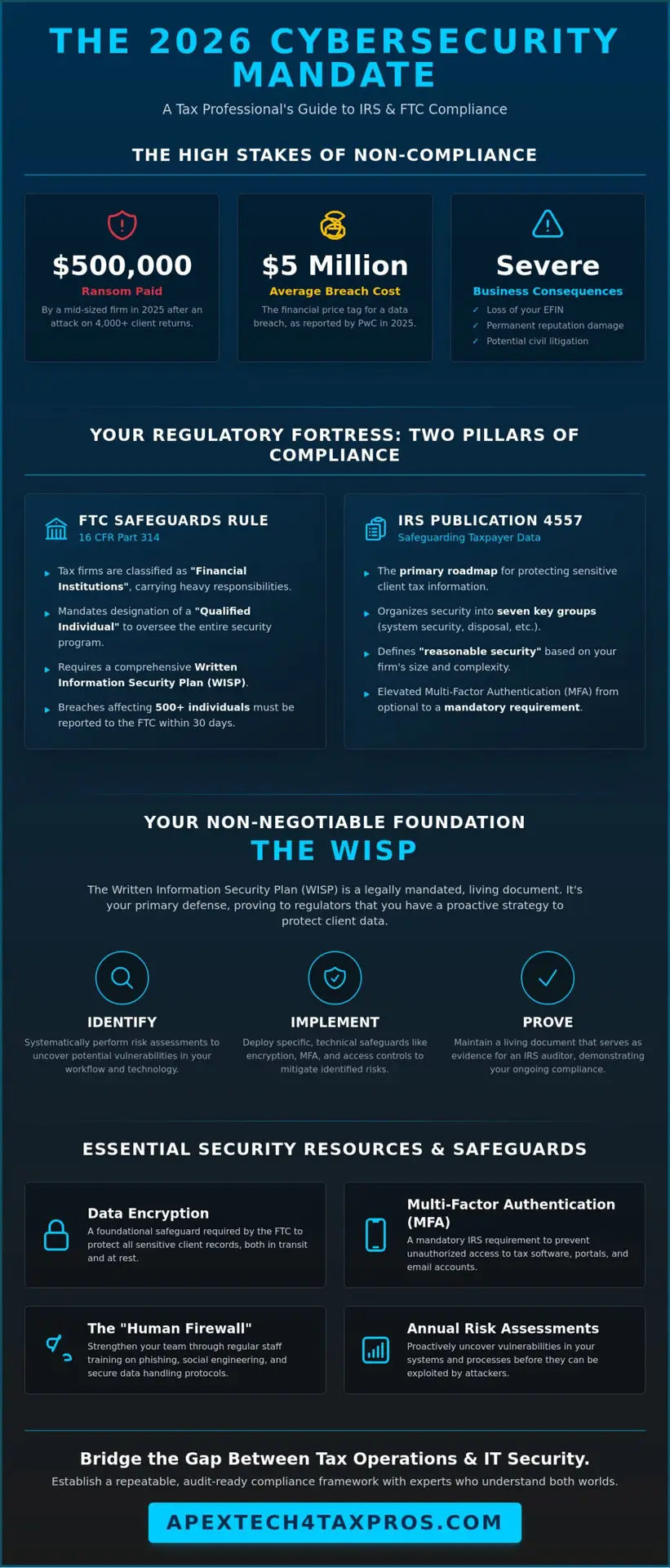
In March 2025, a mid-sized accounting firm paid a $500,000 ransom after an attack encrypted over 4,000 client tax returns, proving that even established practices are in the crosshairs of modern cybercriminals. You likely feel the weight of this responsibility every day as you balance the demands of tax season with the complex requirements of the FTC Safeguards Rule. It’s often exhausting to distinguish between general IT security and the specific regulatory standards mandated by IRS Publication 4557. Finding reliable cybersecurity resources for tax professionals shouldn’t be a secondary job that pulls you away from your core practice.
We understand that your time is your most valuable asset, and the fear of an IRS audit or a $5 million data breach price tag, as reported by PwC in 2025, is a heavy burden to carry. This guide provides the definitive roadmap to achieving full compliance and protecting your data through curated tools designed for the 2026 regulatory environment. You’ll discover how to implement a tailored Written Information Security Plan (WISP), establish a repeatable security framework, and bridge the gap between tax preparation and technical integrity once and for all.
Key Takeaways
- Learn why a Written Information Security Plan (WISP) is the non-negotiable foundation for meeting IRS Publication 4557 and FTC Safeguards Rule mandates.
- Identify the specific encryption standards and multi-factor authentication (MFA) protocols required to protect sensitive client data from sophisticated 2026 threats.
- Access a curated list of cybersecurity resources for tax professionals that transition your firm from a generic security posture to a robust, compliant ecosystem.
- Discover how to strengthen your “Human Firewall” through staff training and annual risk assessments that uncover vulnerabilities before they become breaches.
- Understand the “Dual-Expert” advantage of bridging the gap between tax operations and IT security to establish a repeatable, audit-ready compliance framework.
The 2026 Regulatory Landscape: IRS and FTC Cybersecurity Mandates
The regulatory environment for tax professionals hasn’t just evolved; it’s been rebuilt around the concept of personal accountability. By May 2026, the intersection of IRS mandates and FTC enforcement has created a zero-tolerance zone for data negligence. Understanding the available cybersecurity resources for tax professionals is no longer a luxury reserved for large firms. It’s a survival requirement for every independent preparer and boutique agency. Protecting sensitive information requires more than just basic software; it demands a disciplined approach to regulatory standards.
Many professionals mistake “checking a box” for true safety. Compliance is meeting the minimum legal standards to avoid penalties, while security is the actual practice of shielding your infrastructure from evolving threats. While they overlap, a firm can be compliant on paper while remaining vulnerable to a breach. Integrating fundamental cybersecurity principles into your daily workflow ensures that your practice isn’t just legally protected, but operationally resilient. It’s about bridging the gap between what the law requires and what your clients deserve.
IRS Publication 4557: The Seven Security Groups
IRS Publication 4557 (Rev. 5-2024) serves as your primary roadmap for safeguarding taxpayer data. It organizes requirements into seven specific security groups: system security, report of theft, disposal, and more. The IRS evaluates “reasonable” security based on your firm’s size and the complexity of your operations, but the core expectations don’t change. Through the Security Summit, a collaborative effort between the IRS and industry leaders, standards like Multi-Factor Authentication (MFA) have moved from optional recommendations to mandatory requirements. This publication is one of the most critical cybersecurity resources for tax professionals because it defines the baseline for a secure practice.
FTC Safeguards Rule: Mandatory Protections for Tax Pros
Under the FTC Safeguards Rule (16 CFR Part 314), tax preparation firms are classified as financial institutions. This classification carries heavy weight. You’re required to designate a “Qualified Individual” to oversee your information security program. This person is responsible for the integrity of your Written Information Security Plan (WISP) and must provide regular reports to your firm’s governing body. Additionally, as of 2026, any breach affecting 500 or more individuals must be reported to the FTC within 30 days. These mandates ensure that encryption and MFA are foundational safeguards for every client record you hold.
Financial fines are painful, but the collateral damage of non-compliance is often worse. In 2024, the IRS uncovered $9.1 billion in tax fraud, leading to increased scrutiny of how tax professionals handle sensitive files. Failing to meet these standards can result in the loss of your EFIN, permanent damage to your professional reputation, and potential civil litigation. Protecting your practice requires moving beyond generic IT tips and adopting a structured, professional approach. You need a system that balances technical precision with the pragmatic needs of a busy tax office.
The Written Information Security Plan (WISP): Your Essential Foundation
By 2026, the Written Information Security Plan (WISP) has transitioned from a recommended best practice to a strict legal mandate for every tax professional. Under the FTC Safeguards Rule, also known as 16 CFR Part 314, firms must maintain a comprehensive, written strategy to protect client data. This document isn’t merely a piece of paper to be filed away. It’s a living roadmap that proves to regulators you’ve identified potential vulnerabilities and implemented specific, technical safeguards to mitigate them. Among the essential cybersecurity resources for tax professionals, a robust WISP stands as your primary defense against both cyber threats and regulatory penalties.
A common mistake is relying on a generic, one-size-fits-all template. While a FREE WISP download template provides an excellent starting point, an IRS auditor looks for evidence that the plan is tailored to your firm’s unique operations. A generic plan often fails to account for your specific software stack, your office’s physical security, or your unique vendor relationships. A tailored plan reflects the actual day-to-day reality of your practice, ensuring that every protocol documented is actually being followed by your staff. This distinction between a “placeholder” document and a functional security plan can be the difference between a passed audit and a heavy fine.
Core Components of a Compliant WISP
To satisfy federal requirements, your WISP must clearly identify a “Qualified Individual” responsible for overseeing the security program. This person ensures that the plan remains effective and that all staff members adhere to its guidelines. Your WISP must also document regular risk assessments, which are formal evaluations of where your data might be at risk. Finally, the plan must establish protocols for service provider oversight. You’re legally responsible for ensuring that your software vendors and IT partners maintain security standards that match your own, making vendor management a critical chapter in your compliance story.
WISP Maintenance: Beyond the Initial Draft
The 2026 regulatory environment requires that your WISP remains current. You must conduct annual reviews of the plan to ensure it still addresses the threats your firm faces. If you adopt new tax software, move to a new cloud provider, or change your office location, these constitute “material changes” that must be documented immediately within your plan. Keeping a log of these updates demonstrates to the IRS that you are vigilant and proactive. The WISP acts as the central nervous system of firm compliance, coordinating every technical and administrative safeguard you have in place to protect your clients’ most sensitive financial information.
Essential Technical Resources for Data Integrity and Protection
Implementing a Written Information Security Plan requires moving beyond policy and into technical execution. By 2026, the baseline for technical cybersecurity resources for tax professionals has shifted from optional upgrades to mandatory safeguards. It’s no longer enough to rely on consumer-grade antivirus or basic file-sharing services. Protecting taxpayer data at rest and in transit requires a professional-grade ecosystem that ensures data integrity while maintaining your firm’s operational efficiency. This transition requires a clear understanding of which tools are engineered for specific accounting workflows versus general business use. You’re building a digital fortress that must withstand increasingly sophisticated AI-powered phishing and ransomware attacks.
Encryption and Multi-Factor Authentication (MFA) are the twin pillars of this fortress. According to the latest IRS cybersecurity guidelines for tax professionals, MFA is essential for any person accessing customer information. Implementing MFA can stop 99% of bulk automated attacks, making it the single most effective technical control you can deploy. Similarly, encryption must be applied to all customer data, both when it’s stored on your servers and when it’s being sent to a client or a third-party vendor. These aren’t just suggestions; they’re the technical standards that define a compliant practice in 2026.
Secure Data Transmission and Client Portals
The era of the email attachment has ended for the tax industry. Standard email is inherently insecure. Sending sensitive documents as attachments is a primary vector for Business Email Compromise, which accounted for over $2.9 billion in losses in 2023. Secure client portals are now mandatory for document exchange. These portals use end-to-end encryption to ensure that only the intended recipient can access the files. This shift reduces the risk of document interception and centralizes your communication logs for audit purposes. You must also apply the principle of “Least Privilege” when managing access controls. This protocol ensures staff members only have access to the specific data necessary for their roles, reducing the potential blast radius of a compromised account.
Backup and Disaster Recovery Resources
There’s a critical difference between a “sync” folder and a true Secure Cloud Backup. Services that merely sync your files to the cloud can actually spread ransomware; if your local files are encrypted by a hacker, the sync service will immediately encrypt your cloud copies too. A professional-grade backup follows the 3-2-1 rule: three copies of your data, on two different media types, with one copy stored off-site. For 2026 compliance, your off-site copy should be “immutable” or “air-gapped,” meaning it cannot be changed or deleted by ransomware. An untested backup is a liability. You must regularly test your recovery process to ensure that if a disaster strikes, you can restore your firm’s continuity in hours, not weeks.
The Human Firewall: Training and Risk Assessment Resources
Technical safeguards are only half the battle in a modern tax practice. Even the most advanced encryption cannot stop a staff member from falling for a deepfake audio clip or a highly personalized, AI-generated phishing email. Human error remains a primary vulnerability; data breaches have increased by 72% since 2021, often triggered by a single misplaced click. In 2026, building a “Human Firewall” through consistent education is one of the most effective cybersecurity resources for tax professionals. It’s about moving from a culture of convenience to a culture of disciplined vigilance that starts at the partner level and extends to every seasonal hire.
Many firms ignore training because they feel they lack the time to build a program from scratch. However, the cost of silence is too high. With the average cost of a data breach in the financial industry reaching $5 million in 2025, proactive education is a pragmatic investment in your firm’s longevity. You don’t need to be an IT expert to foster this environment. You simply need a structured approach that treats security as a core competency of tax preparation, much like staying current on new tax codes. Bridging the gap between technical tools and human behavior ensures your compliance efforts aren’t undermined by a lack of awareness.
Cybersecurity Awareness Training Framework
Staff must be prepared for more than just suspicious links. Quarterly phishing simulations are essential for training the “eye” to spot AI-enhanced social engineering that often bypasses standard spam filters. For remote and hybrid teams, training should include specific protocols for home network security and the mandatory use of secure portals over personal email. Every member of your firm needs to participate in incident response drills. Knowing exactly which systems to isolate and who to notify during a suspected breach can prevent a minor event from escalating into a total operational shutdown. To build this resilience, you can implement Cybersecurity Awareness Training tailored specifically for the high-stakes tax environment.
Professional Risk Assessments: A Step-by-Step Approach
A formal risk assessment is the diagnostic tool for your firm’s overall health. This process begins with a comprehensive inventory of every hardware device and software application used across the practice. You can’t protect an asset if you don’t know it’s connected to your network. Beyond digital inventories, you must evaluate physical security measures. This includes everything from office door locks and visitor logs to “clean-desk” policies that prevent sensitive taxpayer documents from being left exposed on workstations. Conducting these assessments annually allows you to identify and remediate vulnerabilities before they are exploited, ensuring your practice remains a safe harbor for client data.
Bridging the Gap: How Apex Tech 4 Tax Pros Simplifies Compliance
Identifying the risks and regulatory hurdles is only the first step toward a secure practice. The true challenge lies in implementing these complex standards without disrupting your firm’s operations during the peak of tax season. Apex Tech 4 Tax Pros exists to bridge the gap between tax preparation and technical security. With over 20 years of experience in both healthcare IT and the tax industry, we offer a “Dual-Expert” advantage that generic IT providers can’t match. We understand the specific nuances of IRS Publication 4557 and the daily pressures you face, allowing us to provide the most effective cybersecurity resources for tax professionals available in 2026.
Our approach is grounded in the belief that compliance shouldn’t be a burden that pulls you away from your clients. We’ve seen how the average cost of a data breach in the financial sector reached $5 million in 2025, and we’re committed to ensuring your firm never becomes part of that statistic. By focusing on data integrity and specialized safeguards, we move your practice from a state of vulnerability to a state of secure compliance. This isn’t just about avoiding fines; it’s about honoring the trust your clients place in you when they hand over their most sensitive financial information.
Our Specialized WISP and Training Solutions
We specialize in translating the dry, academic requirements of IRS mandates into actionable IT workflows. This begins with moving beyond generic templates to develop a customized Written Information Security Plan (WISP) that reflects your office’s actual hardware, software, and staff protocols. While we offer a FREE WISP download template as a starting point for your journey, our primary mission is to help you build a tailored plan that stands up to the most rigorous audits. We provide ongoing support to ensure your firm stays compliant as federal regulations evolve, keeping your “Human Firewall” strong with training that targets 2026’s specific AI-powered threats.
The Peace of Mind Guarantee
Protecting your firm’s reputation is our highest priority. As a family-owned business, we value personal accountability and the long-term success of our clients. We take the “compliance burden” off your shoulders by managing your risk assessments, secure cloud backups, and staff awareness programs. This allows you to focus on what you do best: tax preparation. You don’t have to navigate these technical requirements alone. You can secure your firm’s future with a customized WISP from Apex Tech 4 Tax Pros and move forward with the confidence that your data is in safe, capable hands.
Moving from Vulnerability to Verified Compliance
Tax professionals face a landscape where regulatory oversight and digital threats have reached an all-time high. You’ve seen how a single breach can cost millions. You know the IRS now mandates specific, documented safeguards through Publication 4557. By establishing a tailored WISP and strengthening your technical infrastructure, you protect more than just data. You protect the reputation you’ve spent years building. Utilizing specialized cybersecurity resources for tax professionals ensures that your firm remains resilient against the sophisticated AI-driven social engineering seen throughout 2026.
Apex Tech 4 Tax Pros brings over 20 years of specialized experience in both IT and the tax industry to your practice. As a family-owned business, we’re mission-driven to help you navigate the complexities of the FTC Safeguards Rule with clinical precision and personal care. We specialize in bridging the gap between your tax software and the security requirements that keep your EFIN active. Our team understands the high-stakes environment of tax preparation because we’ve been in the trenches with you.
Download our Free WISP Template or Schedule a Professional Risk Assessment today to begin your journey toward secure compliance. You don’t have to face these mandates alone. We’re here to ensure your sensitive data is in safe, capable hands so you can focus on a successful tax season.
Frequently Asked Questions
Is a Written Information Security Plan (WISP) legally required for solo practitioners?
Yes, a Written Information Security Plan is legally required for every tax preparer, including solo practitioners. The FTC Safeguards Rule (16 CFR Part 314) classifies all tax preparation firms as financial institutions. This means even if you’re a one-person office, you must document your safeguards. Failing to maintain a WISP can result in the loss of your EFIN and significant federal penalties.
What are the most common cybersecurity gaps found in tax firm audits?
The most frequent gaps found in audits include a lack of Multi-Factor Authentication (MFA) and the absence of a documented WISP. Audits often reveal that firms still rely on standard email for sensitive document exchange, which is a major vulnerability. Additionally, many firms fail to conduct the mandatory annual risk assessments required to identify new technical weaknesses in their infrastructure.
How often does the IRS require tax professionals to update their security training?
The IRS and FTC require that you provide security awareness training to all staff members at least once per year. However, given that cyber attacks on US financial companies increased by 27% in 2024, many experts recommend quarterly updates. Consistent training ensures your staff stays alert to new threats like AI-powered phishing and deepfake social engineering that evolve faster than annual cycles.
Can I use a free WISP template for IRS compliance?
You can use a free WISP template as a foundation, but it won’t satisfy the IRS on its own. The law requires a tailored plan based on a specific risk assessment of your firm’s hardware, software, and physical location. A generic document that isn’t actively followed or updated annually is often viewed by auditors as a failure to meet the “reasonable” security standard.
What is the difference between the FTC Safeguards Rule and IRS Publication 4557?
The FTC Safeguards Rule is the federal regulation that carries the force of law for all financial institutions. IRS Publication 4557 is the agency’s official guidance designed to help you meet those legal requirements. While the FTC sets the broad mandate, Publication 4557 provides the specific roadmap and “Seven Security Groups” specifically engineered for the tax and accounting industry.
What should a tax professional do immediately after a suspected data breach?
You must immediately isolate affected systems to prevent further data loss and contact your insurance provider or legal counsel. If the breach affects 500 or more individuals, the FTC mandates reporting within 30 days of discovery. You should also refer to your WISP’s incident response plan to ensure you’re following the documented steps for client notification and law enforcement contact.
Do I need a ‘Qualified Individual’ if my accounting firm has fewer than 10 employees?
Yes, every firm must designate a Qualified Individual to oversee their information security program, regardless of employee count. While smaller firms can designate an existing staff member or an outside consultant, the responsibility for the program’s integrity must be assigned to a specific person. This individual is responsible for providing regular reports on the firm’s security posture to the owners or governing body.
How much does professional cybersecurity compliance cost for a tax practice?
Professional compliance costs vary based on the level of technical support and the complexity of your practice. While specific pricing depends on your firm’s needs, it’s helpful to consider the alternative risks. PwC reported in 2025 that the average cost of a data breach in the financial industry is $5 million. Investing in cybersecurity resources for tax professionals is a pragmatic step to avoid these devastating financial and reputational losses.