
Your small firm’s data security is no longer a private matter; as of May 13, 2024, the FTC began publicly disclosing any notification event affecting 500 or more consumers on its website. If you believe your practice is exempt from the ftc safeguards rule because you serve fewer than 5,000 clients, you’re operating under a misconception that could lead to fines of up to $100,000 per violation. While certain smaller businesses are exempt from written risk assessments, the core requirement to maintain a comprehensive security program and report breaches within 30 days applies to nearly every tax professional in the country.
We understand the anxiety that comes with the threat of federal audits and the confusing overlap between IRS Publication 4557 and FTC mandates. It’s difficult to feel confident in your security when you lack the technical IT background to implement complex digital controls. This guide bridges the gap between tax preparation and cybersecurity, providing the clarity you need to protect your practice from federal penalties. You’ll learn exactly how to meet the “Qualified Individual” standard and establish a tailored Written Information Security Plan (WISP) that safeguards your clients’ most sensitive data.
Key Takeaways
- Learn why tax preparers are legally classified as financial institutions under the Gramm-Leach-Bliley Act and what this means for your client data integrity.
- Master the nine administrative, technical, and physical requirements of the ftc safeguards rule to move beyond optional best practices into full federal compliance.
- Debunk the dangerous myth that cloud-based tax software provides automatic compliance; it doesn’t protect your firm’s local network or hardware.
- Understand the critical link between your Written Information Security Plan (WISP) and the mandatory security declarations required for your annual PTIN renewal.
- Explore how professional risk assessments identify hidden vulnerabilities, providing a clear path to bridging the gap between your tax expertise and IT security needs.
What is the FTC Safeguards Rule for Tax Professionals?
The ftc safeguards rule is a set of federal standards designed to ensure that financial institutions protect the security, confidentiality, and integrity of customer information. While the term “financial institution” might conjure images of massive banks, the Federal Trade Commission applies this classification to any business significantly engaged in providing financial products or services. This includes tax professionals who handle sensitive nonpublic personal information (NPI). By operating under the Gramm-Leach-Bliley Act, tax preparers are legally obligated to implement a comprehensive security program that shields taxpayer data from unauthorized access.
In 2026, the regulatory climate has shifted toward proactive data protection. Federal agencies no longer accept reactive breach responses as a sufficient defense. The primary objective is to maintain data integrity through a structured framework of administrative and technical controls. This shift ensures that sensitive taxpayer records remain private, reducing the risk of identity theft and financial fraud that often follows a data breach. We focus on helping you build this foundation so your practice remains resilient against evolving digital threats.
Who Must Comply with the Safeguards Rule?
Size doesn’t grant an exemption from the core requirements of the ftc safeguards rule. Whether you’re a solo practitioner or a multi-state firm, if you have a Preparer Tax Identification Number (PTIN), you likely fall under this jurisdiction. Firms maintaining information on fewer than 5,000 consumers are exempt from certain administrative requirements, such as written risk assessments and incident response plans. However, they’re still required to designate a qualified individual to oversee their security, manage service providers, and maintain a basic information security program. Compliance is a mandatory standard for anyone handling taxpayer data.
The Evolution of Data Privacy Standards in 2026
Compliance standards have matured significantly. Multi-factor authentication (MFA) is now the baseline requirement for any system containing customer data. The 2026 enforcement climate is increasingly strict, with penalties for non-compliance reaching up to $100,000 per violation. Regulators now expect “continuous monitoring” of your digital environment. This means your security isn’t a one-time setup; it’s a vigilant, ongoing process of assessment and adjustment. We bridge the gap between complex IT requirements and the daily realities of your tax practice to ensure these standards are met without disrupting your workflow.
The 9 Core Requirements of the FTC Safeguards Rule
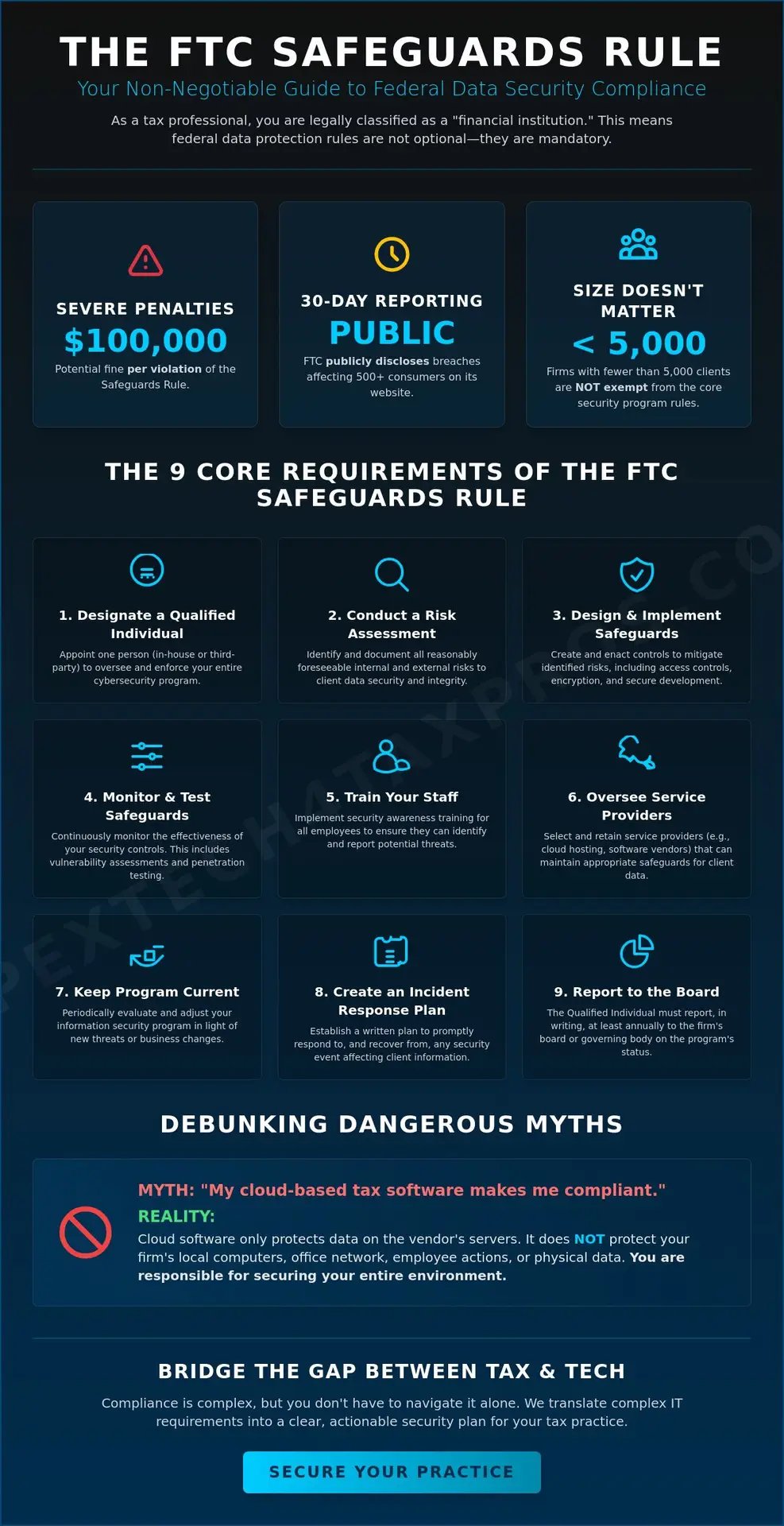
The ftc safeguards rule establishes a rigid framework that moves beyond basic digital hygiene into a set of non-negotiable federal mandates. These nine requirements are designed to protect the entire lifecycle of taxpayer data, from initial intake to final disposal. While many tax professionals view these as “best practices,” the Federal Trade Commission treats them as legal requirements. This includes the mandatory creation of a written risk assessment for all covered entities, which serves as the foundation for your entire security program. You can find the full list of expectations in the FTC Safeguards Rule guide, which details the administrative, technical, and physical protections your firm must maintain.
Designating Your Qualified Individual
Every firm must appoint a single “Qualified Individual” responsible for overseeing and enforcing the security program. For a solo practitioner, this may be the owner, provided they possess the technical literacy to manage the firm’s digital defenses. Larger practices often designate a senior IT lead or a specialized third-party provider. This individual must provide a written report at least annually to the firm’s governing body, detailing the overall status of the security program and any material matters related to compliance. Successful compliance requires a “Dual-Expert” perspective; the individual must understand the specific seasonal workflows of a tax office while maintaining deep technical knowledge of cybersecurity protocols.
Technical Safeguards: Encryption and Multi-Factor Authentication
Technical controls form the backbone of your defense. You’re required to encrypt all customer information both at rest on your hard drives and in transit through email or secure portals. As of 2026, basic password protection is insufficient. The standard now requires robust encryption, such as AES-256, to ensure data remains unreadable if intercepted. Additionally, Multi-Factor Authentication (MFA) is mandatory for any individual accessing customer information on your systems. This provides a critical layer of protection that prevents unauthorized access even if a staff member’s credentials are compromised. If you aren’t sure where your current technical gaps lie, a professional risk assessment can provide the necessary roadmap for remediation.
Monitoring and Testing Your Security Program
Security is not a static achievement. The rule requires regular testing and monitoring of your safeguards’ effectiveness. For most firms, this means implementing “continuous monitoring” systems that watch for threats in real-time. If you don’t have continuous monitoring, you must conduct annual vulnerability assessments. A vulnerability scan acts as a proactive health check for your network, identifying weaknesses before hackers can exploit them. Larger firms with more complex infrastructures are also required to perform periodic penetration testing to simulate real-world attacks and verify their defenses hold up under pressure.
Common Misconceptions: Why “I am too small” is a Dangerous Myth
Many solo practitioners and small boutique firms operate under the dangerous assumption that federal regulations only target the “big players.” This mindset often stems from a misunderstanding of the ftc safeguards rule and its specific exemptions. While the law provides some administrative relief for smaller entities, it doesn’t offer a “get out of jail free” card. The reputational damage from a data breach often proves more fatal to a small firm than the federal fines themselves. If your practice’s name appears on the FTC’s public breach list, which now includes events affecting as few as 500 consumers, local trust evaporates instantly.
Another common error is believing that cloud-based software providers like Drake, UltraTax, or Lacerte handle all your compliance needs. This ignores the Shared Responsibility Model of cybersecurity. While your software provider secures the data once it reaches their servers, you remain responsible for the security of the “last mile.” This includes the workstation where the data is entered, the local network it travels over, and the physical office where documents are stored. Software alone can’t protect a firm from a compromised local router or a staff member’s weak password.
The Reality of the 5,000 Consumer Threshold
The 5,000 record rule refers to the total number of individuals whose nonpublic personal information you maintain, not the number of tax returns you file annually. According to the FTC’s official compliance guide, firms below this threshold are only exempt from four specific requirements: written risk assessments, incident response plans, annual reporting by the Qualified Individual, and continuous monitoring. You’re still legally mandated to implement multi-factor authentication (MFA), robust encryption, and a Written Information Security Plan (WISP). The IRS specifically requires a WISP for all tax professionals as part of the annual PTIN renewal process, regardless of client count.
Third-Party Service Provider Oversight
You hold the legal responsibility to ensure your IT vendors and software providers maintain standards that mirror your own. Under the ftc safeguards rule, you must periodically assess the risks posed by these third parties. When vetting an IT provider in 2026, don’t just ask if they “do security.” Ask for specific evidence of their encryption standards and their own internal data integrity protocols. We help firms evaluate these complex vendor relationships to ensure every link in your data chain is secure. Ensuring your vendors are compliant isn’t just good business; it’s a federal requirement that protects you from secondary liability during an audit.
Integrating the FTC Rule with Your IRS WISP
The Written Information Security Plan (WISP) serves as the tangible evidence of your firm’s adherence to the ftc safeguards rule. For several years, the IRS has required tax professionals to check a box during their annual PTIN renewal confirming they have a security plan in place. This isn’t a mere formality. If the IRS or FTC audits your practice, the WISP is the first document they’ll request to verify your data integrity protocols. It bridges the gap between federal mandates and your daily office operations by documenting exactly how you protect sensitive taxpayer information.
A stagnant document from 2022 won’t suffice in 2026. Your plan must be a living document that evolves alongside your technology stack and the latest federal mandates. Each requirement mentioned in the ftc safeguards rule should map directly to a specific chapter in your WISP. This alignment ensures that your administrative, physical, and technical safeguards aren’t just theoretical ideas but documented procedures. We help firms move beyond generic paperwork to create a functional shield for their practice.
Elements of a Compliant 2026 WISP
A compliant WISP includes detailed chapters on risk assessment, system access controls, and encryption standards. While a “free template” might seem convenient, these generic documents often fail audits because they aren’t tailored to your specific hardware and software environment. A truly effective plan must also include a robust employee training section. This ensures your staff understands their role in maintaining regulatory standards and protecting sensitive taxpayer information. If you’re starting from scratch, you can begin with our FREE WISP Download Template to see the necessary structure for a professional security program.
Incident Response Planning
Your WISP must include a clear, written incident response plan. As of May 13, 2024, the FTC requires notification within 30 days of discovering a “notification event” that affects 500 or more consumers. This 30-day window is incredibly tight. Having a pre-defined plan reduces panic decision-making during a cyber event by outlining exactly who to call and what steps to take. It transforms a potential catastrophe into a managed process, helping you fulfill your reporting obligations while protecting your firm’s reputation. A well-documented plan demonstrates to regulators that you take your role as a “Dual-Expert Guardian” of client data seriously.
Bridging the Compliance Gap with Apex Tech 4 Tax Pros
Apex Tech 4 Tax Pros serves as your Dual-Expert Guardian. We’ve spent 20 years bridging the gap between high-stakes tax preparation and complex IT security. We understand that you aren’t an IT expert; you’re a tax professional who needs to focus on client returns without the constant fear of an audit. Our professional risk assessments identify the specific vulnerabilities in your hardware and network that generic software simply can’t see. We don’t just hand you a document; we build a tailored defense that meets the exact requirements of the ftc safeguards rule while fitting your specific office workflow.
The peace of mind that comes from a professional partnership is invaluable. You shouldn’t have to guess if your encryption is strong enough or if your staff training meets federal standards. We speak both “tax” and “IT,” allowing us to translate clinical technical requirements into pragmatic business solutions. This supportive approach ensures your regulatory burdens are understood and your sensitive data remains in safe, capable hands.
Our Process: From Vulnerability to Secure Compliance
Our methodical approach guides you from vulnerability to secure compliance through a defined, four-step process. We begin with a comprehensive assessment of your current digital environment to find hidden gaps. From there, we develop your customized WISP and conduct cybersecurity awareness training to turn your staff into a human firewall. We also implement secure cloud backup solutions to ensure your practice remains resilient against data loss or hardware failure. This steady, deliberate rhythm mirrors the meticulous nature of the tax profession itself, replacing frantic energy with professional certainty.
Next Steps for Your Practice
Protecting your firm doesn’t have to be an overwhelming burden. You can start today by using our free WISP download template to organize your initial security thoughts. While a template provides a helpful structure, it’s only the first step toward a fully compliant program that stands up to federal scrutiny. We invite you to move beyond the basics and validate your safeguards with a professional review. Schedule your 2026 FTC Safeguards Compliance Review today to ensure your practice is fully protected and compliant with the latest ftc safeguards rule mandates.
Securing Your Firm’s Future Through Data Integrity
The regulatory landscape of 2026 demands more than just basic awareness; it requires a documented, vigilant approach to security. You’ve seen that the ftc safeguards rule applies to every tax professional regardless of practice size, which makes the “I’m too small” excuse a significant legal liability. Relying solely on cloud-based tax software for security leaves dangerous gaps in your local network and physical office. A tailored Written Information Security Plan (WISP) isn’t just a hurdle to clear for PTIN renewal; it’s the blueprint for your practice’s survival.
Apex Tech 4 Tax Pros brings 20 years of experience in tax-specific IT security to help you bridge these gaps. We serve as a trusted advisor for national tax and accounting firms, providing a specialized focus on IRS Publication 4557 and FTC standards. We don’t just provide generic templates. We deliver professional remedies that protect your clients and your professional reputation. Secure your practice and meet FTC mandates with a customized WISP from Apex Tech 4 Tax Pros.
You’ve built your practice on a foundation of trust and meticulous accuracy. By formalizing your security protocols today, you’re ensuring that your hard-earned legacy remains protected from federal penalties and digital threats.
Frequently Asked Questions
Does the FTC Safeguards Rule apply to solo tax preparers?
Yes, the ftc safeguards rule applies to solo tax preparers because the Gramm-Leach-Bliley Act classifies any business significantly engaged in financial services as a financial institution. While firms with fewer than 5,000 consumers have some administrative exemptions, solo practitioners must still implement core technical safeguards. This includes multi-factor authentication and a written security plan to protect taxpayer data integrity.
What is a “Qualified Individual” under the FTC Safeguards Rule?
A Qualified Individual is a designated person responsible for overseeing and enforcing your firm’s information security program. This person can be an internal employee or a third-party service provider with the technical expertise to manage digital defenses. They must provide an annual report to your firm’s leadership regarding the status of your compliance and any material security risks identified during the year.
Is a WISP mandatory for all tax professionals in 2026?
Yes, a Written Information Security Plan (WISP) is mandatory for every tax professional in 2026. The IRS requires you to confirm the existence of this plan during your annual PTIN renewal process. Failing to maintain this document leaves you vulnerable to federal audits. It serves as the physical proof that your practice has implemented the administrative and technical controls required by federal law.
Can I use a free WISP template to satisfy FTC requirements?
You can use a template as a starting point, but a generic document rarely satisfies the technical standards of the ftc safeguards rule. The law requires your security plan to be based on a risk assessment tailored to your specific IT environment. If your WISP doesn’t accurately reflect your firm’s actual hardware, software, and staff workflows, regulators will likely consider it non-compliant during an investigation.
What are the penalties for non-compliance with the FTC Safeguards Rule?
Non-compliance can result in civil penalties of up to $100,000 per violation under the Gramm-Leach-Bliley Act. Beyond these federal fines, the FTC now publicly discloses breach events affecting 500 or more consumers on its website. This public listing can cause a total loss of client trust, which is often more damaging than the monetary penalties for a small tax practice.
How often do I need to update my Written Information Security Plan?
You should update your WISP at least once every 12 months or whenever you make significant changes to your technology stack. If you implement new cloud software or hire new staff, your risk assessment must reflect these changes. Regular updates ensure your plan remains a living document that accurately describes how you protect data in an evolving threat environment.
Does my tax software provider handle my FTC Safeguards compliance?
No, your tax software provider only secures the data once it reaches their servers. You’re still responsible for the security of your local workstations, office network, and physical file storage. This shared responsibility means you must implement your own multi-factor authentication and encryption protocols to protect client information before it’s uploaded to the cloud.
What is the 30-day breach notification requirement?
As of May 13, 2024, the FTC requires you to report any notification event affecting 500 or more consumers within 30 days of discovery. A notification event includes any unauthorized acquisition of unencrypted customer information. You must submit this notice electronically through the FTC’s website. Having a pre-defined incident response plan is essential to meeting this tight 30-day reporting window.