
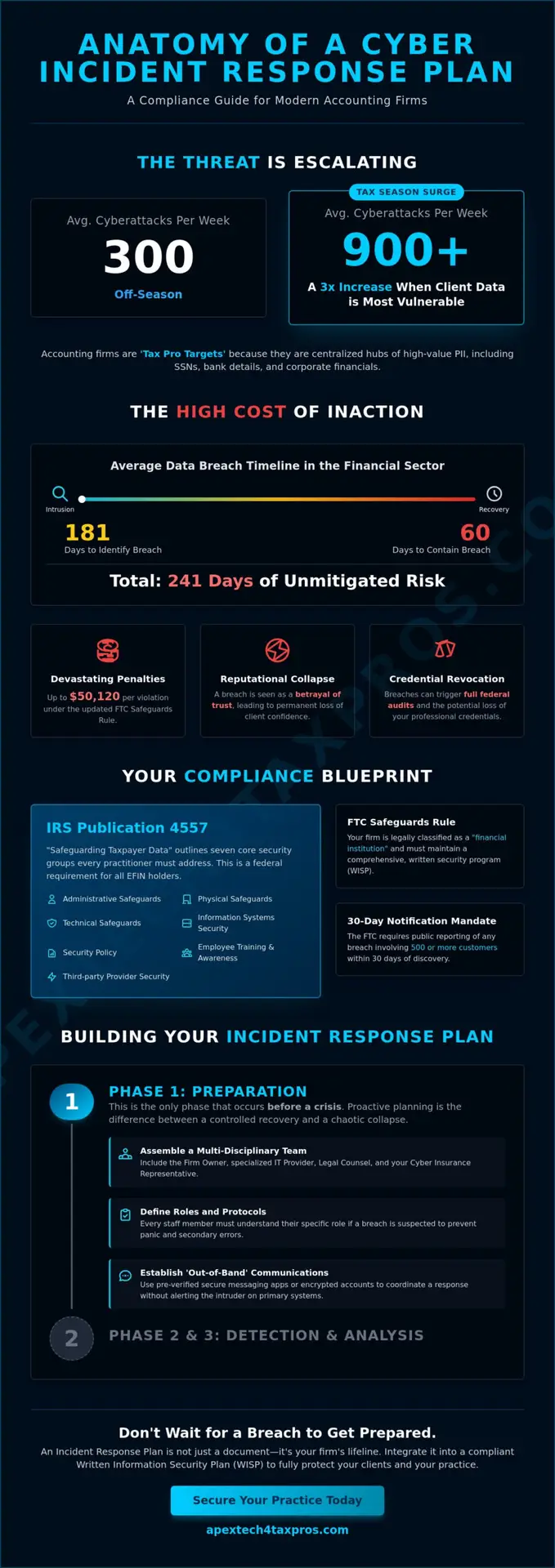
With accounting firms facing an average of 300 cyberattacks per week, a number that can surge to over 900 during the height of tax season, the question is no longer if a breach will occur, but when. You likely recognize that your digital perimeter is under constant pressure, yet the complexity of federal mandates can make the path to compliance feel like a moving target. It’s frustrating to manage the distinction between mere IT recovery and the rigorous regulatory reporting required by the Gramm-Leach-Bliley Act. This guide will show you how to develop a robust incident response plan for accounting firms that bridges the gap between technical recovery and the strict reporting requirements of the FTC Safeguards Rule and IRS Publication 4557.
We understand the weight of protecting sensitive client data while navigating the threat of a $50,120 penalty per violation. You’ll learn how to build an actionable framework that secures your practice without the need for an enterprise-level security operations center. We’ll preview the essential components of a 2026-compliant strategy, including the “Security Six” technical controls and the protocols needed to meet the FTC’s 30-day notification mandate. By the end of this guide, you’ll have a clear roadmap to minimize downtime and ensure your firm remains a trusted, compliant sanctuary for the financial lives you manage.
Key Takeaways
- Understand why cybercriminals prioritize tax professional data and how a specialized response process prevents your firm from becoming a high-value target.
- Identify the essential phases of a robust incident response plan for accounting firms, focusing on detection and analysis within specialized tax software environments.
- Master the strict notification timelines required by the IRS Stakeholder Liaison while navigating the complex intersection of state-specific data breach laws.
- Learn to conduct a formal risk assessment that identifies and secures your clients’ most sensitive personally identifiable information (PII).
- Discover how to integrate your response protocols into a Written Information Security Plan (WISP) to ensure full compliance with federal Safeguards mandates.
Why Accounting Firms Require a Specialized Incident Response Plan
In the current threat environment, an incident response plan for accounting firms is no longer a luxury reserved for national practices; it’s a fundamental requirement for any professional handling taxpayer data. While many firms rely on general IT support, a specialized response framework is designed to address the unique intersection of financial data and federal law. A foundational question many partners ask is: What is an Incident Response Plan? At its core, an IRP is a documented, methodical process that your team follows to identify, contain, and recover from a security breach. It’s the difference between a controlled recovery and a chaotic collapse.
In 2026, cybercriminals have refined the ‘Tax Pro Target’ phenomenon. Accounting firms are prioritized because they serve as centralized hubs of high-value data, including Social Security numbers, bank account details, and corporate financial structures. While a generic business continuity plan focuses on keeping the lights on during a power outage, a tax-specific incident response plan for accounting firms addresses the specific vulnerabilities of tax software and the regulatory fallout of a data leak. Under the FTC Safeguards Rule, firms are classified as financial institutions, meaning they’re legally obligated to maintain a comprehensive, written security program that includes a documented response strategy.
IRS Publication 4557 and Your Legal Obligations
IRS Publication 4557, “Safeguarding Taxpayer Data,” outlines seven core security groups that every practitioner must address: Administrative Safeguards, Physical Safeguards, Technical Safeguards, Information Systems Security, Security Policy, Employee Training and Awareness, and Third-party Provider Security. For EFIN holders, having this ‘plan on paper’ is a federal requirement. The IRS and the FTC have intensified their scrutiny, and failing to maintain an active response framework can lead to devastating consequences. Under the updated FTC Safeguards Rule, violations can result in penalties of up to $50,120 per violation, which can quickly escalate into millions for a single firm-wide breach.
The High Cost of Inaction: Beyond Technical Downtime
The average time to detect a data breach in the financial sector is 241 days, which includes 181 days to identify the intrusion and 60 days to contain it. For a tax professional, this delay is catastrophic. Reputational damage in this industry is unique; clients don’t just see a technical glitch, they see a betrayal of trust. A single breach often triggers a ‘cascade effect’ where one compromised client record leads to a full-scale federal audit of the entire firm. Since the FTC now requires breaches involving 500 or more customers to be reported within 30 days and made public, the cost of inaction includes the permanent loss of client confidence and the potential revocation of your professional credentials.
The Anatomy of a Compliant IRP for Tax Professionals
A structured incident response plan for accounting firms is built on a modular framework that allows for rapid action under pressure. While generic security standards provide a foundation, tax professionals must tailor these phases to account for the specific lifecycle of sensitive client data. You can find a detailed breakdown of these foundational steps in the CISA Incident Response Plan Basics, which serves as a vital reference for your firm’s security leadership. By defining these stages now, you ensure that your response is methodical rather than reactive.
Phase 1: Preparation and the Incident Response Team
Preparation is the only phase that occurs before a crisis. It involves assembling a multi-disciplinary team that includes the firm owner, your specialized IT provider, legal counsel, and your cyber insurance representative. Every staff member must understand their specific role. If a breach is suspected, clear protocols prevent panic and secondary errors. One critical component is establishing ‘out-of-band’ communication channels. Since your firm’s primary email system may be compromised, your team should have pre-verified methods, such as secure messaging apps or encrypted personal accounts, to coordinate the response without alerting the intruder.
Phase 2 & 3: Detection and Immediate Containment
Detection in an accounting environment often looks different than in other sectors. You might notice unexpected e-file acknowledgments for returns you didn’t submit, or find that specific client folders are suddenly inaccessible. These are immediate red flags. To bridge the gap between suspicion and certainty, performing regular Risk Assessments allows you to identify detection gaps before a threat actor exploits them.
When a workstation is suspected of being compromised, immediate containment is vital. However, you shouldn’t simply pull the power cord. Modern forensics require that the machine remains on but isolated from the network to preserve volatile memory data. Disconnect the ethernet cable or disable the Wi-Fi immediately. This stops the ‘lateral movement’ of the attacker while keeping the evidence intact for regulatory investigators and insurance adjusters.
Following containment, the eradication phase involves removing the threat and verifying that the environment is clean. This is where your secure cloud backups become invaluable. Restoring from a known-clean point ensures that you aren’t re-introducing the malware into your system. Finally, the post-incident activity phase is a mandatory IRS requirement. You must document what happened, how it was handled, and what changes were made to the incident response plan for accounting firms to prevent a recurrence. This documentation is essential for fulfilling your reporting obligations under the FTC Safeguards Rule and maintaining your professional standing.
Navigating the Regulatory Notification Minefield
Once a breach is contained, your firm enters a high-stakes period of legal and ethical obligations. The technical recovery is only one side of the coin; the other is a complex web of mandatory disclosures. An effective incident response plan for accounting firms must account for the FTC’s 2025 reporting mandate, which requires firms to notify the commission within 30 days if a breach involves 500 or more customers. These notifications are public records, making the precision of your reporting critical to your firm’s long-term reputation. Simultaneously, you must navigate a patchwork of state-level statutes that often have conflicting timelines and definitions of personally identifiable information (PII).
IRS Reporting: The 24-Hour Rule
Your first external call should be to your local IRS Stakeholder Liaison. While federal regulations provide some leeway, the internal standard for a robust incident response plan for accounting firms is to initiate this contact within 24 hours of discovering a compromise. This promptness allows the IRS to implement “Security Summit” protocols, which help block fraudulent tax returns filed using your clients’ stolen data. When you make this report, be prepared to provide your firm’s name, EFIN, and a general summary of the incident. Avoid transmitting specific client Social Security numbers or names during this initial outreach unless you are using a verified, encrypted channel designated by the Liaison.
Client and Third-Party Communications
Managing client expectations requires a blend of transparency and calm authority. Your notification letter should be drafted with the help of legal counsel to ensure it meets all state and federal requirements while reassuring clients that you have taken control of the situation. It’s often beneficial to involve your cyber insurance provider early in this process, as they frequently provide access to specialized breach response teams who can manage the logistics of mass mailings and credit monitoring services. For incidents involving ransomware or significant data theft, you should also file a report with the FBI’s Internet Crime Complaint Center (IC3). This not only fulfills a civic duty but also provides a formal record that can be essential for insurance claims and potential regulatory defenses.
Implementing Your Plan: From Document to Defense
Transitioning from a theoretical document to an active defense requires a methodical approach that mirrors the precision of a professional tax audit. The first step involves conducting a formal Risk Assessment to identify your “Crown Jewels,” which include the client PII and sensitive financial records that represent your firm’s greatest liability. Once these assets are mapped, you must customize a response template to reflect your specific firm size and tech stack. A small practice utilizing cloud-based tax software will have vastly different recovery priorities and communication needs than a larger firm managing legacy on-premise servers. This customization ensures your plan is actionable rather than generic.
Technical firewalls provide a necessary barrier, but they’re frequently bypassed by social engineering triggers that target your staff. Training your team to recognize these psychological tactics is essential, yet education shouldn’t stop at a manual. Executing a “Tabletop Exercise” allows your firm to simulate a ransomware attack in a controlled environment. During this exercise, you’ll walk through the decision-making process, identify communication bottlenecks, and clarify roles. This simulation reveals where your incident response plan for accounting firms might fail before a real-world threat actor exploits those weaknesses.
Staff Training: Your First Line of Incident Response
Integrating IRP awareness into your ongoing Cybersecurity Awareness Training programs ensures that every team member understands their role in the security lifecycle. It’s vital to foster a “no-blame” culture where employees feel safe reporting suspicious activity immediately. If a staff member fears professional repercussions for clicking a deceptive link, they’re likely to hide the error, providing the attacker with undetected access to your network. Statistics consistently show that human error is the primary catalyst for data breaches in the accounting sector, often occurring during the high-stress environment of tax season.
The Role of Secure Cloud Backup in Recovery
When ransomware successfully encrypts your primary data, “offline” or “immutable” backups become your only reliable defense. These specialized archives are engineered to be read-only once written, ensuring that the malware cannot reach or corrupt your historical data. However, it’s a common mistake to assume a backup is functional without verification. You must regularly test the “Restore” function to confirm that your data is not only present but also usable and current. For a deeper analysis of how to protect your firm’s most critical records, consider reviewing our specialized Secure Cloud Backup protocols.
Finally, remember that security is a continuous cycle. You should review and update your IRP annually or after any significant changes to your software or hardware infrastructure. This maintenance ensures that your contact lists, regulatory requirements, and recovery procedures remain aligned with the evolving threat landscape of 2026. This proactive cycle transforms your written plan from a compliance checkbox into a resilient shield for your practice.
The Final Piece: Integrating Your IRP into a WISP
While a comprehensive incident response plan for accounting firms provides the tactical steps for crisis management, it cannot exist in a vacuum. It must be integrated into your Written Information Security Plan (WISP), which serves as the master document for your firm’s entire security posture. The IRS and FTC view the WISP as the foundational proof that your practice is meeting its legal obligations under the Gramm-Leach-Bliley Act. Within this structure, the IRP acts as the actionable appendix. It’s the specific protocol that fulfills the “Response” requirement of federal Safeguards mandates, ensuring that if preventative measures fail, your firm has a pre-verified path to recovery.
A customized WISP does more than just satisfy a compliance checklist; it significantly simplifies your mandatory annual risk assessment process. By having your response protocols and technical safeguards documented in a central location, you can easily identify where your infrastructure has changed and where new threats may have emerged. Apex Tech 4 Tax Pros specializes in bridging the gap between technical IT operations and the specific language of IRS compliance. We ensure that your security measures aren’t just functional, but are also properly documented to withstand the scrutiny of a federal audit.
Why Templates Aren’t Enough for 2026 Audits
The danger of relying on generic “Free WISP Templates” is that they often fail to account for the specific workflows and software integrations unique to your practice. In a 2026 regulatory environment, an auditor will quickly identify a plan that doesn’t reflect the firm’s actual operations. If your documentation claims you use specific encryption protocols or communication channels that don’t exist in your daily workflow, the entire plan may be deemed non-compliant. Professional WISP development ensures that your incident response plan for accounting firms is functional and that your staff actually understands the protocols they are expected to follow during a crisis.
Next Steps for Firm Security
Building a resilient practice requires following a clear compliance roadmap: conducting a formal risk assessment, implementing staff training, finalizing your WISP, and securing your cloud backups. Beyond the necessity of avoiding federal penalties, a robust security posture serves as a powerful marketing advantage. High-net-worth clients and corporate entities are increasingly selective about the professionals they trust with their sensitive financial data. Demonstrating that you have invested in a professional-grade security framework signals that you value their privacy as much as their financial success. To ensure your practice is fully protected and compliant, you can get your customized WISP and IRP from Apex Tech 4 Tax Pros today.
Securing Your Practice for the 2026 Tax Season and Beyond
The complexity of modern federal mandates requires a shift from reactive recovery to proactive protection. By establishing a specialized incident response plan for accounting firms, you ensure that your practice is prepared to meet the strict 30-day reporting windows and IRS standards. This strategy transforms your security from a technical burden into a documented, mission-driven asset that protects your firm’s reputation and its clients’ most sensitive data. You’ve seen how a compliant framework bridges the gap between IT recovery and regulatory reporting, providing a clear path forward during a crisis.
Our team at Apex Tech 4 Tax Pros specializes in this high-stakes niche, providing expert-led risk assessments and cybersecurity awareness training designed specifically for tax professionals. We ensure your firm is fully IRS and FTC Safeguards Rule compliant. You don’t have to navigate these regulatory minefields alone. Our heritage of technical precision and industry-specific expertise ensures your firm remains secure and ready for whatever the next tax season brings. It’s time to move from uncertainty to a state of secure compliance.
Secure Your Firm’s Future with a Customized WISP and gain the confidence that comes from professional, specialized protection. Your commitment to security today is the foundation for your firm’s success tomorrow.
Frequently Asked Questions
Is an incident response plan required by the IRS for all accounting firms?
Yes, a documented incident response plan is a federal requirement for all tax professionals under IRS Publication 4557 and the FTC Safeguards Rule. These regulations classify accounting firms as financial institutions, necessitating a written information security program. Failing to maintain an active response framework leaves your firm vulnerable to penalties of up to $50,120 per violation. It’s a critical component of your professional compliance profile.
How often should my accounting firm test its incident response plan?
You should test your incident response plan for accounting firms at least once per year or whenever you implement significant software changes. Regular tabletop exercises allow your team to simulate ransomware scenarios in a controlled environment. This frequency ensures that contact lists remain current and that staff members remember their specific roles. Annual testing is often a requirement for maintaining cyber insurance coverage and meeting federal documentation standards.
What is the first thing I should do if I suspect a data breach at my firm?
The immediate priority is to isolate the suspected workstation from your network by disconnecting the ethernet cable or disabling Wi-Fi. You shouldn’t power the machine down, as this can destroy volatile forensic evidence needed by investigators. Once the device is isolated, you should activate your internal response team and contact your specialized IT provider. This swift action prevents the intruder from moving laterally through your client database.
Do I need to report a breach if no data was actually stolen?
You must report any unauthorized access to your systems, even if you don’t believe data was successfully exfiltrated. The IRS and FTC focus on the compromise of the environment rather than just the theft itself. Early reporting allows the IRS Stakeholder Liaison to monitor for fraudulent filings using your EFIN. Transparency with regulatory bodies often serves as a primary defense during subsequent compliance audits or insurance claims.
What is the difference between a WISP and an Incident Response Plan?
A Written Information Security Plan (WISP) is your firm’s comprehensive master document that outlines all administrative and technical safeguards. In contrast, an incident response plan is the specific, actionable subset of the WISP that dictates how you react during a security event. While the WISP focuses on daily prevention and policy, the IRP provides the methodical steps for containment, recovery, and mandatory federal reporting.
Who should be on my firm’s incident response team if I’m a solo practitioner?
Solo practitioners should build a virtual response team consisting of their specialized IT provider, legal counsel, and cyber insurance representative. Since you don’t have internal departments, these external partners serve as your expert advisors during a crisis. You should keep their emergency contact information in a physical format outside of your digital network. This ensures you can coordinate a response even if your primary systems are encrypted.
Does cyber insurance cover the cost of implementing an incident response plan?
Cyber insurance policies generally don’t pay for the initial development of your security documents, but they often require a documented plan to qualify for a policy. Having an active incident response plan for accounting firms can lead to lower premiums and better coverage terms. While the insurance handles the costs of breach recovery and legal fees, the responsibility for building the proactive framework remains with the firm owner.
How do I report a cyber incident to the IRS Stakeholder Liaison?
You can report an incident by contacting the IRS Stakeholder Liaison designated for your specific state. The IRS maintains a directory of these officials who are trained to handle tax-related data compromises. When you reach out, you should be prepared to provide your firm’s EFIN and a high-level summary of the suspicious activity. They’ll guide you through the Security Summit protocols to protect your clients from identity theft.