
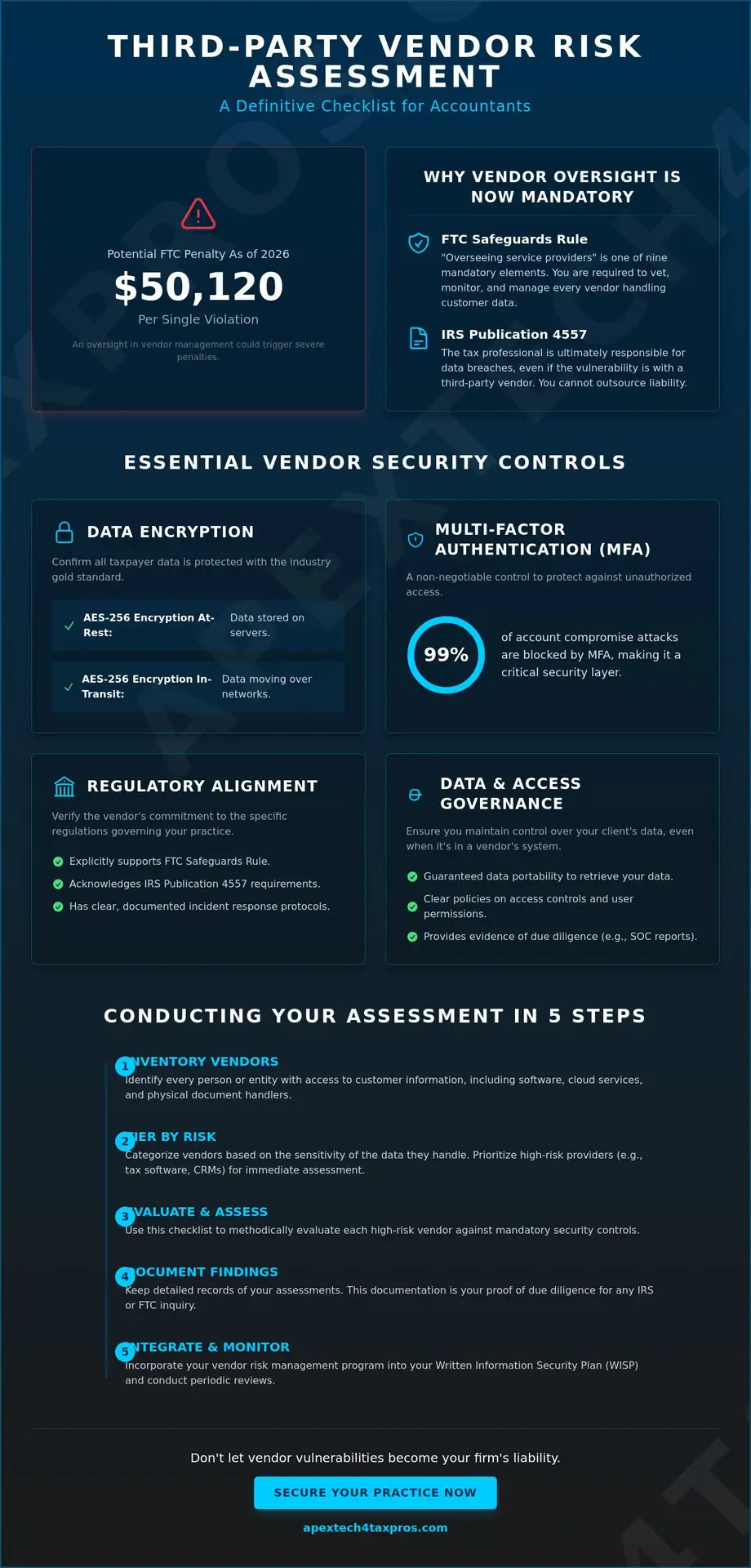
Did you know that as of 2026, a single oversight in your vendor management could trigger FTC penalties of up to $50,120 per violation? It’s understandable if you feel overwhelmed by the technical jargon found in SOC reports or the constant pressure to monitor every cloud service your firm touches. You’ve spent years building a reputation for precision and trust, yet the digital age places a heavy regulatory burden on your shoulders that goes far beyond traditional tax preparation. This guide provides a definitive third-party vendor risk assessment checklist for accountants, offering a mission-driven framework to help you evaluate, monitor, and document the security of every provider you use.
We understand that your time is best spent serving clients, not conducting deep technical audits. That’s why we’ve streamlined the complex requirements of IRS Publication 4557 and the FTC Safeguards Rule into a pragmatic, printable tool. You’ll learn exactly how to verify AES-256 encryption, confirm mandatory multi-factor authentication, and gather the evidence of due diligence necessary to satisfy any federal inquiry. This article previews the essential security controls your vendors must have and provides a clear path toward a more secure, compliant practice.
Key Takeaways
- Understand why the 2026 FTC Safeguards Rule makes vendor oversight a mandatory pillar of your firm’s regulatory compliance.
- Utilize our comprehensive third-party vendor risk assessment checklist for accountants to verify that your software providers meet rigorous AES-256 encryption and MFA standards.
- Learn a streamlined five-step process to inventory and tier your service providers based on the sensitivity of the taxpayer data they handle.
- Discover how to integrate vendor risk management into your Written Information Security Plan (WISP) to provide clear evidence of due diligence for IRS audits.
IRS Compliance and the FTC Safeguards Rule: Why Vendor Risk Matters
The regulatory landscape for accounting firms has shifted from general best practices to strict, enforceable mandates. Central to this shift is Third-party risk management, a discipline that ensures your firm’s security perimeter extends to every software provider and cloud service you utilize. Under the 2026 FTC Safeguards Rule, “overseeing service providers” is one of the nine mandatory elements of a compliant information security program. This means you can’t simply assume your tax software or document portal is secure. You must verify it through active, documented oversight.
The IRS holds the tax professional ultimately responsible for any data breach, even if the vulnerability originated within a third-party environment. This accountability stems from the principle that while you can outsource a task, you cannot outsource the legal responsibility for taxpayer confidentiality. For many firms, the gap between “reasonable security” and “regulatory compliance” is where the greatest danger lies. Using a third-party vendor risk assessment checklist for accountants helps bridge this gap by replacing subjective assumptions with documented evidence of due diligence that can withstand the scrutiny of an IRS audit.
The Role of IRS Publication 4557 in Vendor Management
IRS Publication 4557 serves as the operational guide for safeguarding taxpayer data. It explicitly requires accountants to ensure that external partners, particularly those providing cloud storage or remote access, adhere to the same stringent standards as the firm itself. Failing to vet these providers isn’t just a technical lapse; it’s a legal failure that can result in penalties of up to $50,120 per violation as of January 2025. Your 2026 compliance strategy must treat every external link in your data chain as a potential point of failure that requires your professional validation.
Identifying Your High-Risk Service Providers
Not all vendors are created equal, but all require scrutiny. High-risk providers are those with direct access to Personally Identifiable Information (PII), such as your tax prep software or CRM. However, even “low-tech” vendors like physical document shredding services or off-site storage facilities pose a compliance risk if they handle sensitive records. According to FTC standards, a service provider is any person or entity that receives, maintains, processes, or otherwise is permitted access to customer information through its provision of services directly to your firm. Identifying these entities is the first step in applying a third-party vendor risk assessment checklist for accountants effectively across your entire operation.
The 2026 Third-Party Vendor Risk Assessment Checklist for Accountants
Effective compliance in 2026 requires more than a cursory glance at a vendor’s marketing materials. It demands a methodical verification of their technical and administrative infrastructure. This third-party vendor risk assessment checklist for accountants serves as your primary framework for evaluating whether a service provider’s security posture aligns with the rigorous demands of federal law. You aren’t just looking for a service; you’re looking for a partner capable of upholding your firm’s professional standards.
Your evaluation should begin with foundational data security. You must confirm that all taxpayer data is protected by AES-256 encryption while at rest and during transit. Multi-factor authentication (MFA) is another non-negotiable requirement. Since MFA can block 99% of account compromise attempts according to industry research, any vendor failing to enforce it for their own staff or your firm’s users presents an unacceptable risk to your practice.
Regulatory alignment is equally vital. You need to ensure the vendor explicitly supports compliance with the FTC Safeguards Rule. If their documentation is vague about IRS Publication 4557 or GLBA requirements, they may not be prepared for the specific scrutiny your firm faces. Additionally, clarify their incident response protocols. With breach notification requirements fully enforceable since May 2024, you must know exactly how and when a vendor will report a security event to your firm.
Finally, consider data portability and access controls. You should have the contractual right to securely retrieve and delete your data at the end of a service term. Internally, the vendor must prove they manage their employees’ access to your client data through strict “least privilege” protocols. If these technical nuances feel overwhelming, professional risk assessments can help you navigate the vetting process with confidence and precision.
Technical Security Controls to Verify
A robust third-party vendor risk assessment checklist for accountants includes a thorough review of independent audits. Request SOC 2 Type II reports or ISO 27001 certifications to verify that the vendor’s controls are both designed and operating effectively. Don’t stop at certifications; ask about their penetration testing cadence. Regular, third-party testing ensures that vulnerabilities are identified and remediated before they can be exploited by sophisticated cybercriminals.
Administrative and Physical Safeguards
Security extends beyond the digital realm. Evaluate the vendor’s physical safeguards, such as the security of the data centers housing your tax records. You should also confirm that they perform rigorous background checks on any support staff who might have access to your environment. Most importantly, verify that the vendor maintains their own Written Information Security Plan (WISP). A vendor without a documented security plan cannot provide the protective reassurance your firm requires to maintain its own compliance.
Evaluating Critical Accounting Vendors: Software, Cloud, and IT
Generic procurement strategies often overlook the high-stakes nature of professional tax preparation. While standard business software might handle basic contact information, your core applications process Social Security numbers, bank details, and sensitive financial histories. This distinction is why a specialized third-party vendor risk assessment checklist for accountants is essential for vetting the primary pillars of your firm’s technology stack. You must move beyond general transparency and look for specific safeguards that protect the integrity of the tax ecosystem.
Your tax preparation software is the most critical link in this chain. It doesn’t just store data; it facilitates the transmission of sensitive records to the IRS and state agencies. If the software’s internal security is compromised, your firm’s EFIN could be at risk. Similarly, client portals and document management systems act as the “front door” of your firm. If these portals lack end-to-end encryption or robust MFA, they become an open invitation for credential harvesting. Adhering to AICPA guidance on proper vendor management ensures that these “front door” tools remain fortified against unauthorized access.
Managed Service Providers (MSPs) and cloud backup solutions also require deep scrutiny. These partners often have administrative access to your entire network, meaning their security posture directly dictates your own. A backup solution that isn’t properly isolated can actually become a backdoor for ransomware. When evaluating these partners, your third-party vendor risk assessment checklist for accountants should prioritize providers who demonstrate a clear understanding of the professional standards required by federal regulators.
Specific Questions for Tax Software Providers
When vetting software, ask how the vendor handles IRS e-file security requirements within the application itself. You should also verify if the software supports granular user permissions. This allows you to restrict staff access to only the specific clients they serve, following the principle of least privilege. Finally, confirm where your data is physically stored. US-based cloud storage is often preferred for maintaining a clear chain of custody and ensuring compliance with domestic data protection laws.
Vetting Your IT and Cloud Support Partners
Your IT partner must understand the specific requirements of IRS Publication 4557. Ask if they’re willing to sign a data security contract that mirrors your own compliance obligations. It’s also vital to investigate the security of the remote access tools they use to support your firm. These tools are frequent targets for cybercriminals, so they must be protected by strict access controls and session logging to ensure your network remains secure during every support interaction.
How to Conduct a Vendor Risk Assessment in 5 Steps
Execution is where compliance moves from a theory in your WISP to a practical shield for your firm. Conducting a thorough assessment doesn’t require an advanced degree in computer science, but it does require a disciplined approach. By following a structured 5-step process, you can transform a complex regulatory requirement into a manageable annual routine. This methodical path ensures that your firm remains vigilant without becoming overwhelmed by technical minutiae.
The process begins with an exhaustive inventory and tiering of your service providers. Once you’ve identified who has access to your data, you must move into the inquiry and evaluation phases. This involves sending a customized security questionnaire and reviewing the actual evidence of their security claims, such as SOC 2 reports. Finally, you must document every finding. If your firm hasn’t updated its vendor list this year, our professional risk assessments can help you identify hidden vulnerabilities in your supply chain.
Step 1: The Inventory and Tiering Process
Your first task is to identify every third-party tool that touches client data. This must include “shadow IT,” which refers to applications or cloud services staff might use for convenience without formal firm approval. Once identified, classify each vendor into one of three tiers. “Critical” vendors handle high volumes of PII or provide essential firm functions; “Significant” vendors have limited data access; and “Low” risk vendors have no access to sensitive information. Data-mapping is the foundation of vendor risk because it provides the essential visibility needed to track the lifecycle of taxpayer information from entry to deletion.
Step 2: Reviewing the Paperwork
Reviewing a vendor’s Service Level Agreement (SLA) is about more than uptime; it’s about accountability. You should look for specific language regarding data ownership and breach notification timelines. A major red flag in a privacy policy is any clause that allows the vendor to sell “de-identified” data to third parties, as this can often be re-identified with enough effort. Using a third-party vendor risk assessment checklist for accountants will remind you to look for a “Right to Audit” clause. This provision gives your firm the legal authority to request additional security documentation or perform a review if a security concern arises, ensuring you aren’t just taking the vendor’s word for their safety protocols.
After the paperwork is reviewed, move to the evaluation phase. Don’t just collect SOC 2 reports; read the “Bridge Letter” if the report is more than six months old. This letter confirms that no significant changes have occurred in the vendor’s control environment since the last audit. Finally, file the completed assessment in your compliance record. This documentation serves as your primary evidence of due diligence if the IRS or FTC ever requests proof of your vendor oversight program.
Integrating Vendor Risk into Your Written Information Security Plan (WISP)
A Written Information Security Plan (WISP) is the foundational document of your firm’s compliance architecture. However, a WISP that fails to address external service providers is fundamentally incomplete. Since the FTC Safeguards Rule requires a comprehensive program, your vendor management protocols must be formally integrated into this living document. By embedding your third-party vendor risk assessment checklist for accountants directly into your WISP, you create a cohesive strategy that protects taxpayer data regardless of where it resides. This integration ensures that security isn’t treated as a secondary IT task but as a core operational standard.
Beyond meeting federal mandates, a well-documented vendor management section serves as a shield for your professional reputation. It demonstrates to regulators and clients alike that you have performed the necessary due diligence to secure the entire data lifecycle. When you can show a clear path from vendor selection to ongoing monitoring, you transform a regulatory burden into a narrative of trust and reliability. This proactive stance is what distinguishes a modern, secure firm from one that is merely reactive.
Building Your Firm’s Compliance Library
Documentation is the only defense during a federal inquiry. You must organize your vendor assessments so they’re “audit-ready” for the IRS at a moment’s notice. This means maintaining a centralized repository of SOC reports, signed SLAs, and completed security questionnaires. For 2026 compliance, you should retain these records for at least three years, though keeping five years of history provides a more robust narrative of consistent due diligence. If the process of evaluating complex technical documentation feels outside your wheelhouse, utilizing Apex Tech 4 Tax Pros’ risk assessment services can bridge the gap between regulatory requirements and your firm’s current capacity.
Continuous Monitoring vs. One-Time Assessment
Security isn’t a “set it and forget it” task. While annual reviews are the minimum standard for 2026 compliance, the most resilient firms implement continuous monitoring. This involves setting up alerts for vendor data breaches or significant security policy changes. If a provider updates their privacy terms to be less restrictive, your WISP should trigger a mandatory re-evaluation. Automated reminders ensure that your most critical vendors are never overlooked during the busy season. Finally, train your staff to recognize signs of third-party security issues, such as unusual login prompts from a client portal. To begin fortifying your firm’s posture, Download our FREE WISP Template to start your compliance journey today.
Securing Your Practice Through Professional Oversight
The regulatory landscape of 2026 leaves no room for ambiguity when it comes to vendor management. By establishing a structured inventory and integrating a formal third-party vendor risk assessment checklist for accountants into your Written Information Security Plan, you transform a complex federal mandate into a manageable operational standard. Protecting taxpayer data is a continuous commitment that requires vigilant oversight of every software provider and IT partner that touches your firm’s network.
You don’t have to navigate these technical and regulatory burdens alone. Apex Tech 4 Tax Pros brings decades of experience in niche accounting security and specialized expertise in IRS Publication 4557 compliance. We provide customized WISP solutions and thorough evaluations that are specifically engineered for the unique needs of tax professionals. Secure your firm with a professional Risk Assessment from Apex Tech 4 Tax Pros and gain the peace of mind that comes with expert protection. You’ve spent years building your clients’ trust; it’s time to ensure your digital infrastructure is just as reliable.
Frequently Asked Questions
Is a SOC 2 report enough to prove a vendor is secure for an accounting firm?
A SOC 2 Type II report is a significant piece of evidence, but it’s not a substitute for your firm’s own due diligence. These reports verify that a vendor’s controls were operating effectively during a specific period, yet they don’t guarantee compliance with every IRS mandate. You should use a third-party vendor risk assessment checklist for accountants to ensure the vendor’s specific technical controls align with your firm’s unique regulatory profile.
What does the FTC Safeguards Rule specifically say about third-party service providers?
The FTC Safeguards Rule mandates that financial institutions, including tax preparers, take reasonable steps to select and retain service providers that can maintain appropriate safeguards. You must require your service providers by contract to implement and maintain these protections. This means a verbal assurance isn’t enough; your contracts must explicitly state the vendor’s responsibility to protect the sensitive client data they handle on your behalf.
Do I need to assess a vendor if they are a major company like Microsoft or Intuit?
Yes, you must assess every vendor regardless of their size or market dominance. While companies like Microsoft and Intuit maintain world-class security infrastructures, the IRS and FTC still require you to document your review of their security posture. You aren’t auditing their data centers personally, but you are responsible for maintaining a record that proves you’ve verified their compliance with federal standards for your specific usage.
How often should an accounting firm perform a vendor risk assessment?
You should conduct a formal review of your critical vendors at least once per year. The 2026 regulatory environment requires this annual cadence as a minimum standard to ensure that your safeguards remain effective against evolving threats. Additionally, you should perform an assessment whenever a vendor introduces significant changes to their platform or if your firm modifies how it processes taxpayer information through that specific service.
What are the most common red flags to look for during a vendor security review?
Common red flags include a vendor’s inability to provide a current SOC 2 report or a Written Information Security Plan (WISP) of their own. If a provider lacks multi-factor authentication (MFA) for their support staff or uses vague language regarding breach notification timelines, they present a high risk. Using a third-party vendor risk assessment checklist for accountants helps you spot these deficiencies before they lead to a catastrophic data breach for your firm.
Can I be fined by the IRS if my tax software provider has a data breach?
You can be held liable for a vendor’s breach if you didn’t fulfill your regulatory obligation to oversee that service provider. The IRS holds the tax professional responsible for the security of taxpayer data, regardless of where that data is stored. If an audit reveals that you failed to perform due diligence or lacked the required documentation, your firm could face substantial penalties even if the technical failure occurred at the software level.
What is the difference between a vendor risk assessment and a general risk assessment?
A general risk assessment focuses on your firm’s internal environment, such as staff training and physical office security. In contrast, a vendor risk assessment specifically targets the external entities that process or store your data. While both are mandatory components of a compliant security program, the vendor assessment requires a deeper dive into the technical infrastructure and administrative policies of your cloud, software, and IT support partners.
How do I document vendor risk in my Written Information Security Plan (WISP)?
To document vendor risk effectively, you should create a dedicated “Service Provider Oversight” section within your WISP. This section must detail your firm’s process for selecting secure vendors, the specific security requirements included in your contracts, and your schedule for periodic reviews. Keeping these assessments organized ensures you’re always prepared to provide evidence of your diligent oversight during a federal inquiry or professional audit.