
What if the most significant threat to your tax practice isn’t a data breach, but a single checkmark on your PTIN renewal? As you prepare for the 2027 tax year, the IRS and FTC have made it clear that “not knowing” the law is no longer a valid defense. Understanding the full scope of irs safeguards rule penalties is now a matter of professional survival for every independent preparer and CPA. While the $18.75 renewal fee is straightforward, the hidden costs of non-compliance can be devastating to your livelihood.
You probably feel overwhelmed by the conflicting requirements between IRS Publication 4557 and the latest FTC mandates. It’s exhausting to worry if a basic antivirus setup will actually satisfy a federal auditor. We promise to cut through the legal jargon to show you exactly how to protect your revenue and your reputation. You will discover the specific financial fines, the reality of EFIN suspension, and a clear defense strategy to keep your firm secure and compliant throughout 2026.
Key Takeaways
- Distinguish between the FTC’s civil monetary authority and the IRS’s power to revoke your professional licensing for security failures.
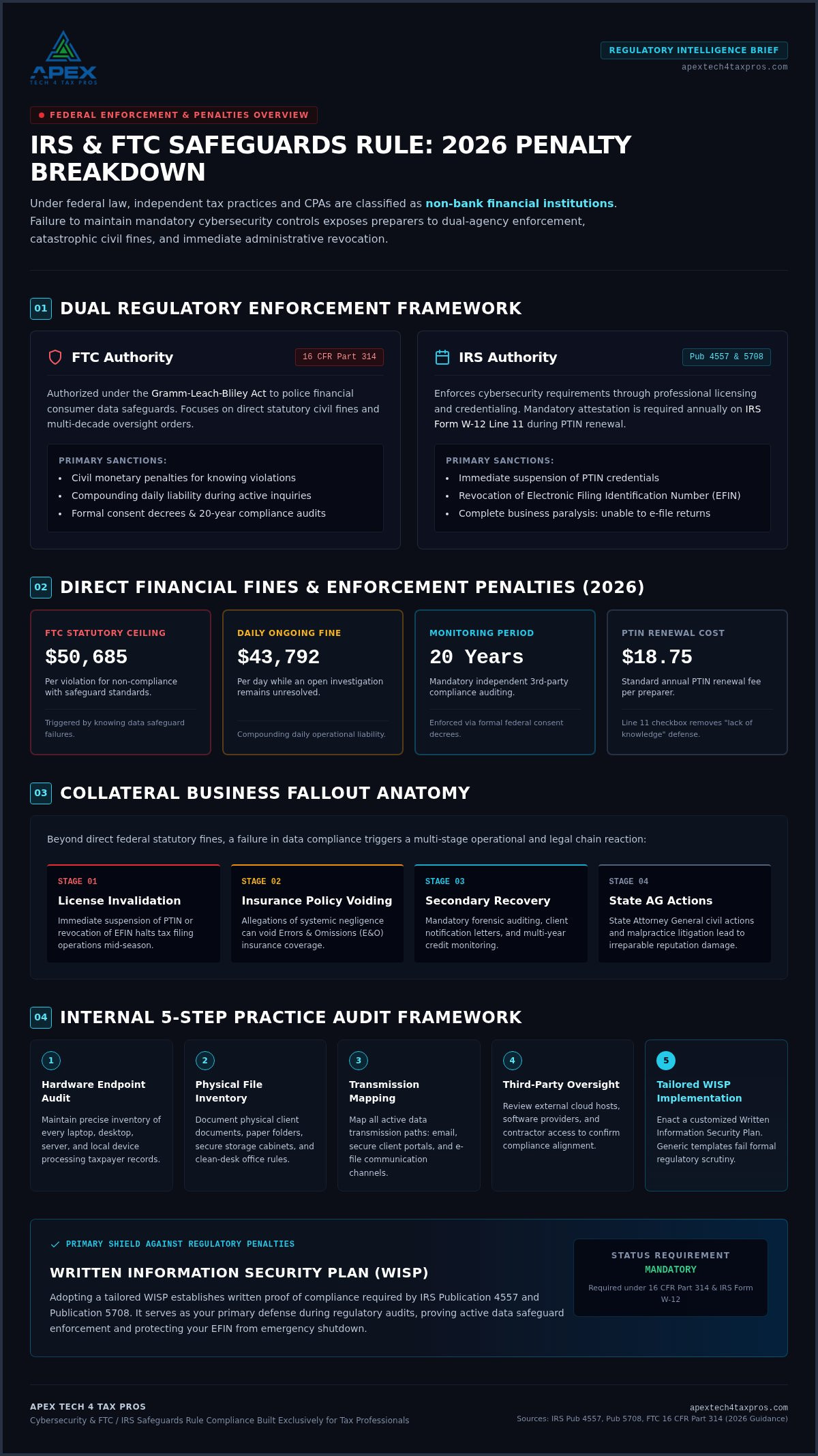
- Understand the specific triggers for irs safeguards rule penalties, which can reach $50,685 per violation and $43,792 per day for ongoing non-compliance.
- Implement a five-step internal audit to inventory your hardware, client files, and data transmission paths to identify firm vulnerabilities.
- Learn why a customized Written Information Security Plan (WISP) is required to pass a regulatory review and why generic templates often fail.
What are the IRS Safeguards Rule penalties for tax preparers in 2026?
Many tax professionals view themselves simply as tax preparers, but federal law categorizes your national practice as a non-bank financial institution. This classification triggers strict data protection requirements that, if ignored, lead to severe irs safeguards rule penalties. Federal regulators penalize data negligence through dual-agency statutory fines and administrative revocations. Achieving full compliance isn’t just about checking a box; it provides genuine operational relief by eliminating the constant dread of federal inquiries or sudden audits that could disrupt your peak season productivity.
The Dual Enforcement Framework: FTC Civil Penalties vs. IRS Authority
The Federal Trade Commission (FTC) holds primary enforcement power under 16 CFR Part 314, which stems from the Gramm-Leach-Bliley Act. While the FTC focuses on civil monetary fines, the IRS integrates these standards through Publication 4557 and Publication 5708 guidelines. You certify your awareness of these requirements every year on IRS Form W-12 Line 11 during your PTIN renewal. This is a formal attestation that removes “lack of knowledge” as a legal defense, making the irs safeguards rule penalties much harder to contest in a court of law or during a professional hearing.
Direct Administrative Sanctions: Loss of PTIN and EFIN Revocation
The IRS doesn’t need to issue a fine to shut you down. If a security review finds your office lacking, they can immediately suspend your PTIN or revoke your Electronic Filing Identification Number (EFIN). An EFIN revocation causes total business paralysis because you can’t transmit returns to the IRS, effectively closing your doors mid-season. Adopting a custom WISP establishes the written proof of compliance needed to protect your credentials during these reviews. This document serves as your primary shield, proving that your firm takes taxpayer data protection seriously and has professional remedies in place for any identified risks.
How much are the FTC Safeguards Rule fines for tax preparers in 2026?
The financial burden of non-compliance extends far beyond a simple fine. You must account for statutory civil penalties, administrative losses, and forensic recovery expenses that arise during a breach investigation. For 2026, federal penalty rates reach up to $50,685 per violation. These costs escalate quickly, as ongoing failure fines can accumulate up to $43,792 per day while an investigation remains open. These figures represent the direct impact, yet the indirect operational costs often prove even more damaging to your firm’s bottom line.
FTC Statutory Penalties: Daily Compounding Fines and Enforcement Orders
The FTC Safeguards Rule empowers regulators to calculate civil monetary penalties based on knowing violations of data safeguards. Beyond the immediate cash outlay, firms often face formal consent decrees. These orders mandate twenty years of independent third-party monitoring, which is both intrusive and expensive. It’s a heavy administrative weight that lasts for decades. Allegations of systemic negligence can also void your errors and omissions insurance policy, leaving your practice personally liable for every dollar of the irs safeguards rule penalties.
Collateral Business Fallout: Malpractice Claims and Irreparable Reputation Damage
Regulatory fines are only one facet of the risk. State attorney general civil actions often follow federal inquiries, creating a second wave of litigation. You’ll also face secondary recovery expenses like mandatory forensic auditing, client notification letters, and multi-year credit monitoring for affected taxpayers. The resulting client attrition usually causes irreparable reputation damage that takes years to rebuild. You can protect your firm’s future by scheduling a WISP IT system assessment to locate hidden liabilities before they trigger these irs safeguards rule penalties. Taking proactive steps now ensures your practice remains a secure and trusted partner for your clients.
How do I audit my tax practice to prevent IRS Safeguards Rule penalties?
Preventative security requires a systematic approach to your office operations rather than guesswork. Implementing an internal five-step audit framework lets you discover operational vulnerabilities before federal regulators do. This process centers on precise inventory procedures for tracking hardware endpoints, physical client files, and active data transmission paths. It’s equally vital to review third-party cloud workflows to ensure your tax preparation software vendors maintain identical data safety standards. Your entire internal evaluation should map directly to federal benchmarks, which we detail extensively in our guide on IRS WISP requirements.
Step-by-Step Risk Assessment for Tax Office Vulnerabilities
Begin your audit by cataloging every workstation, local server, backup drive, and mobile device that handles taxpayer data. Look closely for common procedural gaps that often slip through the cracks during the frantic tax season. These include shared office passwords, outdated antivirus programs, and unencrypted email transmissions of sensitive financial records. Documenting this structured risk evaluation provides essential written proof of your proactive compliance efforts, which can significantly mitigate potential irs safeguards rule penalties if an unexpected security incident occurs.
Implementing Core Technical Safeguards Mandated by Publication 4557
Once you map your data paths, you must deploy the specific technical controls required by IRS Publication 4557. First, enforce mandatory multi-factor authentication across all tax software and corporate email systems. Second, verify full-disk encryption on all stationary workstations, laptops, and off-site backup storage units. Finally, protect your physical workspace from external digital threats. You can secure your perimeter by deploying a hardened secure office network to block unauthorized lateral data movement. To ensure your technical controls meet federal standards, book a professional IT assessment with our experienced team today.
Building a Penalty-Proof Security Posture with a Tailored WISP
A Written Information Security Plan (WISP) serves as more than just a regulatory requirement. It’s the primary shield protecting your livelihood from the irs safeguards rule penalties discussed throughout this guide. By tailoring this plan to your specific firm operations, you show federal auditors that your security measures are intentional rather than accidental. We recommend implementing layered endpoint defenses that work alongside your WISP to isolate sensitive tax returns from compromised local equipment. This structured approach creates a resilient environment that withstands modern cyber threats while satisfying the clinical precision required by federal oversight bodies.
Why Generic Templates Fail and Custom WISPs Protect Your Firm
Auditors frequently scrutinize generic boilerplate language that fails to reflect actual office workflows. If a WISP describes security protocols that your staff doesn’t actually follow, it becomes a liability rather than a defense during an investigation. Custom security documentation establishes a defensible standard of professional care by detailing your firm’s specific hardware, software, and data handling procedures. An active, tailored WISP transforms compliance from an abstract risk into a recognized, professional defense.
Deploying Managed Virtual Infrastructure and Ongoing Staff Training
Technical isolation represents a critical shift in how modern tax offices operate. Adopting a secure virtual desktop isolates taxpayer records from vulnerable local machines, ensuring that a single malware infection on a home laptop doesn’t lead to a catastrophic firm-wide breach. Even the strongest technical architecture requires a vigilant team. The law mandates structured cybersecurity awareness training to prevent phishing compromises that often bypass traditional firewalls. By combining these managed services with behavioral education, you eliminate the threat of compounding irs safeguards rule penalties. You don’t have to face these regulatory burdens alone. Secure your compliance posture today to ensure your practice remains both resilient and profitable through 2026 and beyond.
Secure Your Practice Against Regulatory Oversight
Protecting your tax practice in 2026 requires more than basic antivirus software. You’ve seen how the dual enforcement roles of the FTC and IRS create a high-stakes environment where negligence leads to EFIN revocation and massive daily fines. Understanding the full weight of irs safeguards rule penalties is the first step toward building a resilient firm. Our team brings over two decades of specialized IT security and federal compliance expertise directly to your office. We provide a comprehensive turnkey security stack built specifically to satisfy IRS Publication 4557 and FTC standards, ensuring your data remains encrypted and your workflows stay audit-ready.
Don’t wait for a regulatory inquiry to discover vulnerabilities in your current setup. You can take control of your compliance today and replace anxiety with professional confidence. Book a WISP Assessment with Apex Tech 4 Tax Pros to establish your primary regulatory shield. Your clients trust you with their most sensitive information; it’s time to ensure that trust is backed by an unbreakable defense strategy. You’ve worked hard to build your practice, and we’re here to help you protect it.
Frequently Asked Questions
Can the IRS really revoke my EFIN for not having a WISP?
Yes, the IRS considers a Written Information Security Plan (WISP) a mandatory requirement for all Electronic Return Originators. If you fail an office review or a security audit and cannot produce a compliant plan, the IRS has the authority to suspend or permanently revoke your Electronic Filing Identification Number (EFIN). This administrative sanction effectively shuts down your ability to transmit tax returns, causing immediate business paralysis during the filing season.
How much can the FTC fine a tax preparer for Safeguards Rule non-compliance?
The Federal Trade Commission can assess civil monetary penalties of up to $50,685 per violation for non-compliance with the Safeguards Rule. These irs safeguards rule penalties often escalate because the FTC treats each day of continued non-compliance as a separate violation, which can cost up to $43,792 daily. Beyond these fines, practitioners typically face twenty year consent orders requiring biennial independent audits, which adds significant long term administrative costs to your practice.
Are home-based and solo tax preparers exempt from Safeguards Rule penalties?
No, home-based and solo practitioners aren’t exempt from the core requirement to maintain a Written Information Security Plan. While firms with data on fewer than 5,000 consumers are exempt from specific administrative tasks, like annual reporting to a board, they must still implement the technical and physical safeguards required by law. Every paid preparer with a PTIN must comply with federal data protection standards to avoid professional sanctions and EFIN suspension.
What happens if a tax preparer suffers a data breach without a WISP?
Suffering a data breach without a WISP significantly increases your legal and financial exposure. Regulators view the absence of a plan as evidence of willful neglect, which can trigger the maximum irs safeguards rule penalties and void your professional insurance coverage. You’ll also be required to notify all affected taxpayers and the FTC if the breach involves unencrypted data for 500 or more consumers, leading to massive forensic costs and client attrition.
Does checking the WISP box on Form W-12 protect me from an IRS audit?
Checking the box on Form W-12 Line 11 doesn’t protect you from an audit; instead, it serves as a legal attestation that you’re aware of the WISP requirement. If you check this box but don’t actually have a plan in place, you’re certifying a false statement to the federal government. This can lead to perjury charges or immediate EFIN suspension if the IRS conducts a random security review or office inspection.