
What if the biggest threat to your tax practice isn’t a high-tech hacker, but a missing piece of paper? Many independent preparers assume that managing cybersecurity on a small firm budget requires choosing between hiring expensive IT consultants and risking heavy IRS penalties. The truth is that you can achieve full compliance with IRS Publication 4557 and the FTC Safeguards Rule by focusing on a professional Written Information Security Plan (WISP) and high-impact security basics. You don’t need a six-figure tech budget to protect your PTIN and your clients’ sensitive data; you just need a methodical, documented strategy.
I understand how overwhelming it feels to stare at complex federal regulations while trying to keep your overhead low. It’s frustrating when the security solutions you see online feel like they’re built for massive corporations rather than a local tax office. This guide will show you how to prioritize your spending on mandatory tools versus optional extras so you can finally stop worrying about compliance audits. We’ll walk through a clear roadmap for budget-friendly security, ensuring your firm meets every legal standard while keeping your hard-earned revenue where it belongs.
Key Takeaways
- Learn why managing cybersecurity on a small firm budget is about smart risk assessment rather than buying every tool on the market.
- Understand how a professional Written Information Security Plan (WISP) serves as your primary defense for IRS Publication 4557 and FTC Safeguards Rule compliance.
- Discover why simple, low-cost steps like Multi-Factor Authentication (MFA) provide the highest return on investment for your data security.
- See how seasonal or yearly subscriptions can help you spread out compliance costs while avoiding unnecessary spending on redundant software.
How Can Small Tax Firms Balance Cybersecurity with Budget Constraints?
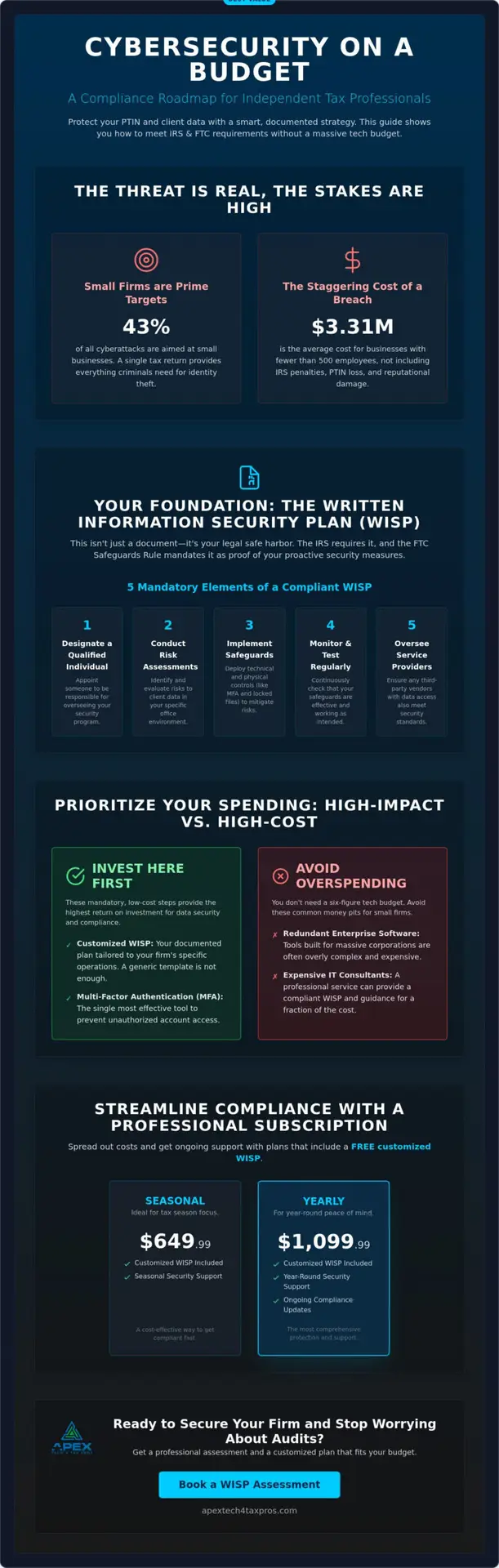
Managing cybersecurity on a small firm budget starts with identifying mandatory federal requirements versus optional tools. You don’t need the same infrastructure as a global bank to keep your clients safe. Instead, focus on a risk-based approach that prioritizes the specific mandates set by the IRS and FTC. This shifts the focus from an infinite tech expense to a manageable administrative process. Achieving compliance offers a profound sense of relief from the burden of potential data breach costs. For businesses with fewer than 500 employees, the average cost of a breach reached $3.31 million in 2026. Investing in a structured plan is simply good business sense.
The IRS requires every professional tax preparer to have a Written Information Security Plan (WISP) regardless of their annual revenue or staff size. This requirement stems from the broader framework of Information security management, which helps organizations protect sensitive data through documented policies. By focusing on these core legal requirements first, you ensure your PTIN remains secure without overspending on redundant software.
Why Small Firms Are High-Value Targets for Cybercriminals
Many independent preparers believe they’re too small to target, but the data suggests otherwise. 43% of all cyberattacks target small businesses. A single tax return is a goldmine on the dark web because it provides everything a criminal needs for identity theft, including Social Security numbers and bank account details. Hackers don’t usually hand-pick their victims. They use automated tools to scan the internet for vulnerabilities in small, unmanaged networks. If your office has an open door, they’ll find it.
The Cost of Non-Compliance vs. The Cost of Security
It’s helpful to contrast the predictable price of a Customized WISP with the devastating impact of a regulatory audit or a data breach. Beyond IRS penalties and the potential loss of your PTIN, the reputational damage can be permanent. Clients trust you with their most private financial details. A security incident breaks that bond. This often leads to a loss of business that far outweighs the cost of professional compliance services.
How Do I Build a Foundation Using a WISP for IRS Publication 4557 Compliance?
Think of your Written Information Security Plan (WISP) as the glue that holds your entire office security strategy together. It isn’t just a static file you save on a hard drive and forget; it’s a living roadmap that describes exactly how your firm protects client data. While IRS Publication 4557 sets the standard for taxpayer data protection, the FTC Safeguards Rule is the actual law that mandates these protections. Having a documented plan serves as a legal safe harbor because it proves you’ve taken proactive steps to secure information. This approach is rooted in the principles of Information security management, which helps small firms turn a complex legal requirement into a manageable administrative process.
Can I Create a Compliant WISP Without a Massive Budget?
You can certainly start the process by using a FREE WISP Download Template to get the basics on paper. This is a smart first step when managing cybersecurity on a small firm budget. However, a generic template usually isn’t enough to satisfy an auditor. The IRS looks for firm-specific details, such as who has access to certain files and which specific software you use for e-filing. If you’re unsure how to tailor these documents to your unique office layout, a Customized WISP ensures every regulatory box is checked without the high cost of a dedicated IT department.
What Are the Mandatory Elements of a Tax Office Security Plan?
The FTC requires five core components in every plan, including regular risk assessments and service provider oversight. You must also designate a Qualified Individual to oversee the security program. This person doesn’t need to be a technical genius; they simply need to be responsible for maintaining and updating the plan as your firm grows. For practical guidance on these roles, the FTC offers resources on Cybersecurity for Small Business that are very helpful for independent preparers. If you’re ready to move from confusion to clarity, you can always reach out for a quick assessment of your current documentation to see where you stand.
What Are the Most High-Impact, Low-Cost Strategies for Securing Client Data?
Managing cybersecurity on a small firm budget isn’t about buying every gadget; it’s about closing the easiest doors hackers use. Multi-Factor Authentication (MFA) is your single most cost-effective defense. It’s usually free to enable on your email and tax software, yet it stops the vast majority of automated password attacks. Beyond tools, your team is your biggest variable. Since human error drives most data breaches, investing in Cybersecurity Awareness Training turns your staff into a proactive defense line rather than a vulnerability.
You should also adopt a ‘Least Privilege’ access model. This simply means giving people access only to the files they need for their specific job. Even in a two-person office, separating administrative tasks from daily tax prep reduces the damage if one account is compromised. This approach aligns with the IRS data security plan requirements, which emphasize that security is a combination of technical controls and office policy.
How Can I Secure My Digital Environment on a Shoestring Budget?
Managing cybersecurity on a small firm budget also means being smart about your home office setup. If you or your staff work from home, don’t let client data sit on personal laptops. Using a Secure Virtual Desktop keeps sensitive information in a protected cloud environment rather than on local hard drives. Combine this with a password manager and encrypted email to create a professional security stack without the enterprise-level price tag.
How Do I Implement Physical Security to Protect Laptops and Paper Records?
Physical security is just as vital as digital defense. Ensure your operating system’s ‘Full Disk Encryption’ is turned on; it’s a free feature that makes data unreadable if a laptop is stolen. Don’t forget the basics: lock your filing cabinets and use privacy screens in public areas. If you’re ready to see how these pieces fit your specific office, book an IT Assessment today to identify your highest-priority gaps.
Streamlining Compliance: Professional Subscriptions and Long-Term Security
Managing cybersecurity on a small firm budget doesn’t have to be a recurring administrative headache. Many preparers find that moving toward a subscription model for their security needs is the most efficient way to spread out costs. Our Seasonal and Yearly subscriptions allow you to maintain a high standard of protection without the massive upfront investment typically associated with enterprise IT departments. This ‘set it and forget it’ approach ensures your documentation stays current with evolving federal mandates while you focus on serving your clients during the busiest months of the year.
Before you purchase another piece of security software, it’s vital to understand what your office actually needs. An IT Assessment serves as a professional diagnostic tool that prevents wasted spending on redundant tools. We often see firms paying for three different services that all perform the same function. By identifying these overlaps, you can reallocate those funds toward mandatory requirements like professional WISP maintenance and secure backups.
Beyond staying out of trouble with regulators, a robust security posture is a significant marketing advantage. High-value clients are increasingly concerned about identity theft and data privacy. When you can confidently explain that your firm follows a professional Written Information Security Plan and uses advanced encryption, you build a level of trust that sets you apart from the competition. It’s not just about avoiding a penalty; it’s about proving you’re a disciplined protector of your clients’ financial lives.
Choosing Between DIY and Professional Compliance
Many independent preparers consider the DIY route to save money, but the time-cost of researching every IRS update is substantial. A $649.99 Seasonal subscription often costs less than the billable hours you’d lose trying to interpret Publication 4557 yourself. Professional plans include the customized WISP required for your PTIN renewal, ensuring you meet the IRS standards without the stress of manual drafting. This specialized support is a core part of our mission to provide relief from the regulatory burden for tax professionals.
Your Next Steps Toward a Secure Tax Practice
The best time to secure your practice is before the next filing season begins. Start by conducting a thorough risk assessment to see where your vulnerabilities lie. If you’re feeling overwhelmed by the technical jargon or the conflicting requirements of the Safeguards Rule, we’re here to help. Our Dallas-based team has over 20 years of combined experience in both tax and IT, offering a supportive and pragmatic approach to your firm’s safety.
Reach out to us at info@at4tp.com for a consultation that respects your budget and your time. You can also Book a WISP Assessment today to ensure your practice is fully compliant and secure for the 2026 tax season.
Take Control of Your Firm’s Security Today
Security isn’t a one-time purchase but a disciplined habit that grows with your practice. By focusing on a professional WISP and high-impact tools like multi-factor authentication, you’ve already done the heavy lifting to protect your clients. Managing cybersecurity on a small firm budget is entirely possible when you stop trying to buy every tool on the market and start focusing on what the IRS and FTC actually require for compliance. It’s about working smarter, not spending more, to achieve that essential relief from regulatory burdens.
Take the next step to protect your legacy and your peace of mind. Our Dallas-based team brings over 20 years of combined tax and IT experience to help you stay compliant with IRS Publication 4557. We specialize in creating documentation specifically for independent preparers and small firms, so you don’t have to navigate these complex federal regulations alone. This supportive approach ensures your data is in safe, capable hands while you focus on the success of your clients.
Secure your firm with a Customized WISP for the 2026 season and get back to what you do best. You’ve worked hard to build your practice; let’s make sure it stays safe and successful for many years to come. We’re here to help you every step of the way.
Frequently Asked Questions
Is a WISP required for a solo tax preparer with no employees?
Yes, every professional tax preparer is required to have a Written Information Security Plan regardless of their firm size. The IRS and FTC consider anyone who handles sensitive taxpayer data to be a financial institution under the law. This means even if you work alone from a home office, you must document exactly how you protect that information. It’s a foundational step in managing cybersecurity on a small firm budget because drafting your initial policies primarily costs time rather than hardware.
What is the cheapest way to comply with the FTC Safeguards Rule?
The most cost-effective way to comply is to prioritize administrative documentation and free technical settings already available to you. Start by creating your WISP and enabling Multi-Factor Authentication on every professional account. Most modern operating systems also include free full disk encryption tools like BitLocker or FileVault. By combining these built-in tools with a solid written plan, you meet the core legal requirements without purchasing expensive enterprise-grade software packages that your firm might not actually need.
Do I need to hire a full-time IT person to manage my cybersecurity?
No, most small tax practices don’t need a full-time IT staff member to stay secure and compliant. You can effectively manage your security by using specialized compliance subscriptions or by partnering with a firm that understands the unique needs of the tax industry. This approach allows you to access professional expertise for a fraction of the cost of a full-time salary. It’s often more effective because general IT professionals may not be familiar with the specific IRS Publication 4557 mandates.
Can the IRS fine me if I don’t have a Written Information Security Plan?
Yes, the IRS can impose significant penalties for non-compliance with data security requirements. Beyond potential financial fines, failing to have a WISP can jeopardize your PTIN renewal and your ability to e-file. If a breach occurs and you don’t have a documented plan, you could face much harsher scrutiny from federal regulators. Having your plan in place acts as a critical safety net that proves you have taken reasonable, proactive steps to protect taxpayer information.
How often should a small firm update its cybersecurity plan?
You should review and update your cybersecurity plan at least once a year. It’s also necessary to refresh the document whenever you make significant changes to your office operations, such as hiring new staff or switching to a new tax software provider. Regular updates ensure that your plan remains a living document that accurately reflects your current security environment. This consistent maintenance is a key part of managing cybersecurity on a small firm budget over the long term.