
What if your most effective marketing tool for the 2026 tax season isn’t a referral program, but a simple letter about cybersecurity? You can professionally communicate your protection measures by using a professional client data security assurance letter template that translates technical IRS Publication 4557 requirements into plain English for your clients. This approach answers their unspoken concerns about identity theft while proving your firm meets the rigorous standards of the FTC Safeguards Rule.
We know how overwhelming it feels to keep up with federal mandates while trying to maintain a personal, warm connection with the families and businesses you serve. It is natural to worry that talking about data security might cause unnecessary alarm. However, being transparent about your “Security Six” controls actually builds deeper trust and positions you as a disciplined protector of their sensitive financial information. You aren’t just filing forms; you’re guarding their digital lives.
I’m going to show you how to turn mandatory compliance into a major competitive advantage for your practice. We will walk through the specific language that satisfies regulators and provide a ready-to-use template that sounds both professional and reassuringly human.
Key Takeaways
- Understand how a security assurance letter acts as a professional handshake, translating your technical safeguards into a message of trust that aligns with the transparency goals of the FTC Safeguards Rule.
- Learn how to highlight essential protections like AES-256 encryption and Multi-Factor Authentication (MFA) to demonstrate that you are using the industry’s most robust defenses.
- Access a professional client data security assurance letter template that you can easily customize to match your firm’s unique personality while meeting 2026 IRS standards.
- Discover a simple two-step process to audit your current technology stack, ensuring your firm’s actual security measures perfectly align with your written promises.
- Learn why a client letter is a vital communication tool, but a Customized Written Information Security Plan (WISP) remains the ultimate legal proof of your firm’s compliance.
What is a client data security assurance letter for tax pros?
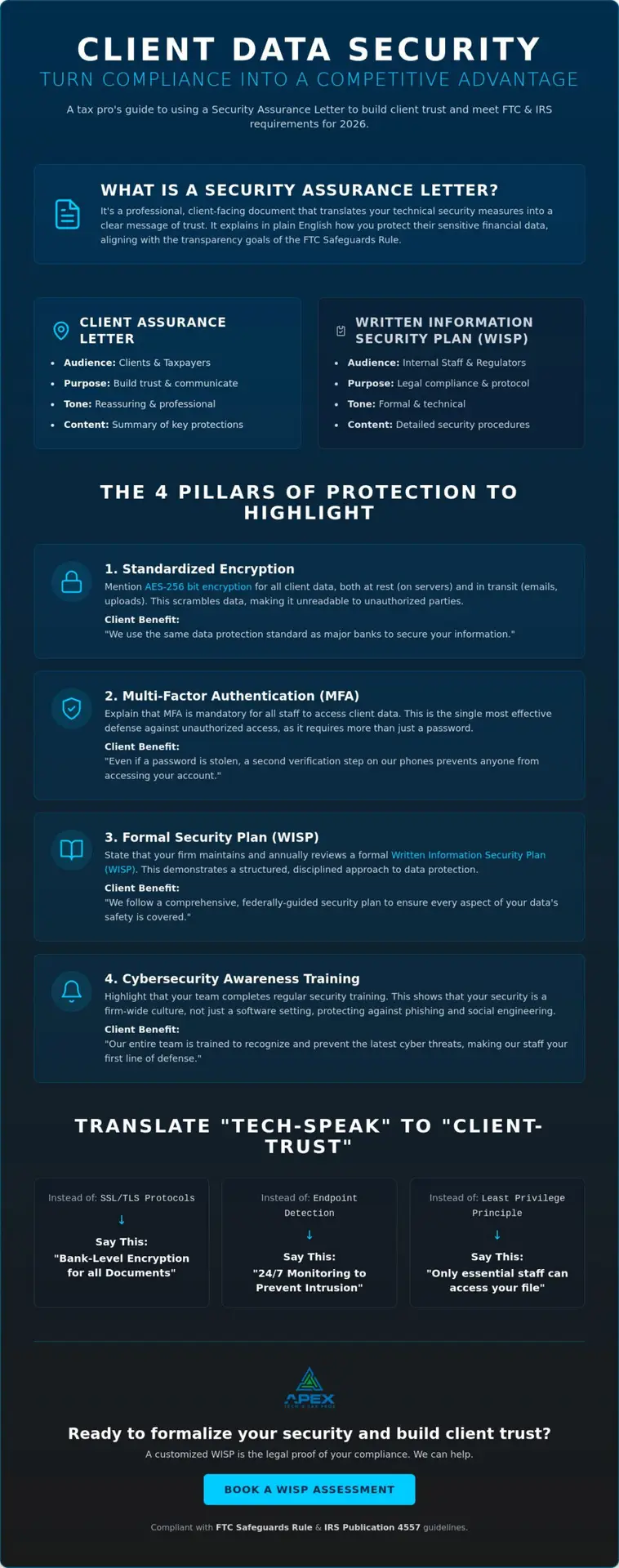
A client data security assurance letter is a formal statement that details the specific technical and administrative safeguards your firm employs to protect taxpayer information. While it isn’t a legal requirement in the same way as a Written Information Security Plan (WISP), it serves a vital role in fulfilling the transparency spirit of the FTC Safeguards Rule. This rule essentially classifies tax preparers as financial institutions, requiring us to demonstrate how we protect non-public personal information. The assurance letter is a bridge between your technical security and your client’s peace of mind.
It is crucial to distinguish this document from your internal Customized WISP. Your WISP is a detailed, internal-facing manual that guides your staff through specific protocols and regulatory requirements. In contrast, the letter is a client-facing summary that uses clear language to explain your adherence to fundamental information security principles. Using a professional client data security assurance letter template ensures you hit all the right notes without overwhelming your clients with technical jargon or exposing internal vulnerabilities.
Why 2026 is the year to formalize your security communication
We’ve seen a sharp rise in sophisticated phishing attacks specifically targeting independent tax offices. These criminals aren’t just looking for simple passwords; they’re hunting for firm-wide access to client databases. A proactive letter reduces security anxiety during the high-pressure weeks of tax season by showing clients you’re already three steps ahead of these threats.
Today’s clients are more tech-savvy than ever. They’ve seen the news about global data breaches and they now expect to see mentions of Multi-Factor Authentication (MFA) and high-level encryption when they hand over their life’s data. Addressing these concerns through a professional client data security assurance letter template isn’t just about compliance; it’s about proving you value their privacy as much as they do.
Key components of an IRS-compliant security assurance letter
A high-quality client data security assurance letter template should focus on four pillars that demonstrate your firm’s vigilance. First, you must mention standardized encryption. We use AES-256 bit encryption for all data, whether it’s sitting on our servers or traveling between our office and your computer. This is the same standard used by major financial institutions to keep data scrambled and unreadable to hackers.
Second, emphasize Multi-Factor Authentication (MFA). It remains the most effective defense against unauthorized access because it requires more than just a stolen password to get in. Your letter should also reassure clients that your firm maintains a formal Written Information Security Plan (WISP) that is reviewed every year. Finally, highlight that your entire team completes regular Cybersecurity Awareness Training. This proves that your security isn’t just a software setting; it’s a culture of protection.
Translating technical safeguards into client benefits
Technical jargon often creates a barrier rather than building trust. When you use your client data security assurance letter template, try to swap complex terms for relatable ones. Instead of discussing SSL/TLS protocols, tell your clients you use “bank-level encryption for your documents.” Rather than “Endpoint Detection,” describe it as “24/7 monitoring to prevent unauthorized intrusion.” You should also explain the “Least Privilege” principle by stating that only the specific staff members working on their file have access to their sensitive data. This makes the security feel personal and intentional.
Referencing federal mandates correctly
You don’t need to sound like a lawyer to prove you’re compliant. You can naturally mention that your firm follows the guidelines in Publication 4557, Safeguarding Taxpayer Data to ensure every federal standard is met. Stating that your office is fully compliant with the FTC Safeguards Rule provides an extra layer of professional authority. If you aren’t sure where your current tech stack stands, you can always request a professional risk assessment to verify your safeguards before sending out your letters.
How to use our client data security assurance letter template
Implementing a client data security assurance letter template is a methodical process that starts with an honest audit of your current tech stack. You shouldn’t promise a safeguard that hasn’t been fully deployed in your office yet. We recommend using a structured resource like the AICPA cybersecurity checklist to verify your firewalls, MFA settings, and encryption levels. Once you’ve confirmed your defenses, customize the warm introduction to reflect your firm’s unique personality. This document serves as a conversation, not just a legal notice.
Distribution should be intentional and professional. We suggest uploading the letter to your secure client portal or including it as a standard welcome PDF for new clients during onboarding. This sets a tone of vigilance from day one. Finally, remember that your security posture is dynamic. You must update the letter annually, ideally coinciding with your Annual Risk Assessment. This ensures your client-facing promises stay perfectly aligned with your actual technical infrastructure.
Sample template: A knowledgeable colleague’s approach
A high-quality template focuses on a partnership between the firm and the client. Start with a clear header including your [Firm Name], the [Date], and a summary of [Specific Safeguards] like your AES-256 encryption. We always suggest adding a “What you can do” section to the letter. This encourages clients to take their own security seriously by using strong passwords and enabling MFA on their personal accounts.
Don’t forget to add a personal touch that emphasizes your firm’s heritage. Mentioning our team’s 20 plus years of combined tax and IT experience reminds clients they’re working with seasoned professionals who understand the stakes. Before you send your first batch of letters, it’s wise to verify your compliance. You can Book a WISP Assessment today to ensure your firm’s security is as robust as your letter claims.
Beyond the letter: Turning assurance into a robust security culture
While your client data security assurance letter template serves as a professional promise to your clients, it’s only as strong as the documentation backing it up. In the eyes of the IRS and the FTC, a letter is a helpful communication tool, but a Customized WISP is the legal proof of your compliance. It’s the difference between stating you’re secure and proving you’ve followed federal mandates. We view cybersecurity as a relief from a burden. When the right systems are in place, you can focus on tax law while we manage the technical shields.
To help you bridge this gap, we offer Seasonal ($649.99) and Yearly ($1,099.99) subscriptions that include a free customized WISP. This ensures your firm isn’t just sending a polite notice, but is operating with a fully compliant security program that could even lead to a 30% to 50% reduction in your cyber insurance premiums. You should Book a WISP Assessment to ensure your firm’s daily operations match the high standards described in your client data security assurance letter template.
The role of secure infrastructure in client trust
A robust security culture requires more than just paperwork. Implementing a Secure Virtual Desktop makes protection automatic by isolating sensitive data from local hardware risks. Likewise, a Secure Office Network ensures every device in your building is shielded from external threats. These aren’t just technical upgrades; they are the foundation of the trust your clients place in you every year. If you’re ready for a compliance check-up, email our Dallas-based team at info@at4tp.com to schedule a consultation.
Strengthening Your Firm’s Digital Handshake
Your firm’s commitment to data protection is one of your most valuable assets. By using a professional client data security assurance letter template, you translate complex IRS mandates into a message of care and competence. This simple act of transparency doesn’t just satisfy the spirit of the FTC Safeguards Rule; it transforms compliance from a seasonal headache into a year round marketing advantage. For firms looking to leverage these trust signals for growth, Exclusive Business Marketing can help integrate your security standards into a compelling brand message. It tells your clients that their sensitive information is being guarded by a disciplined, vigilant professional.
While a letter builds trust, a robust Written Information Security Plan (WISP) provides the legal backbone for your practice. Our team brings over 20 years of combined tax and IT experience to help you navigate IRS Publication 4557 and 5708 requirements with ease. We specialize in making security feel like a relief rather than a burden, ensuring your technical reality always matches your professional promises. If your organization requires validation against international standards like ISO 27001 or NIS2, you can visit CWORT to explore their enterprise compliance platform. We are here to ensure you meet every federal standard while keeping your focus on your clients.
Book your WISP Assessment and get your customized security plan today. Our Yearly Subscriptions even include a free customized WISP to get you fully compliant right away. You have worked hard to build your practice; let’s work together to protect its future and your clients’ peace of mind.
Frequently Asked Questions
Is a data security assurance letter required by the IRS?
No, the IRS doesn’t explicitly mandate a client-facing letter, but it does require you to implement the technical safeguards described within it. Federal law under the FTC Safeguards Rule requires tax professionals to maintain a comprehensive information security program. Sending a letter based on a professional client data security assurance letter template helps you fulfill the transparency expectations of these regulations. It proves to your clients that you’re meeting federal standards without them having to ask.
What is the difference between a WISP and a security assurance letter?
A Written Information Security Plan (WISP) is your internal, legally required document that details specific protocols for staff and regulators. In contrast, a security assurance letter is a client-facing summary that translates those technical details into plain English. While the WISP is your actual legal shield and proof of compliance, the letter acts as a professional handshake. It reassures your clients that their sensitive financial data is being handled with the highest level of care.
How often should I send a security update to my tax clients?
You should send a security update to your clients at least once a year, ideally just before the start of the busy tax season. This timing reminds them of your commitment to their privacy before they hand over their sensitive documents. If your firm implements significant new protections, such as shifting to a secure virtual desktop or updating your encryption standards, it’s also appropriate to send a mid-year update. Keeping clients informed throughout the year helps maintain a culture of security.
Can I use a generic business security template for my tax office?
It isn’t advisable to use a generic template because tax professionals are subject to specific federal mandates that other businesses don’t face. Your letter needs to reflect the unique requirements of IRS Publication 4557 and the FTC Safeguards Rule. Using a specialized client data security assurance letter template ensures you mention industry-specific controls like the “Security Six.” Generic business templates often overlook these nuances, which could leave your clients feeling under-protected or confused about your specific protocols.
What happens if I promise security in a letter but experience a breach?
If a breach occurs, your primary responsibility is to follow the reporting protocols outlined in IRS Publication 4557. This includes contacting your local IRS stakeholder liaison, the FBI, and local police. While the letter shows your intent to protect data, your internal WISP serves as the legal evidence that you took reasonable steps to prevent the incident. Demonstrating that you had a disciplined plan in place can help mitigate potential penalties and show clients that you handled the crisis with professional accountability.