
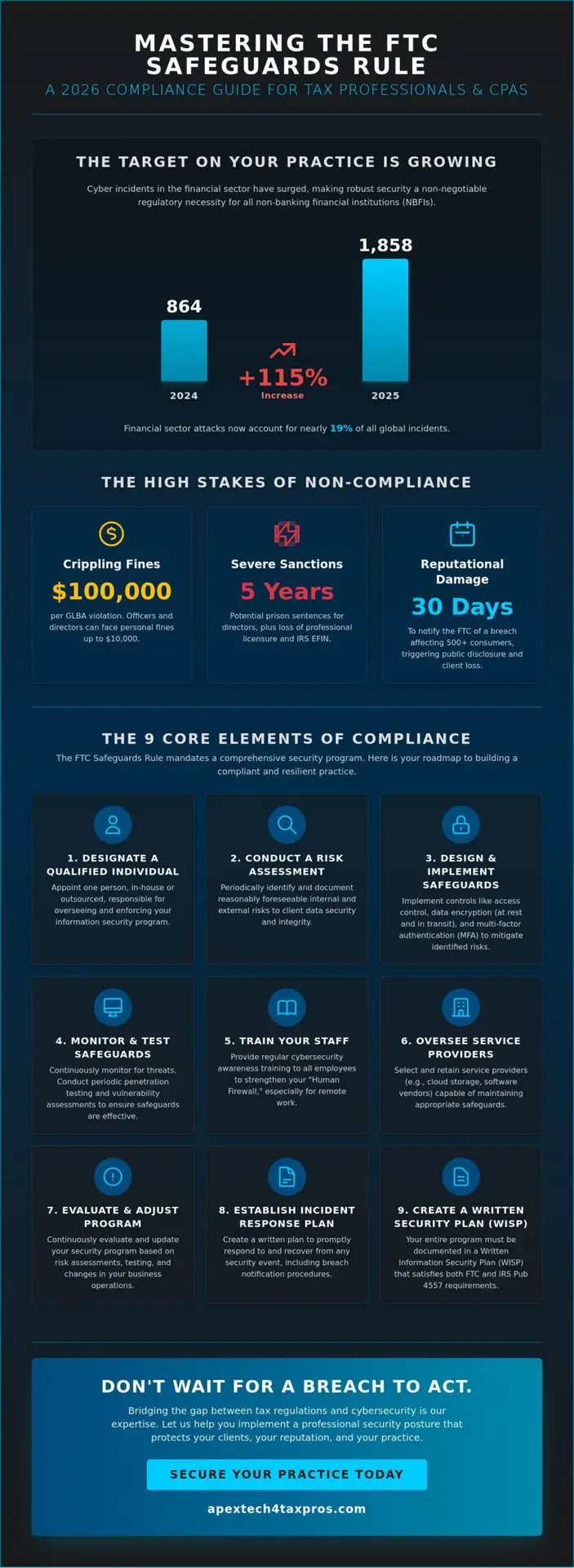
Cyber incidents in the financial sector more than doubled from 864 in 2024 to 1,858 in 2025, accounting for nearly 19% of all global attacks. If you feel like the target on your practice is growing, you’re right. Managing non-banking financial institution security has evolved from a simple IT task into a high-stakes regulatory necessity. You’ve likely spent hours worrying about the 30 day notification window for data breaches or the looming threat of a $100,000 penalty per GLBA violation. It’s a heavy burden for any professional to carry while trying to maintain a seamless workflow.
We understand that your primary focus is serving your clients; you shouldn’t have to be an IT expert to stay compliant. This guide provides the clarity you need to master the FTC Safeguards Rule and protect your firm’s data integrity. We’ll provide a clear roadmap for federal compliance by breaking down the essential components of a Written Information Security Plan (WISP) and the technical safeguards required to keep your practice secure through 2026. By bridging the gap between tax regulations and cybersecurity, we’ll help you secure your practice against sophisticated modern threats.
Key Takeaways
- Identify the specific federal mandates that classify tax professionals and CPAs as financial institutions under the updated FTC Safeguards Rule.
- Understand the nine core elements of compliance and the mandatory requirement to designate a “Qualified Individual” to oversee your security program.
- Learn how to develop a dynamic Written Information Security Plan (WISP) that satisfies both the FTC and IRS Publication 4557 requirements.
- Strengthen your firm’s “Human Firewall” by implementing mandatory annual risk assessments and tailored cybersecurity training for remote work environments.
- Master the technical safeguards and professional protocols necessary to achieve a high standard of non-banking financial institution security without disrupting your workflow.
Defining Non-Banking Financial Institutions (NBFI) and Security Mandates
The regulatory landscape for financial services has undergone a fundamental shift. In the past, robust cybersecurity was often viewed as a competitive advantage or a professional “best practice.” As of 2026, the Federal Trade Commission (FTC) has solidified these expectations into strict federal mandates. For practitioners, maintaining non-banking financial institution security is no longer optional. It’s a foundational requirement for staying in business. This shift reflects a growing recognition that data integrity is the bedrock of public trust. When a tax professional or CPA firm handles sensitive financial data, they aren’t just processing numbers; they’re guarding the personal identities and financial futures of their clients. The Financial Stability Oversight Council (FSOC) reinforced this in early 2026 by prioritizing an “activities-based approach” to regulation, focusing on what a firm does rather than just its size or charter.
Who Counts as an NBFI in 2026?
The definition of Non-Banking Financial Institutions (NBFI) under the Safeguards Rule is deceptively broad. It includes entities that many small business owners might not traditionally view as “financial” in the same way they view a local bank.
- Mortgage brokers and non-bank lenders.
- Tax preparation firms and CPAs.
- Investment advisors and financial planners.
- Payday lenders and check-cashing services.
The “ancillary services” rule is particularly critical. If your business significantly engages in providing financial products or services, the FTC likely considers you an NBFI. Size provides no shield here. Whether you’re a solo practitioner or a multi-state firm, the core security requirements apply once you handle customer information. The logic is simple: a client’s data is just as sensitive in a two-person tax office as it’s in a national brokerage firm. We believe in bridging the gap between these complex federal requirements and your daily operations, ensuring that your security posture protects your reputation as much as your data.
The Consequences of Security Non-Compliance
The stakes for negligence have never been higher. Under the Gramm-Leach-Bliley Act (GLBA), financial institutions can face fines reaching $100,000 per violation. Individual officers and directors can be held personally liable; they face fines up to $10,000 per violation and potential prison sentences of up to five years. Beyond these federal penalties, the IRS uses Publication 4557 as a benchmark for practitioner security. Failing to meet these standards doesn’t just invite an audit. It can lead to the loss of your professional licensure and irreparable reputational damage. A single breach affecting 500 or more consumers now requires an FTC notification within 30 days of discovery. This public disclosure often triggers a ripple effect that can dismantle a practice faster than any fine. With the financial services sector experiencing a 65% ransomware attack rate in 2024, regulators have moved toward an era of zero tolerance for inadequate safeguards.
The FTC Safeguards Rule: Mandatory Standards for Data Protection
The FTC Safeguards Rule provides the technical and administrative framework for protecting sensitive consumer data. Compliance isn’t a suggestion; it’s a structural requirement for any firm managing financial information. The rule consists of nine core elements designed to ensure data integrity. These include conducting thorough risk assessments, designing and implementing specific safeguards, and regularly testing those safeguards to ensure they remain effective against evolving threats. For tax professionals, this means moving beyond basic antivirus software and adopting a comprehensive security posture.
Continuous monitoring is a pivotal part of this strategy. In 2025, cyber incidents in the financial sector rose to 1,858 events. This 115% increase from the previous year proves that passive security is no longer sufficient. Firms must implement periodic penetration testing and vulnerability assessments to identify weaknesses before attackers do. Additionally, encryption is mandatory for all customer information. This applies to data at rest on your local servers or cloud storage and data in transit as it moves across the web. These technical safeguards are essential to maintaining non-banking financial institution security and preventing the unauthorized acquisition of unencrypted customer information.
The Qualified Individual Requirement
Every firm must designate a single “Qualified Individual” to oversee and enforce the information security program. This person is responsible for the program’s success and must provide regular, written reports to the board of directors or senior management at least annually. For many small firms, maintaining a high-level in-house expert is often impractical. The rule allows you to outsource this responsibility to a managed service provider. However, the firm still retains the ultimate responsibility for compliance. We often help practitioners bridge the gap between these high-level requirements and their daily operations by acting as that technical anchor. This ensures your security lead has the specialized expertise required for the tax industry.
Access Controls and Multi-Factor Authentication (MFA)
Access controls are the primary defense against unauthorized data acquisition. The “Principle of Least Privilege” dictates that employees should only have access to the specific data required for their job functions. This limits the potential damage if an individual account is compromised. Multi-factor authentication (MFA) is now a non-negotiable standard for any person accessing customer information or internal systems. It’s the most effective way to stop the 27.7% of phishing attempts directed at the financial sector. Managing third-party service provider risks is equally vital. You must ensure that your vendors maintain safeguards that meet the same rigorous standards you follow. This requires reviewing contracts and conducting due diligence on their security posture to ensure they don’t become a weak link in your chain.
The Written Information Security Plan (WISP): Your Compliance Foundation
The Written Information Security Plan (WISP) is the strategic anchor of any compliant practice. It’s not a “set it and forget it” template that sits in a drawer; it’s a living document that must evolve with your firm. A robust Written Information Security Plan (WISP) serves as the formal bridge between your technical IT settings and your daily office policies. While technical safeguards provide the “how,” the WISP provides the “why” and the “who.” This document is essential for maintaining non-banking financial institution security because it aligns your internal workflows with federal expectations.
IRS Publication 4557 explicitly benchmarks practitioner security against the WISP. If you face a professional liability audit or a data breach investigation, this plan is the first document an investigator will request. It demonstrates that you’ve acted with due diligence rather than negligence. We see many firms struggle with the technical translation of policy. A WISP ensures that when you claim to use encryption, your IT settings actually reflect that promise. It protects the firm by creating a clear, auditable trail of compliance.
Core Components of an Effective WISP
An effective plan begins with a comprehensive data inventory. You must identify exactly where sensitive customer information resides, whether it’s in your tax software, local servers, or cloud backups. Classification helps you prioritize your most vulnerable assets. Beyond data, your plan must outline specific employee management and training protocols. Since 49% of ransomware attacks in 2024 resulted in successful data encryption, your staff must know how to spot threats. Finally, an incident response procedure is mandatory. You need a clear, step-by-step guide for what happens when a breach occurs, including the specific 30 day notification steps required by the FTC.
Customization vs. Generic Templates
Generic templates are often worse than no plan at all because they create a false sense of security. A “canned” document that mentions hardware or software you don’t use will fail to protect you during an audit. Your WISP should be tailored to your specific software stack, whether you rely on Drake, Lacerte, or UltraTax. It must reflect your actual office workflow, including how you handle remote work and mobile device access. A Written Information Security Plan (WISP) is the mandatory primary defense in an IRS audit. By customizing your plan, you ensure that your non-banking financial institution security is as unique as your practice, providing a tailored shield against both cyber threats and regulatory scrutiny.
Risk Assessments and Cybersecurity Training: The Human Firewall
Annual risk assessments are a non-negotiable pillar of federal compliance. The FTC Safeguards Rule mandates that every institution conducts these evaluations to identify foreseeable risks to customer information. While technical tools are vital, they can’t account for the human element without a structured, documented review process. For a modern practice, this means evaluating how data flows through remote home offices and personal mobile devices. These endpoints are often the weakest links in your non-banking financial institution security posture. Because remote work has become a standard operational model, your assessment must scrutinize home Wi-Fi security and the physical security of devices used outside the office environment.
Conducting a Comprehensive Risk Assessment
A pragmatic risk assessment follows a logical, three-step progression that mirrors the meticulous nature of tax preparation. First, you must inventory every hardware and software asset that touches client data; this includes firm-issued laptops, employee tablets, and third-party cloud applications. Second, you identify potential internal and external threats. This includes everything from accidental data deletion by staff to sophisticated external ransomware groups. Finally, you evaluate the effectiveness of your current controls. If a gap exists between your current settings and the requirements of your WISP, you must close it immediately to maintain compliance. This process ensures that your safeguards are not just theoretical but functional and auditable.
Fostering a Culture of Cybersecurity Awareness
Staff training is the most cost-effective security layer available to your firm. Traditional once-a-year training videos are insufficient to combat the sophisticated threats of 2026. Your team needs continuous learning to recognize AI-powered social engineering and deepfake authentication bypasses. These scams are designed to trick even seasoned professionals into granting access to secure systems or transferring funds. By implementing simulated phishing exercises, you meet federal training mandates while building a “Human Firewall” that actively defends your practice. These simulations provide a safe environment for employees to learn from mistakes before a real attacker strikes.
We believe in empowering employees to report suspicious activity without fear of retribution. A culture of vigilance is far more effective than a culture of blame. When an employee flags a suspicious email or a strange login notification, they’re providing real-time intelligence that can prevent a catastrophic breach. If you’re unsure where to begin with your annual requirements, we can help you conduct a professional risk assessment that meets all federal standards. This proactive approach transforms your staff from a potential vulnerability into your strongest line of defense, ensuring that your non-banking financial institution security remains uncompromised and your client data stays protected.
Bridging the Gap: Implementing a Professional Security Posture
Transitioning from a state of vulnerability to secure compliance requires more than just installing software. It demands a holistic integration of technical safeguards and administrative oversight. By the time you reach the 2026 tax season, your firm’s non-banking financial institution security must be a functional reality, not just a document on a shelf. This transition marks the point where your Written Information Security Plan (WISP) becomes the operational heartbeat of your practice. It ensures that every team member understands their role in protecting data integrity and that your systems are engineered to withstand the 1,858 cyber incidents currently targeting the financial sector annually.
Secure Cloud Backup and Disaster Recovery
Many practitioners mistake file syncing services like Dropbox or OneDrive for a true backup solution. While these tools are excellent for collaboration, they often lack the versioning and air-gapped protection required for disaster recovery. In 2024, 49% of ransomware attacks on financial organizations resulted in successfully encrypted data. If your files sync a ransomware infection to the cloud, your data is lost. A professional security posture utilizes encrypted, off-site financial record storage that remains independent of your primary network. Encryption must meet federal standards for data at rest and in transit. More importantly, you must test your recovery speed. The “R” in backup stands for Recovery; having data is useless if it takes two weeks to restore during the peak of tax season. Your business continuity depends on a recovery time objective (RTO) that keeps your workflow moving.
Selecting a Compliance Partner
Choosing a security provider is a high-stakes decision for any NBFI. A generalized IT provider might understand how to fix a printer or set up a server, but they often lack the specialized knowledge of IRS Publication 4557 or the specific nuances of the FTC Safeguards Rule. A “Dual-Expert” approach is essential. You need a partner who speaks the language of tax preparation and understands the technical requirements of IT security. Specialized boutique firms offer personal accountability that faceless corporations cannot match. As you prepare for the year ahead, use this final checklist to ensure your firm is ready:
- Finalize and sign your customized WISP for 2026.
- Formally designate your “Qualified Individual” to oversee the security program.
- Verify that Multi-Factor Authentication (MFA) is active on every entry point.
- Complete your annual risk assessment and document the findings.
- Schedule your staff training on deepfake scams and social engineering.
Our family-owned roots and 20 years of experience allow us to provide the protective reassurance you need to focus on your clients. We help you bridge the gap between complex federal mandates and your daily practice. To ensure your firm meets every regulatory standard, you can protect your firm with a customized WISP from Apex Tech 4 Tax Pros. Taking this final step secures your professional legacy and ensures that your non-banking financial institution security remains a pillar of strength for your clients.
Securing Your Professional Legacy for 2026 and Beyond
Establishing a robust framework for non-banking financial institution security is the most significant step you can take to protect your practice this year. We’ve explored how federal mandates like the FTC Safeguards Rule and IRS Publication 4557 have transformed cybersecurity from a technical choice into a professional requirement. By maintaining a dynamic Written Information Security Plan (WISP) and fostering a vigilant “Human Firewall,” you ensure your firm remains resilient against the rising tide of 1,858 annual cyber incidents. These measures aren’t just about avoiding penalties; they’re about honoring the trust your clients place in your hands every day.
You don’t have to manage these complex regulatory burdens alone. Our family-owned boutique firm brings over 20 years of experience to every engagement, specializing in the specific standards that tax professionals must meet. We’re dedicated to bridging the gap between your daily operations and the technical safeguards required for total data integrity. It’s time to move from a state of vulnerability to a state of secure compliance with a partner who understands the high-stakes nature of your work.
Download Your FREE WISP Template or Request a Customized Plan to start your journey toward a safer 2026. Your commitment to security today guarantees the trust and peace of mind of your clients tomorrow.
Frequently Asked Questions
What is the definition of a non-banking financial institution for security purposes?
A non-banking financial institution includes any entity significantly engaged in financial activities, such as tax preparation, lending, or investment advising. The FTC Safeguards Rule uses this broad classification to ensure that all businesses handling sensitive consumer data maintain high standards of non-banking financial institution security. This definition covers solo practitioners and large firms alike, focusing on the nature of the data handled rather than the size of the company.
Is a Written Information Security Plan (WISP) required by law for all tax pros?
Yes, every professional tax preparer is legally required to maintain a Written Information Security Plan (WISP). IRS Publication 4557 explicitly states that a WISP is a mandatory requirement for federal compliance. This document serves as your primary defense during an audit. It proves that your firm has implemented the administrative and technical safeguards necessary to protect client data integrity throughout the year.
How often should an NBFI conduct a formal risk assessment?
You must conduct a formal risk assessment at least once per year or whenever significant changes occur in your technology or business structure. The FTC Safeguards Rule requires these periodic evaluations to identify vulnerabilities in your network and physical office. Since cyber incidents in the financial sector increased by 115% between 2024 and 2025, regular assessments are vital for maintaining a professional security posture.
Does the FTC Safeguards Rule apply to firms with fewer than 100 employees?
Yes, the FTC Safeguards Rule applies to all firms regardless of employee count. While businesses maintaining data for fewer than 5,000 consumers are exempt from certain written reporting and incident response plan requirements, they’re still bound by the core technical mandates. Every firm must implement encryption, multi-factor authentication, and access controls to ensure non-banking financial institution security is maintained across all client records.
What are the specific MFA requirements under the FTC Safeguards Rule?
Multi-factor authentication (MFA) is mandatory for any person accessing customer information or internal firm systems. The Rule requires a minimum of two factors: something you know, like a password, and something you have, such as a token or an authenticator app code. This safeguard is critical because financial services accounted for 27.7% of all phishing attempts in 2024. MFA provides a vital layer of protection against credential theft.
What happens if my firm experiences a data breach but we have a WISP in place?
Having an active WISP provides evidence of due diligence, which can significantly reduce the severity of regulatory penalties after a breach. If a breach affects 500 or more consumers, you’re required to notify the FTC no later than 30 days after discovery. Your WISP should contain a detailed incident response plan that guides your team through the recovery process while protecting your professional licensure and reputation.
Can I use a free WISP template to meet IRS and FTC requirements?
A free template is only sufficient if it’s heavily customized to reflect your firm’s unique software stack and office environment. The IRS and FTC require that your WISP accurately describes the specific safeguards you’ve actually implemented. Using a generic, unedited document is often viewed as negligence during an audit. We recommend a tailored approach to ensure your plan meets the exact standards of IRS Publication 4557.
What is the “Qualified Individual” role in a small accounting practice?
The Qualified Individual is the person designated to lead, implement, and enforce your firm’s information security program. In a small practice, this role is often filled by the owner or a specialized third-party service provider. This individual must provide a written report to the firm’s leadership at least annually. This reporting ensures that the owners remain informed about the firm’s compliance status and any identified security vulnerabilities.