
Did you know that the civil penalty for non-compliance with the FTC Safeguards Rule is now as high as $50,120 per violation, per day? To secure your office and achieve true peace of mind cybersecurity for tax season, you must align your practice with IRS Publication 4557 and the FTC Safeguards Rule by implementing a formal Written Information Security Plan (WISP) and the “Security Six” technical controls. This isn’t just about buying new software; it’s about meeting the specific federal standards that protect your EFIN and your clients’ livelihoods.
It’s understandable if the threat of an IRS audit or a sophisticated ransomware attack feels like a constant weight on your shoulders. You’ve built your practice on trust, and the technical jargon of cybersecurity often feels more like a barrier than a benefit. This guide will show you how to turn those complex mandates into a simple, manageable roadmap for your office. We’ll walk through the essential steps to validate your WISP, secure your data environment, and give you the confidence that your practice is fully shielded before the April 15, 2026 filing deadline arrives.
Key Takeaways
- Understand that security for tax professionals means aligning your data protection with federal mandates to avoid costly penalties and protect your practice.
- Learn the critical distinctions between the FTC Safeguards Rule and IRS Publication 4557 to ensure your office meets every legal requirement.
- Discover a five-step roadmap to achieve total peace of mind cybersecurity for tax season by formalizing your Written Information Security Plan (WISP).
- Identify the specific technical safeguards, such as Multi-Factor Authentication (MFA) and encryption, needed to protect your EFIN and client data.
- Explore how professional risk assessments and customized security subscriptions can lift the burden of compliance off your shoulders.
What is peace of mind cybersecurity for tax season?
True peace of mind cybersecurity for tax season is the confidence that comes from knowing your practice is both technically secure and legally compliant. It is the intersection of robust data protection and full adherence to IRS and FTC mandates. For a tax professional, peace of mind comes from having a Written Information Security Plan (WISP) and verified safeguards in place. This ensures that your office isn’t just “safe” from hackers, but is also shielded from the severe penalties associated with non-compliance.
Security for tax offices is about much more than just “not getting hacked.” While basic cybersecurity fundamentals like using strong passwords are helpful, they don’t meet the high bar set by federal law. The FTC Safeguards Rule requires specific, documented actions that go beyond simple IT tools. We view compliance as a relief from a burden rather than a scare tactic. When your WISP is finalized and your risk assessments are complete, the anxiety of potential IRS audits or FTC fines disappears. You can focus on your clients during the filing rush, knowing your professional liability is managed.
The shifting landscape of tax office security in 2026
The threats we face have evolved rapidly. In 2026, AI-driven phishing scams have become incredibly convincing, making it easier for criminals to target high-value tax data. You are a target because you hold the keys to sensitive financial identities. Protecting your Electronic Filing Identification Number (EFIN) requires a vigilant, documented approach that moves faster than the scammers do. Relying on outdated methods isn’t just risky; it’s a compliance failure.
Compliance as a competitive advantage for CPAs
Security isn’t just a cost; it’s a way to grow. By marketing security features to your clients, you build a level of trust that sets you apart from uncertified preparers. Clients want to know their Social Security numbers and bank details are in safe hands. Demonstrating that you meet federal standards provides a professional edge that attracts higher-value clients who prioritize data integrity.
How do I comply with the FTC Safeguards Rule and IRS Publication 4557?
Understanding the difference between these mandates is the first step toward achieving peace of mind cybersecurity for tax season. The FTC Safeguards Rule is the federal law that mandates how you handle non-public information. In contrast, IRS Publication 4557 acts as your practical roadmap, translating those legal requirements into specific actions for your tax office. Both documents rely on the technical standards set by NIST guidance to define what “secure” actually looks like in 2026. Compliance requires several core actions:
- Designating a “qualified individual” to oversee your security program.
- Performing regular IT risk assessments to identify vulnerabilities.
- Implementing Multi-Factor Authentication (MFA) across all systems.
- Maintaining a formal, written security plan tailored to your office.
Understanding the role of the Written Information Security Plan (WISP)
A WISP isn’t a “set it and forget it” document you hide in a drawer. It’s a living plan that evolves with your practice and the latest threats. For every PTIN holder, this document is mandatory. It outlines exactly how you protect client data and what happens if a breach occurs. If you’re unsure where to start, our Customized WISP Solutions provide a professional framework that goes far beyond a generic template.
The consequences of non-compliance for tax practitioners
The stakes are high. As of July 2026, the FTC can levy civil penalties of up to $50,120 per violation per day. Beyond the financial hit, the IRS can revoke your PTIN eligibility, which effectively ends your ability to file returns. We don’t share these facts to cause alarm, but to emphasize why a professional framework is essential. You can protect your future by ensuring your office meets these federal benchmarks today. If you need help, you can evaluate your compliance status before the filing rush begins.
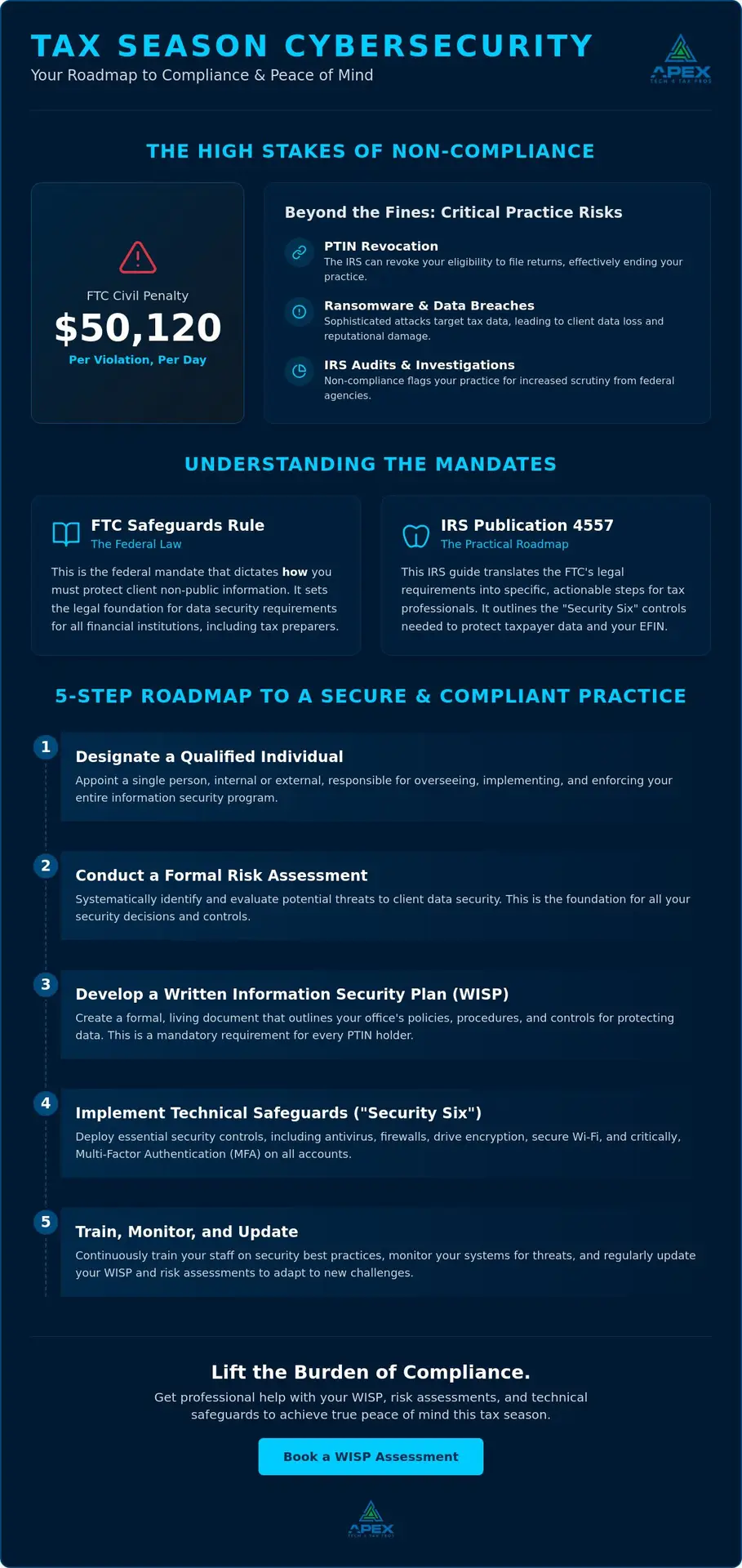
What is the 5-step roadmap to a secure and compliant tax practice?
Achieving peace of mind cybersecurity for tax season involves more than just installing a few software updates; it requires a structured approach that satisfies both the IRS and the FTC. By following a methodical five-step process, you can move from a state of potential vulnerability to one of verified protection. This roadmap ensures your office is fully prepared before the April 15, 2026 filing deadline arrives.
- Step 1: Conduct a professional IT Risk Assessment. You can’t protect what you haven’t identified. A thorough IT Risk Assessment uncovers where sensitive taxpayer data is stored and identifies specific gaps in your current network infrastructure.
- Step 2: Formalize your WISP. Use the findings from your assessment to create a Customized Written Information Security Plan. This document is your primary defense during an audit, proving you have a proactive strategy in place.
- Step 3: Deploy technical safeguards. Implement the “Security Six” measures, with a heavy focus on Multi-Factor Authentication (MFA) and drive encryption. These tools are non-negotiable for protecting your EFIN.
- Step 4: Launch awareness training. Ensure everyone in your office knows how to recognize modern threats. Security is a team effort, and your staff must be prepared.
- Step 5: Establish Secure Cloud Backup. With ransomware attacks on the rise, having a disaster recovery protocol is essential for business continuity and meeting the Safeguards Rule requirements.
Why is staff training your strongest defense?
The human element remains the most common entry point for data breaches. Scammers use highly convincing, AI-generated phishing emails that target busy preparers during the filing rush. Teaching your team to spot these red flags is just as vital as your firewall. Our Cybersecurity Training for staff provides practical guidance that turns your employees into an active defensive shield for your client data.
How do I secure the remote work environment?
Working from home introduces unique risks, especially if preparers use personal devices or unsecured networks. To maintain data integrity, you should avoid storing client files locally on laptop hard drives. A Secure Virtual Desktop is an excellent solution for remote teams, as it keeps all sensitive information within a controlled, encrypted environment. You can book a WISP assessment today to verify that your remote setup meets all federal standards.
How do I choose the right partner for tax office data security?
Selecting a security partner is about finding a team that understands the specific intersection of federal law and information technology. As a Dallas-based firm with over 20 years of combined experience, we don’t just look at your computers; we look at your practice through the lens of IRS and FTC mandates. Our goal is to provide peace of mind cybersecurity for tax season by serving as your technical protector, ensuring your regulatory burdens are handled with clinical precision.
We’ve designed our services to lift the weight of DIY compliance off your shoulders. We offer two clear paths to help you stay secure:
- Seasonal Subscription ($649.99): Focused protection during the peak filing months, including a free customized WISP.
- Yearly Subscription ($1,099.99): Comprehensive, year-round monitoring and continuous compliance updates.
By moving away from the stress of “guessing” at compliance, you can enter the filing season with verified protection. This shift allows you to focus on your core competency: serving your clients and growing your practice.
What makes the Apex Tech 4 Tax Pros approach different?
Our heritage and deep roots in the industry set us apart from generic IT vendors. We work closely with our sister company, APEX Tax Solutions, to stay ahead of the unique challenges that tax preparers face every day. While a free WISP download template is a helpful starting point, our value lies in the precision of a tailored strategy. Starting with a professional IT Assessment allows us to customize your security plan to your specific office environment rather than handing you a generic document that might not pass an audit.
What are the next steps for a stress-free tax season?
The best time to act is before the January rush begins. By being proactive now, you avoid the stress of trying to fix vulnerabilities while you’re focused on high-volume client returns. You can Book a WISP Assessment today or email us at info@at4tp.com to get started. We’ve got your back so you can focus on your clients.
Take Control of Your Compliance Before the Rush
Securing your office shouldn’t be a source of anxiety. By following a clear roadmap and formalizing your Written Information Security Plan, you transform a complex regulatory burden into a manageable business process. The FTC Safeguards Rule and IRS Publication 4557 are designed to protect the trust you’ve built with your clients over the years. Whether you start with our free WISP template or require a fully customized solution, the goal is to ensure your practice remains resilient against modern threats.
Achieving peace of mind cybersecurity for tax season is entirely within your reach when you have the right partner. With over 20 years of combined tax and IT experience, we specialize in helping CPAs and independent preparers meet every federal standard with precision. Don’t wait for the January rush to discover a gap in your security or a vulnerability in your network. Book a WISP Assessment Today and let us handle the technical heavy lifting while you focus on serving your clients. We’re here to help you succeed.
Frequently Asked Questions
Is a WISP mandatory for a single-person tax practice?
Yes, a Written Information Security Plan (WISP) is mandatory for every tax professional who holds a PTIN, even if you operate as a solo practitioner. The FTC Safeguards Rule doesn’t grant exemptions based on the size of your staff. If you handle non-public taxpayer information, federal law requires you to have a documented plan that outlines how you protect that data.
How much does an IRS-compliant cybersecurity plan cost?
The cost of compliance depends on the level of professional support your practice needs. To achieve total peace of mind cybersecurity for tax season, we offer a Seasonal subscription for $649.99 and a Yearly subscription for $1,099.99. Both options include a free customized WISP, which ensures your documentation meets federal standards without the technical burden of creating it yourself.
What is the difference between the FTC Safeguards Rule and IRS Publication 4557?
The FTC Safeguards Rule is the federal law that establishes the legal requirements for protecting consumer financial information. IRS Publication 4557 is the specific guidance provided by the IRS to help tax professionals understand and implement those legal mandates. While the Rule is the law you must follow, the Publication serves as the practical roadmap for your office operations.
Can I use a free WISP template for my accounting firm?
You can use a free WISP template as a starting point, but it isn’t a complete solution on its own. Federal regulations require your WISP to be a living document that is specifically tailored to the unique risks and technical setup of your firm. A generic, unedited template often fails to meet the “reasonable and appropriate” standard required during a formal IRS or FTC audit.
What happens if a tax preparer fails an IRS security audit?
Failing an audit can result in the immediate suspension of your Electronic Filing Identification Number (EFIN), effectively stopping your ability to file returns. Additionally, you may face civil penalties from the FTC, which can reach $50,120 per violation per day as of July 2026. These consequences are designed to ensure that taxpayer data remains protected across the entire industry.