
AI-generated phishing emails now have an open rate as high as 78 percent, making traditional “look for typos” advice dangerously obsolete for your tax practice. Effective phishing prevention for tax preparers requires more than just a keen eye; it demands a structured Written Information Security Plan (WISP) that satisfies the FTC Safeguards Rule and protects your clients. I know you’re already balancing 2026 PTIN renewals with the heavy lifting of tax season, and the thought of a $51,744 per day penalty for a data breach is enough to keep anyone up at night.
You don’t have to face these regulatory burdens alone. I’ll show you how to shield your office from sophisticated 2026 threats while meeting every mandatory IRS requirement. We’ll explore the latest updates to IRS Publication 4557, clarify the difference between general security and a formal WISP; and we’ll provide simple training steps that give you peace of mind during any potential audit. Compliance doesn’t have to be a source of stress when you have a clear, repeatable process in place.
Key Takeaways
- Identify the specific 2026 spear phishing tactics that target your EFIN and PTIN to compromise sensitive taxpayer information.
- Learn how to integrate effective phishing prevention for tax preparers into your mandatory Written Information Security Plan (WISP) to satisfy IRS Publication 4557 requirements.
- Discover why moving away from email attachments in favor of secure client portals is a non-negotiable step for modern FTC Safeguards Rule compliance.
- Explore how specialized cybersecurity training and risk assessments can transform regulatory compliance from a seasonal burden into a repeatable, stress-free process.
Understanding Phishing Threats Specific to Tax Practices in 2026
Phishing in our industry isn’t just a random spam email; it’s a calculated effort to seize your professional identity. In 2026, Understanding Phishing Threats means recognizing that scammers specifically want your EFIN, PTIN, and taxpayer SSNs. They use “spear phishing” to target you with precision, often posing as a lucrative new client who “attached my 1099s” for a quote. Because AI-generated phishing now has an open rate as high as 78 percent, these emails no longer have the obvious typos we once used to spot them. Effective phishing prevention for tax preparers is now a technical necessity because these lures look identical to legitimate business correspondence.
The High Cost of a Successful Attack
A single accidental click triggers a devastating ripple effect. With 49 percent of small businesses targeted by cyberattacks in 2026, the risk is no longer theoretical. Beyond the immediate identity theft of your clients, you’ll face a grueling IRS investigation and potential FTC penalties of up to $51,744 per violation, per day. Reputational damage often hits the hardest. For a firm built on decades of trust, a single breach can end a practice overnight. It’s not just about the money; it’s about the safety of the families you serve.
EFIN and PTIN Credential Harvesting
Scammers frequently impersonate the IRS or software providers to “verify” your credentials. They might claim your 2026 PTIN renewal, which costs $18.75, was rejected or that your EFIN requires immediate re-validation. If you provide your login on their fraudulent portal, you lose control of your filing capabilities. This credential harvesting allows criminals to file fraudulent returns in your name, making phishing prevention for tax preparers the first line of defense for your EFIN’s integrity.
How Phishing Prevention Fits into Your IRS WISP and FTC Compliance
Phishing prevention for tax preparers is a mandatory regulatory pillar, not an optional tech habit. The FTC Safeguards Rule represents the federal law that requires all tax professionals to protect sensitive data. To satisfy this law, you must implement a Written Information Security Plan. Think of the Safeguards Rule as the legal mandate and the IRS WISP as your firm’s specific roadmap for compliance. IRS Publication 4557 explicitly identifies “security awareness” as a core administrative safeguard. This means the IRS expects you to have a documented strategy for identifying and neutralizing digital threats before they reach your server.
The Role of the WISP in Phishing Defense
Your WISP serves as the official record of how your firm handles suspicious activity. It outlines the exact steps staff must take when a “new client” email arrives with unexpected attachments. During an IRS audit or following a reported breach, this document acts as your primary evidence of due diligence. It proves you’ve taken reasonable steps to safeguard taxpayer information. If you’re currently operating without a formal plan, using a Custom WISP Template is a practical way to bridge the gap between your current habits and federal requirements.
Mandatory Security Awareness Training
The FTC Safeguards Rule also mandates regular training for everyone in your office. This requirement applies to year-round CPAs and temporary seasonal staff alike. Because 95 percent of cybersecurity incidents are linked to human error, NIST guidance suggests moving beyond simple checklists to foster a true “culture of security.” Training ensures your team can recognize the sophisticated AI-driven lures that bypass standard filters. It’s about turning your staff into a human firewall. If you’re unsure if your current training meets these standards, a professional it assessment can provide the clarity you need to move forward confidently.
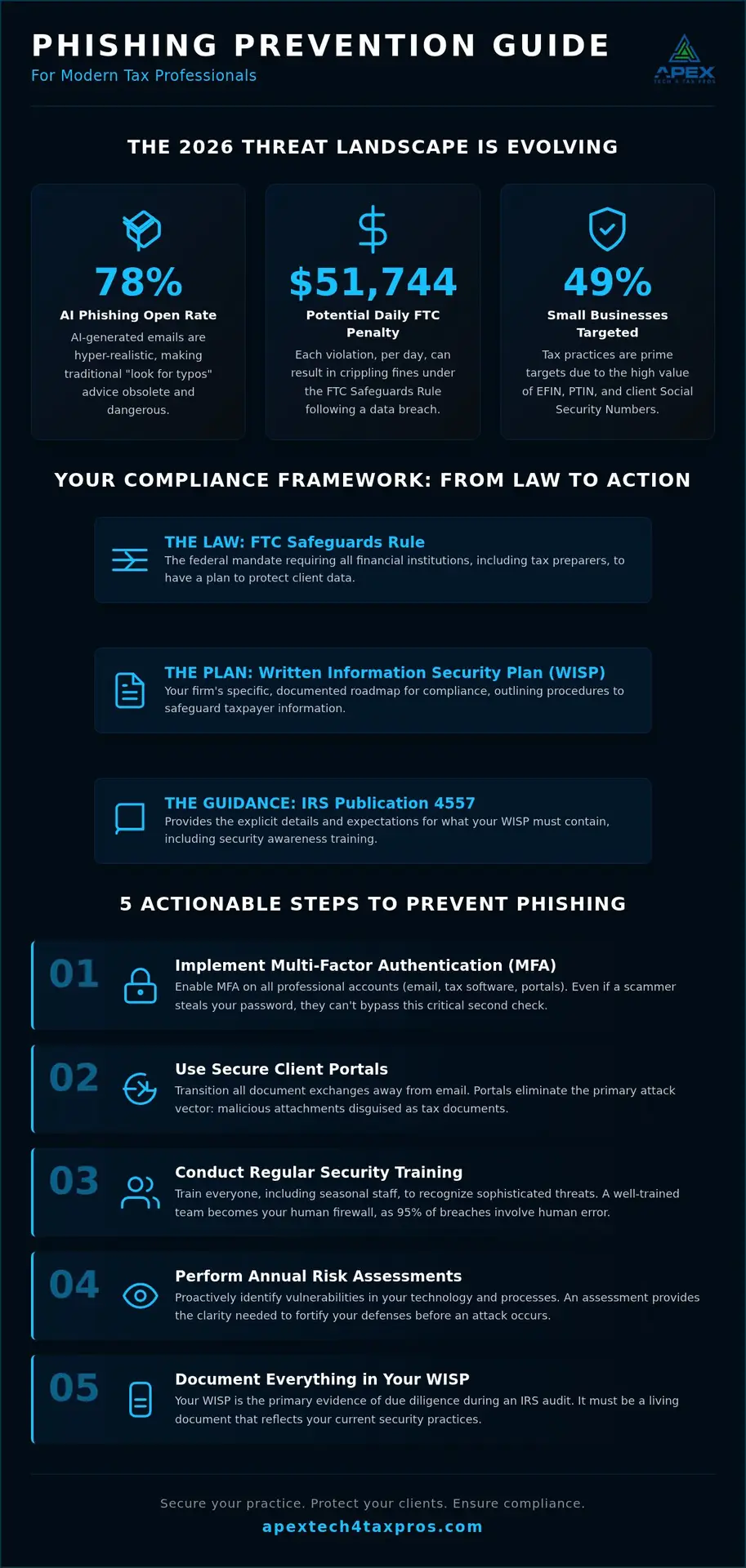
5 Actionable Steps to Prevent Phishing in Your Tax Office
The IRS requires tax pros to have a data security plan that addresses modern threats with technical precision. Practical phishing prevention for tax preparers starts with five defensive layers that protect your EFIN and client data from 2026 lures:
- Implement Multi-Factor Authentication (MFA): Enable MFA on every professional account. Even if a scammer steals your credentials, they can’t bypass this secondary check.
- Use Secure Client Portals: Transition all document exchanges away from email. Portals eliminate the risk of opening malicious attachments disguised as tax documents.
- Deploy Advanced Email Filtering: Use software that flags “external sender” banners. These serve as a visual reminder to stay vigilant before clicking.
- Establish Verbal Verification: Require a phone call to a known number for any request involving funds or sensitive SSNs.
- Run Phishing Simulations: Conduct regular, documented tests to keep your staff sharp against AI-generated scams.
Moving Beyond the Email Inbox
A robust defense requires isolating your workstation from the vulnerabilities of the public internet. Implementing a Secure Office Network ensures that if a threat enters your building, it’s contained and neutralized. For ultimate protection, a Secure Virtual Desktop provides a “sandbox” environment. This prevents malware from reaching your local hardware even if a staff member clicks a malicious link. If you’re ready to modernize your office, you can Book a WISP Assessment to identify your specific needs.
Verifying IRS and Software Provider Communications
The IRS won’t initiate contact with you via email or social media to request personal or financial information. Scammers often spoof these agencies to demand immediate action or “verify” your 2026 PTIN. Use your official e-Services account to check for legitimate notices. If an email from a software provider feels off, don’t click their links. Log in directly through your browser using your saved bookmarks to verify any alerts. Staying skeptical is a core part of phishing prevention for tax preparers.
Building a Resilient Defense with Apex Tech 4 Tax Pros
At Apex Tech 4 Tax Pros, our mission is to provide true relief from the burden of complex federal mandates. We bring over 20 years of combined tax and IT experience to your office, ensuring your phishing prevention for tax preparers isn’t just a policy on paper but a functional shield. We understand the unique pressures of the Dallas tax community. That’s why we offer bilingual support to serve our diverse network of CPAs and independent preparers in both English and Spanish.
Our Seasonal ($649.99) and Yearly ($1,099.99) subscription options are engineered to simplify your security. Both plans include a free customized WISP, tailored specifically to your firm’s operations. Before you implement these tools, a professional IT Assessment helps identify hidden vulnerabilities in your network that automated scanners might miss. It’s about finding the gaps before a scammer does.
Professional WISP Development vs. Generic Templates
While a free template might seem convenient, it often fails to document the specific administrative safeguards the IRS looks for during a regulatory review. A customized plan provides the clinical precision required to survive an audit and proves you’ve taken personal accountability for your data. You can learn more about these nuances in our WISP IRS Requirements Pillar. We ensure your documentation matches your actual office workflow.
Your Next Steps Toward a Secure Tax Season
Securing your practice is a methodical journey. First, assess your current risks. Second, implement your customized WISP. Third, train your staff to recognize 2026 digital threats. Finally, secure your infrastructure with tools like cloud backup and virtual desktops. Don’t wait for a breach to realize your defenses are thin. Book a WISP Assessment today or email info@at4tp.com to start your path toward a stress-free tax season.
Securing Your Firm’s Legacy in a Digital World
Protecting your practice from modern digital threats requires a proactive shift from reactive habits to a documented, resilient strategy. We’ve established that effective phishing prevention for tax preparers is a mandatory administrative safeguard under the FTC Safeguards Rule and IRS Publication 4557. By implementing Multi-Factor Authentication, utilizing secure client portals, and maintaining a customized Written Information Security Plan, you transform your office into a fortress that protects both your EFIN and your clients’ trust.
With over 20 years of specialized tax and IT experience, our team at Apex Tech 4 Tax Pros is dedicated to providing IRS Pub 4557 compliant plans that fit your specific workflow. Our Seasonal subscriptions start at $649.99, offering an affordable way to secure your practice before the next filing deadline. You don’t have to carry the weight of these regulations on your own. Take the first step toward a stress-free season and Book Your WISP Assessment and Secure Your Practice today. We’re here to ensure your data remains safe while you focus on serving your clients.
Frequently Asked Questions
Is a Written Information Security Plan (WISP) required for a one-person tax office?
Yes, the FTC Safeguards Rule requires every professional tax preparer to maintain a WISP, regardless of firm size. Whether you’re a solo practitioner or a large firm, federal law mandates a documented plan to protect taxpayer data. Having this plan in place is a critical component of phishing prevention for tax preparers, as it establishes the protocols you’ll follow to handle suspicious communications and technical vulnerabilities in your one-person office.
How do I report a phishing email that claims to be from the IRS?
You should forward the suspicious email as an attachment to phishing@irs.gov immediately. Don’t click any links or open any attachments within the original message. After forwarding the email, you should delete it from your inbox. Reporting these attempts helps the IRS Security Summit track new 2026 lures and protects the broader tax community from sophisticated credential harvesting campaigns that target Electronic Filing Identification Numbers (EFINs) and PTINs.
What are the penalties for non-compliance with the FTC Safeguards Rule in 2026?
As of 2026, civil penalties for violating the FTC Safeguards Rule can reach up to $51,744 per violation, per day. Additionally, the FTC can impose fines of up to $100,000 per violation for financial institutions and $10,000 for individual officers. Beyond these monetary costs, non-compliance can lead to the suspension of your EFIN and significant reputational damage that could permanently close a practice that has been built over decades.
Does the IRS Publication 4557 mandate specific phishing training for my staff?
Yes, IRS Publication 4557 explicitly identifies security awareness training as a mandatory administrative safeguard for your firm. This guidance requires you to educate all employees, including seasonal staff, on recognizing and reporting digital threats. Effective phishing prevention for tax preparers must be documented in your WISP to prove that your team is trained to identify the latest AI-generated lures and spear phishing tactics used by identity thieves in 2026.
Can a secure client portal completely eliminate the risk of phishing?
A secure client portal doesn’t completely eliminate the risk, but it significantly reduces your attack surface by removing dangerous email attachments from your workflow. While the portal secures document exchanges, scammers may still attempt to phish your portal login credentials through deceptive emails. You must combine secure technology with vigilant staff training and Multi-Factor Authentication (MFA) to create a multi-layered defense that protects your sensitive taxpayer data from all angles.