
Could a single missing document really cost your tax practice $50,685 per violation in 2026? It’s a heavy question, especially when you’re already juggling client returns and the demands of a busy office. You’ve worked hard to build your firm’s reputation, but the technical jargon surrounding cybersecurity resources for tax professionals can make it feel like you’re constantly falling behind. We know that feeling of regulatory anxiety, and we’re here to tell you that compliance doesn’t have to be a source of stress.
In this guide, you’ll discover a curated collection of IRS and FTC-approved tools designed to secure your data and protect your professional legacy. We’ve gathered the most reliable information to help you understand the latest WISP requirements and the IRS Security Six. We’ll walk you through the essential steps to meet the 2026 standards, moving you from a state of vulnerability to one of secure, confident compliance. It’s time to replace technical confusion with a clear, actionable path forward for your practice.
Key Takeaways
- Identify the specific requirements within IRS Publication 4557 and the FTC Safeguards Rule that impact your firm’s operations in 2026.
- Master the implementation of the IRS Security Six to build a robust defense against unauthorized access and hardware failures.
- Learn why your PTIN renewal depends on a compliant Written Information Security Plan and how to transition from a generic template to a custom document.
- Utilize our curated list of cybersecurity resources for tax professionals to eliminate regulatory anxiety and avoid penalties that can reach $43,792 per day.
Understanding the 2026 IRS and FTC Cybersecurity Landscape
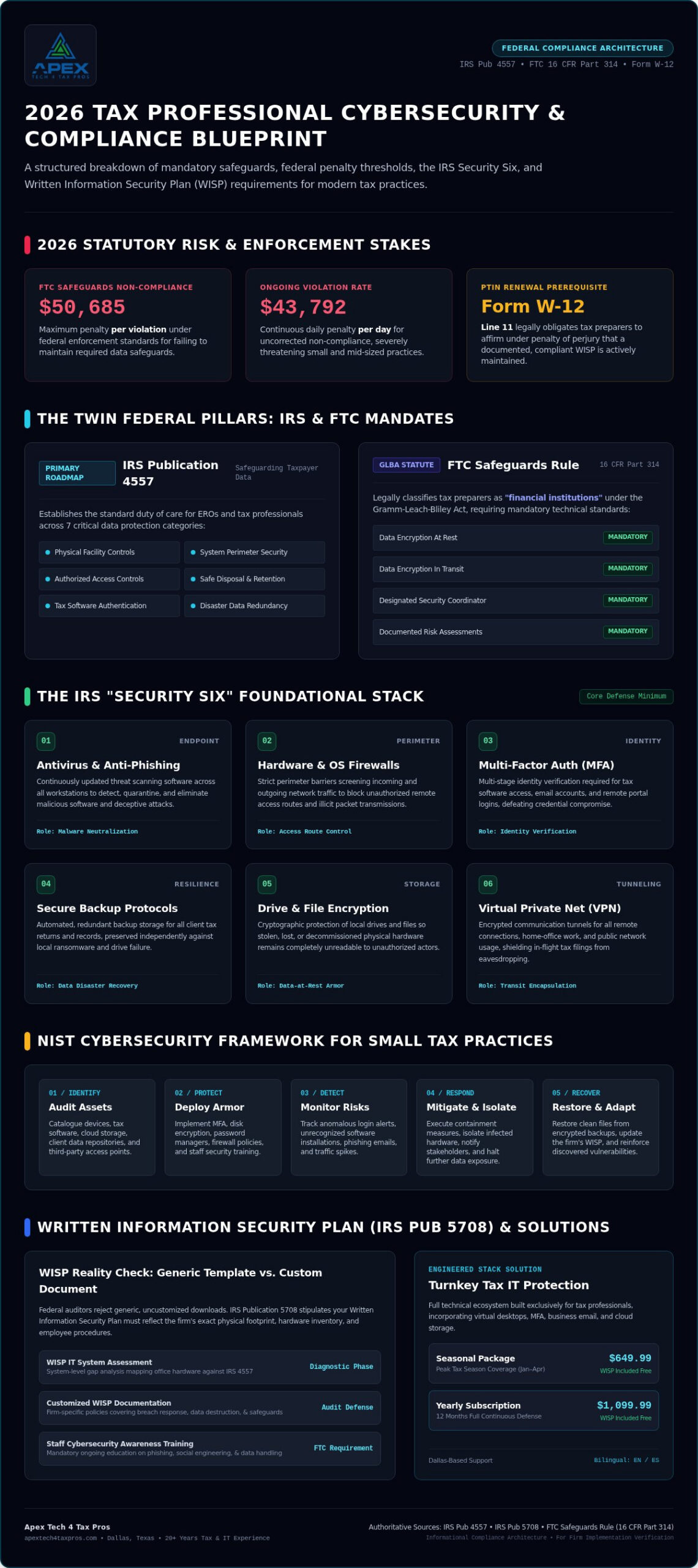
The 2026 regulatory environment for tax practitioners is defined by two primary pillars: IRS Publication 4557 and the FTC Safeguards Rule. While these frameworks can feel like overwhelming technical hurdles, they actually provide the structure for essential cybersecurity resources for tax professionals. Compliance isn’t just about avoiding the 2026 penalties, which can reach up to $50,685 per violation and $43,792 per day. It’s about protecting your clients. Every year during PTIN renewal, you must sign Form W-12 Line 11. This signature confirms you have a Written Information Security Plan (WISP) in place. Viewing these mandates as a framework for “Regulatory Relief” allows you to focus on your clients while we handle the technical heavy lifting.
IRS Publication 4557: Your Primary Compliance Roadmap
IRS Publication 4557 serves as your primary compliance roadmap. It outlines seven critical areas of data protection, ranging from physical security to system safeguards. Think of this document as the minimum standard for every ERO and tax practitioner in the country. It bridges the gap between general office management and the specific technical requirements needed to safeguard taxpayer data. This publication isn’t just a list of rules; it’s a commitment to professional excellence. By following this roadmap, you transition from guesswork to a structured, defensible security posture that satisfies federal auditors.
The FTC Safeguards Rule: Technical Mandates for Financial Institutions
Under the Gramm-Leach-Bliley Act, tax preparers are legally classified as “financial institutions.” This classification triggers the FTC Safeguards Rule (16 CFR Part 314), which mandates specific technical protections. You’re required to implement encryption for data both at rest and in transit. These rules ensure that sensitive information remains unreadable even if a breach occurs. Finding the right cybersecurity resources for tax professionals means choosing tools that meet these specific federal standards. Moving toward a custom WISP document helps you document these technical mandates, turning a complex legal burden into a manageable, professional process.
Core Cybersecurity Resources Every Tax Office Needs
Building a secure practice starts with the IRS “Security Six,” a foundational group of tools designed to shield taxpayer data. These essentials include professional-grade antivirus software, firewalls to control network traffic, multi-factor authentication (MFA), secure backups, drive encryption, and a Virtual Private Network (VPN) for remote access. These aren’t just technical recommendations; they’re the core cybersecurity resources for tax professionals that form the backbone of a compliant office. For more on how these tools integrate with your required documentation, see our WISP IRS requirements guide for 2026.
While tools protect the data, IRS Publication 5708 provides the framework for your Written Information Security Plan. This publication helps you align your internal processes with the IRS Safeguards Program requirements. Implementing these standards doesn’t have to be a solo effort. If you feel overwhelmed by the technical details, a WISP IT system assessment can provide a clear roadmap for your firm’s specific needs.
The IRS Security Summit and “Protect Your Clients” Campaign
Staying ahead of scammers requires constant vigilance. The IRS Security Summit produces the “Protect Your Clients; Protect Yourself” campaign, which offers excellent cybersecurity resources for tax professionals. By subscribing to e-News for Tax Professionals, you’ll receive real-time updates on filing-season threats. These resources are perfect for client education, showing your taxpayers that you take their identity protection seriously.
Leveraging NIST Standards for Small Firm Security
Small firms can achieve enterprise-level security by following the NIST Cybersecurity Framework. This cycle helps you Identify your assets, Protect your data, Detect threats, Respond to incidents, and Recover after a loss. Using NIST standards allows you to evaluate your firm’s maturity and choose compliant hardware and software with confidence. This methodical approach ensures your practice remains resilient against evolving digital threats.
Technical Implementation: Selecting Your Security Stack
Implementing a robust security stack for a small or home-based firm doesn’t require a six-figure IT budget. It requires making smart choices with the right cybersecurity resources for tax professionals. Multi-Factor Authentication (MFA) stands as your single most effective defense against unauthorized access. It stops hackers in their tracks even if they manage to steal your password. To ensure practice continuity, you should pair MFA with secure cloud backup solutions. These tools protect document integrity against ransomware and hardware failure, keeping a clean copy of your data out of reach from malicious actors.
These technical controls are mandatory under the FTC Safeguards Rule under the Gramm-Leach-Bliley Act. Compliance isn’t just a legal checkbox. It’s a shield for your professional livelihood and your clients’ trust.
Securing the Virtual Office: MFA and VPN Essentials
You should enable MFA on every piece of tax software and business email account you use. Don’t rely on SMS codes. Use an authenticator app or a physical security key for better protection. If you prepare returns from a home office or while traveling, a VPN is mandatory. It creates a secure tunnel for your data, preventing anyone on an unsecured network from intercepting sensitive taxpayer information. Secure virtual desktops take this protection even further. They isolate your tax software from general web browsing, which significantly reduces the risk of malware infections from daily internet use.
Risk Assessments: Identifying Gaps Before the IRS Does
Before you can fix security gaps, you have to find them. A baseline assessment compares your current office setup to the latest IRS and FTC requirements. You can book a WISP IT system assessment to get a professional gap analysis. This process identifies exactly where your firm stands and provides a clear roadmap for meeting 2026 standards. Don’t wait for a data breach to discover your security weaknesses.
Developing Your Written Information Security Plan (WISP)
A basic template might seem like a convenient shortcut, but generic documents often fail to meet the prescriptive requirements set by the FTC. To truly protect your firm, you must transition to a document that reflects your office’s specific data flow and hardware. This process includes designating a Qualified Individual as your Security Coordinator. This role is a mandatory requirement under the FTC Safeguards Rule for any firm handling sensitive financial data. This coordinator oversees your security posture and ensures you’re utilizing the right customized WISP solutions to stay compliant. A WISP isn’t a one-time project; it requires continuous monitoring and a formal annual update to address the evolving landscape of cybersecurity resources for tax professionals.
Staff Training: The Human Element of Cybersecurity
Technical tools are only half the battle. Even the most sophisticated firewall can’t stop a staff member from falling for a well-crafted phishing email. This is why cybersecurity awareness training is a cornerstone of any professional WISP. You must educate your team on the latest social engineering tactics and the importance of strict password hygiene. When your staff understands the stakes, they become your most vigilant protectors rather than your greatest risk factor.
From Plan to Action: Implementing Your WISP
Your plan must translate into decisive action during a crisis. A compliant WISP includes clear incident response steps for data breach scenarios, outlining exactly how to contain a threat and which authorities to notify. Don’t wait for a real breach to test your readiness. Regular “fire drills” for your security protocols ensure that your team knows exactly what to do when every second counts. This proactive stance provides the relief of knowing your practice is prepared for any scenario.
Securing Your Practice for the 2026 Tax Season
Securing your tax practice for the 2026 season requires more than just high-quality software; it demands a dedicated commitment to federal standards. You’ve learned how the intersection of IRS Publication 4557 and the FTC Safeguards Rule creates a mandatory framework for your firm. By implementing the Security Six and developing a customized WISP, you aren’t just avoiding penalties that can reach $50,685 per violation. You’re building a resilient foundation that protects your clients’ most sensitive data.
Accessing the right cybersecurity resources for tax professionals is the first step toward achieving this peace of mind. At Apex Tech 4 Tax Pros, we bring 20+ years of combined tax and IT experience to your office. As IRS and FTC compliance experts, we provide the bilingual support you need to navigate these complex requirements without technical jargon. Don’t let regulatory anxiety overshadow your success this year. Ready to secure your practice? Book a Professional WISP Assessment today and move forward with confidence. Your professional legacy is worth the protection.
Frequently Asked Questions
What are the mandatory cybersecurity requirements for tax preparers in 2026?
Mandatory requirements include implementing a Written Information Security Plan (WISP) and designating a security coordinator. You must also adhere to the technical safeguards mandated by the FTC Safeguards Rule, such as encrypting data at rest and in transit. These obligations apply to all practitioners who handle federal tax information. Compliance is verified annually during your PTIN renewal, where you must attest to having these protections in place.
Do I need a Written Information Security Plan (WISP) if I am a solo preparer?
Yes, every tax professional with a PTIN must have a WISP, regardless of firm size. The IRS doesn’t offer exemptions for solo practitioners or home-based offices. When you renew your PTIN on Form W-12, Line 11 requires you to confirm that you’ve developed and implemented a security plan. Having a solo practice actually makes a structured plan more critical, as you’re solely responsible for every layer of data protection.
What is the difference between IRS Publication 4557 and the FTC Safeguards Rule?
IRS Publication 4557 is a comprehensive guidance document that provides a roadmap for protecting taxpayer data. In contrast, the FTC Safeguards Rule is a federal law under the Gramm-Leach-Bliley Act that mandates specific security controls. While the Publication helps you understand best practices, the Safeguards Rule establishes the legal requirements you must meet. Using both as cybersecurity resources for tax professionals ensures your practice stays within legal and professional boundaries.
How much are the penalties for non-compliance with IRS security standards?
Non-compliance penalties for 2026 have adjusted to reflect the high stakes of data protection. You could face fines up to $50,685 per violation under the FTC Safeguards Rule. Additionally, penalties for failing to protect data can reach $43,792 per day. These figures represent the federal government’s commitment to taxpayer privacy. Maintaining a current WISP and active security training is the most effective way to mitigate these significant financial risks.
What is the IRS Security Six and how do I implement it?
The IRS Security Six consists of professional-grade antivirus software, firewalls, multi-factor authentication (MFA), secure backups, drive encryption, and Virtual Private Networks (VPNs). Implementation begins with a thorough assessment of your current hardware and software. You should move beyond consumer-grade tools to enterprise-level solutions that specifically meet IRS standards. Integrating these six pillars into your daily workflow creates a multi-layered defense that satisfies both federal auditors and your clients.