
A sole proprietor tax preparer should adapt the IRS sample WISP to document how the practice protects taxpayer information. If you’re working out how to write a WISP as a sole proprietor tax preparer, start with a plan that reflects your actual business rather than copying procedures designed for a larger firm. The IRS sample in Publication 5708 provides a framework to tailor.
A useful WISP connects written procedures to the decisions you make throughout the year. Seasonal changes in workload, for example, can affect how you organize client files, manage access, and oversee the people or services involved in your work. The plan should make those responsibilities clear, even when you’re the only person in the practice.
This guide explains how to adapt the IRS sample, describe safeguards for a one-person business, and include risk assessment and incident response procedures. It also explains how IRS and FTC requirements apply to your WISP, so you can create documentation that reflects how your practice operates and stays useful as it changes.
Key Takeaways
- Adapt the IRS sample WISP to your sole proprietorship’s actual workflow, systems, and handling of taxpayer information.
- Organize protections into administrative, technical, and physical safeguards so the plan covers both written procedures and the tools you use.
- Make risk assessment and incident response practical by documenting how you spot security gaps and what you’ll do if client data is exposed.
- Review how the FTC Safeguards Rule applies to your practice, including its breach-notification requirements for covered firms.
FTC Safeguards Rule requirements
The FTC Safeguards Rule and the Gramm-Leach-Bliley Act shape how covered businesses protect customer information. Tax professionals handle sensitive taxpayer records, so a WISP should explain how the practice identifies security risks and protects that information. IRS Publication 4557 provides tax professionals with data-protection guidance, while the written plan records the safeguards used in the practice.
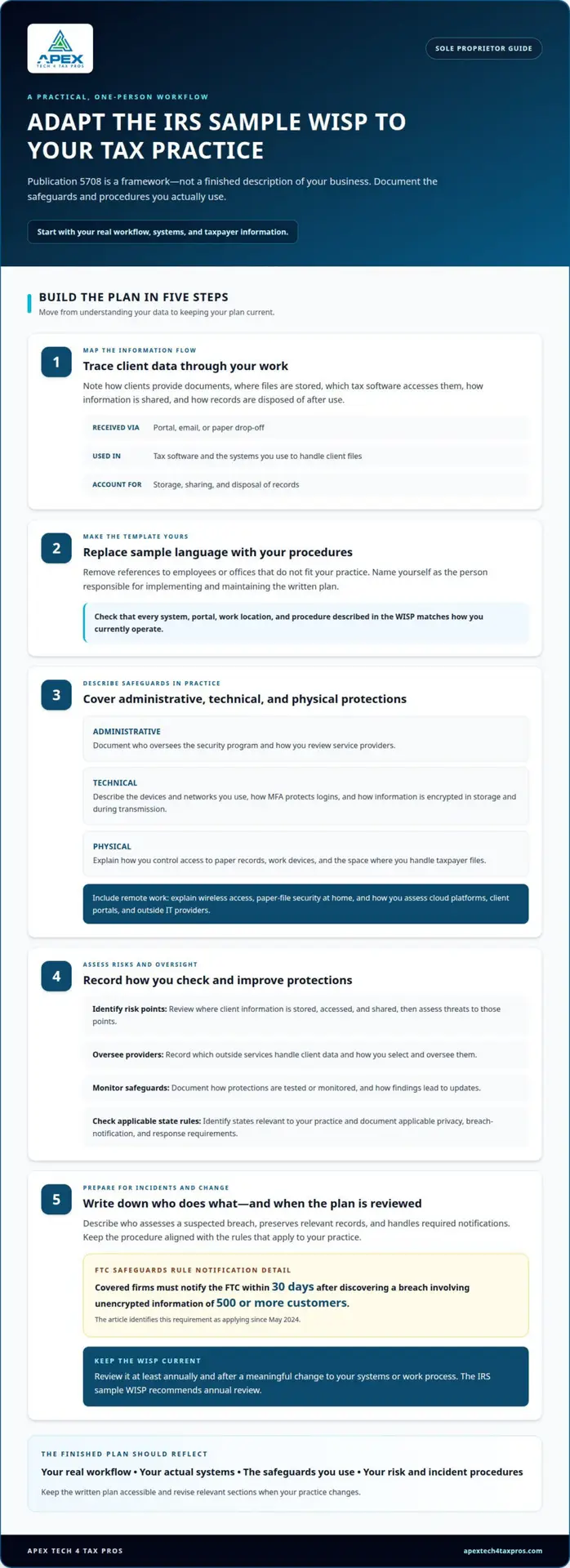
Describe administrative, technical, and physical safeguards in practical terms. Administrative measures include assigning responsibility for the security program and reviewing service providers. Technical measures include multi-factor authentication (MFA) to verify identity and encryption to protect information from unauthorized access. Physical measures cover access to paper records, work devices, and the space where you handle taxpayer files.
Review and update the plan at least annually, and after a meaningful change to your systems or work process. The Internal Revenue Service sample WISP recommends annual review. A sole proprietor can oversee the plan directly as the person responsible for the practice’s security program; document that role and the review date.
Include remote work in the same security plan. Describe the devices and networks you use to access tax software, how MFA protects logins, and how taxpayer information is encrypted in storage and during transmission. Explain how you manage wireless access, secure paper files at home, and assess cloud platforms, client portals, and outside IT providers.
Incident procedures should identify who assesses a suspected breach, preserves relevant records, and handles required notifications. Since May 2024, firms covered by the FTC Safeguards Rule must notify the FTC within 30 days after discovering a breach involving unencrypted information of 500 or more customers, according to the Federal Trade Commission.
Failing to maintain a WISP can create compliance problems and expose taxpayer data to unauthorized access or a breach. A written plan establishes who oversees security, which safeguards are in place, and what steps to take after an incident. Keep it current so it accurately describes the tools and procedures your tax practice uses.
Customizing the IRS sample WISP for a sole proprietorship
The IRS sample WISP in Publication 5708 gives tax preparers a starting framework, not a finished description of every practice. Customize each section to match how your business collects, uses, stores, and shares client data. A one-person practice may have fewer roles than a firm with 10 partners, but its information security plan still needs to describe real procedures.
Start by mapping how client data moves through your work. Note whether clients send documents through a portal, email, or paper drop-off. Record where files are stored, which tax software accesses them, and how you dispose of records after use. Remove sample wording about employees or offices that your practice does not have.
Then tailor the template to your actual operations:
- Responsibility: Identify yourself as the person who implements and maintains the written plan.
- Access: Explain how you secure tax software, devices, email, and any client portal.
- Service providers: Record which cloud platforms or outside providers handle client data and how you oversee their access.
- Remote work: Describe where you work, how devices connect to business systems, and how paper files stay protected.
State laws may add privacy or breach-notification obligations. Use the federal sample as a framework, then identify the states relevant to your practice and document applicable requirements and response procedures. The steps depend on the rules that apply to your business and the people whose information it holds.
Are there templates or sample policies for independent tax preparers? Yes. Publication 5708 provides an IRS sample WISP that a sole proprietor can adapt. Use it as a working template: replace broad sample language with specific tools, records, and procedures from your practice.
Before putting the plan into practice, make sure its descriptions match your current workflow. A WISP that names a portal you don’t use or leaves out a system that stores taxpayer data does not accurately document your safeguards. Keep the written plan accessible, and revise relevant sections when your practice changes.
What IRS and FTC Safeguards Rule requirements apply to a tax preparer’s WISP?
A tax preparer’s WISP connects security requirements to the safeguards used in daily work. IRS Publication 4557 says tax preparers should create and maintain a written plan identifying risks to taxpayer data and controls addressing those risks. The FTC Safeguards Rule requires covered businesses to maintain a security program suited to their operations and information.
For a sole proprietor, describe the security program in practical terms. FTC requirements include identifying risks, evaluating safeguards, and adjusting the program when your business changes or testing reveals gaps. Document your decisions and the procedures you use to put safeguards into practice.
- Risk review: Record where client information is stored, accessed, and shared, then assess threats to those points.
- Responsibility: Name the person responsible for running the security program and maintaining its documentation.
- Service providers: Describe how you select providers that handle taxpayer information and oversee their safeguards.
- Testing: Document how safeguards are monitored or tested, and how findings lead to updates.
The IRS sample WISP in Publication 5708 can help organize these details, while Publication 4557 offers tax-data security guidance. During PTIN renewal, Form W-12, Question 11, asks preparers to confirm they have a WISP. Treat the written plan as the record supporting that confirmation, not as a substitute for safeguards actually in use.
A compliance statement may also address IRC Section 7216, which concerns the use and disclosure of tax return information. Keep this distinct from the safeguards program: the WISP documents security risks and controls, while Section 7216 relates to handling return information.
In a one-person practice, document how you handle each responsibility, even without separate departments. If systems, providers, or work arrangements change, reassess the related risks and update the relevant procedures. This keeps the plan aligned with your current security program instead of relying on generic template language.
What risk assessment and incident response procedures should a tax preparer’s WISP include?
Begin with a risk assessment that traces taxpayer information through your practice. Record where client files arrive, which tax software uses them, and where completed returns are stored. Include paper records, email, devices, cloud platforms, and client portals. For each, describe possible exposure, such as a misplaced laptop or compromised login.
Next, document how you evaluate and address each risk. Note the safeguards already in place, any gaps, and the actions needed to reduce exposure. As a sole proprietor, you can identify yourself as responsible for reviewing findings and updating procedures when systems, providers, or work arrangements change.
The FTC Safeguards Rule requires a written incident response plan. Make it usable under pressure by recording steps for:
- Recognizing and documenting unusual access or missing taxpayer information.
- Limiting further access and preserving relevant records for investigation.
- Assessing what information and systems may have been affected.
- Identifying who handles required communications and notifications.
The IRS recommends a data-theft response plan that includes contacting your local IRS Stakeholder Liaison to report suspected theft. You can also list the Federation of Tax Administrators as a follow-up contact after notifying the IRS. Include a process for addressing state notification duties, which may apply when residents’ information is exposed.
For example, an unfamiliar tax software login should prompt you to document the alert, secure the affected account, and assess whether client records were accessed. Specify how you’ll examine related accounts and records, and who will manage communications. A named Public Information Officer can coordinate external messages during an incident.
A structured tax practice risk assessment can help identify gaps and connect them to documented response procedures. Use its findings to make the WISP reflect your actual systems and incident responsibilities.
Apex Tech 4 Tax Pros
Apex Tech 4 Tax Pros helps sole proprietors turn WISP requirements into a plan that reflects their actual tax practice. If adapting the IRS sample feels difficult, a customized Written Information Security Plan can document your procedures, systems, and safeguards. Risk assessments help identify gaps to address, while Cybersecurity Awareness Training supports safer handling of taxpayer information. Secure Cloud Backup can help protect business records through secure storage.
These services are useful when your current plan doesn’t match your workflow, you’ve changed systems or providers, or you need to document security procedures more clearly. For help with your WISP, contact Apex Tech 4 Tax Pros at info@at4tp.com.
Make your WISP part of your practice
A WISP is most useful when it guides everyday decisions, not just compliance paperwork. Keep its procedures aligned with your practice as your work evolves, so the plan remains a practical resource rather than a document set aside after completion.
If you’d like support putting your plan into practice, Apex Tech 4 Tax Pros offers bilingual support and brings 20+ years of combined tax and IT experience. The company is Dallas-based and serves tax professionals nationwide.
Connect with Apex Tech 4 Tax Pros, email info@at4tp.com, or book an assessment. Take the next step toward a WISP that works for your practice.
Frequently Asked Questions
How do I write a WISP?
Start with a written outline of your practice’s information-handling procedures, and make sure each statement reflects what you actually do. If you’re figuring out how to write a WISP as a sole proprietor tax preparer, begin with the decisions and safeguards specific to your business. Identify who handles each security task, how you approve access to records, and how you preserve earlier plan versions. For example, document who can retrieve archived returns and how you remove access when a contractor’s work ends. Keep the plan readable and available for review.
How to Create a WISP for Your Business?
Build the plan around your business workflow rather than copying a generic company structure. A solo preparer might treat client intake, return preparation, record storage, and secure disposal as distinct activities. For each activity, name the systems and people involved, then describe the access procedure. This makes the WISP useful for answering practical questions, such as where to store a particular client file.
Is a WISP required by law for accountants and tax preparers?
Tax preparers must maintain a WISP as part of federal data-security requirements. The Gramm-Leach-Bliley Act and FTC Safeguards Rule establish security obligations, while IRS Publication 4557 addresses safeguarding taxpayer data. Form W-12, Question 11, asks preparers to confirm they have a WISP during PTIN renewal. The plan should reflect implemented safeguards, not simply state that a document exists.
What is a written information security plan (WISP)?
A WISP is a written record of how a business protects sensitive information and manages its security program. It connects responsibilities and procedures to the way the practice operates. It is not itself a security tool: a password manager, for example, may support a safeguard, while the WISP explains how the practice uses and oversees it.
What does WISP mean for a tax preparer, and what does it need to include?
For a tax preparer, WISP means Written Information Security Plan. It should explain how your practice handles taxpayer information, who is responsible for security, and how you manage safeguards and incidents. Include procedures for routine work, such as granting access to a seasonal employee or securely sharing a client document, so the plan guides real decisions.
Are sole proprietor tax preparers required to have a written information security plan?
Yes. A sole proprietor tax preparer is not exempt because the business has no employees. The owner can carry out the security responsibilities directly, but the WISP should make that responsibility clear and describe how controls are maintained. The IRS sample in Publication 5708 offers a starting point for a plan that reflects a one-person practice rather than a larger firm.