
A policy binder alone does not show whether customer information is protected in practice. An FTC compliance audit examines written policies, supporting records, security practices, and corrective actions to identify gaps and help an organization respond to regulatory concerns. The review can clarify potential enforcement risks, but a finding is not automatically proof of a violation.
It is reasonable to want a clear picture of what an audit examines and what may happen when a concern is identified. This article explains how reports and recommendations work, which policies and records may be reviewed, how stakeholder concerns can shape audit planning, and how compliance issues may lead to penalties or other regulatory action.
You’ll also learn how a focused risk assessment and a well-maintained Written Information Security Plan can help tax and accounting professionals protect sensitive client data and document their security program.
Key Takeaways
- Understand how audit reports present findings and corrective-action recommendations, and how limited Safeguards Rule exemptions may apply to small institutions with data on fewer than 5,000 consumers, according to the Federal Trade Commission.
- Learn which policies, procedures, and supporting records can help demonstrate how an information security program works in practice.
- See how stakeholder concerns can inform audit planning and why clear documentation helps make security decisions easier to explain.
- Understand how compliance concerns may lead to regulatory action, and how a risk assessment, tailored WISP, training, or secure cloud backup can support a more organized response.
Audit reports and corrective-action recommendations
The FTC Office of Inspector General audits Federal Trade Commission operations, while the agency investigates companies’ consumer-protection practices. The FTC Safeguards Rule applies to covered financial institutions’ information-security practices; according to the Federal Trade Commission, small institutions with data on fewer than 5,000 consumers may have limited exemptions from some provisions.
Audit Findings and Reports
An audit report explains why the work took place and presents findings based on the review. The FTC OIG’s FY 2026 performance audit assessed the FTC’s compliance with the Federal Information Security Modernization Act of 2014. These figures describe separate report categories, not a general measure of every organization’s compliance.
Corrective-Action Recommendations
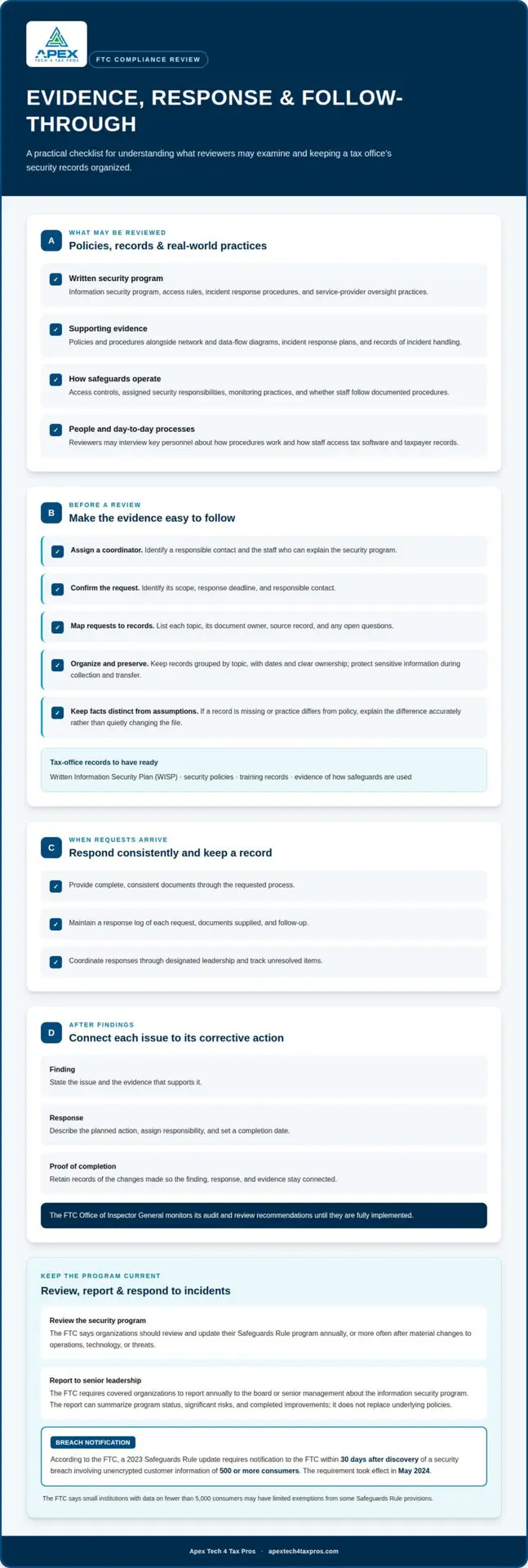
Recommendations turn findings into action. A useful report identifies the issue, explains the supporting evidence, and describes a response. The organization can assign responsibility, set a completion date, and retain records of the changes made. The FTC OIG monitors audit and review recommendations until they are fully implemented. A written corrective-action record connects the finding, response, and evidence.
Breach Reporting and Follow-Through
Breach reporting is one example of a requirement that can shape a review. According to the Federal Trade Commission, a 2023 update to the FTC Safeguards Rule requires notification to the FTC within 30 days after discovering a security breach involving unencrypted customer information of 500 or more consumers; the requirement took effect in May 2024. Reviewers can assess whether an organization documented the incident and followed applicable response steps.
Drummond’s assessment findings report presents findings and recommendations based on the information collected. It links the evidence to proposed responses for review.
Policies, procedures, and supporting documentation
Document reviews compare written information security requirements with an organization’s actual practices. Reviewers assess policies alongside records and technical diagrams to understand how controls operate.
Policies and Procedures
Relevant documents can include an information security program, access rules, incident response procedures, and service-provider oversight practices. A reviewer looks for clear responsibilities, consistent procedures, and evidence that staff follow them. The Federal Trade Commission says organizations should review and update their Safeguards Rule program annually, or more often after material changes to operations, technology, or threats. A customized written security plan can organize responsibilities and procedures in one place.
The Federal Trade Commission also requires covered organizations to report annually to the board or senior management about their information security program. The report can summarize program status, significant risks, and completed improvements, but it does not replace the underlying policies.
Audit Process and Records
An FTC compliance audit may compare stated safeguards with evidence of how information is handled. Records may include policies, procedures, network and data-flow diagrams, and incident response plans. Reviewers may also examine access controls, assigned security responsibilities, monitoring practices, and incident-handling records.
A review typically starts with defining its scope and identifying the evidence requested. Reviewers then assess documents against actual practices and may interview key personnel about how procedures work day to day. Organize records by topic, with dates and clear ownership, so each item can be matched to the relevant control.
Responding to Notices and Requests
After receiving an audit notice or document request, identify its scope, response deadline, and responsible contact. Preserve relevant records, assign an owner to each request, and provide complete, consistent documents through the requested process. If a record is missing or a practice differs from policy, explain the difference accurately rather than quietly changing the file.
Keep a response log of each request, the documents supplied, and any follow-up. This creates a clear record for later questions and helps track open items. Protect sensitive records during collection and transfer, and coordinate responses through designated leadership.
Stakeholder concerns in audit planning
Audit planning takes account of risk, reported concerns, and the program being reviewed. For a tax office, understanding how these factors shape the scope helps the owner prepare relevant taxpayer-data security records and staff.
Audit Preparation
To prepare a tax office for regulatory review, assign a coordinator, organize requested records, and identify staff who can explain the security program. Keep the Written Information Security Plan (WISP), security policies, training records, and evidence of how safeguards are used ready for review.
A review may involve questions about how the office protects taxpayer information. Map each request to a document owner and source record. For example, the person responsible for an access-control policy should be able to explain how staff access tax software and taxpayer records.
Keep a request log listing each topic, its owner, collected documents, and open questions. This helps the office see which evidence is ready and where records need context. Separate documented facts from assumptions so reviewers can assess the response clearly. A clear evidence trail also helps staff explain how the security program operates.
Audit Duration
The duration of a regulatory audit engagement depends on scope, evidence collection, interviews, and follow-up. A typical initial FTC Safeguards Rule audit engagement is described as lasting 9-15 weeks from kickoff to final report. This is a reported engagement timeframe, not a universal schedule for every review.
Planning can prevent avoidable delays. A designated contact, organized records, and access to staff who handle taxpayer information help keep evidence gathering orderly. Requests spanning departments or records needing clarification can take longer to coordinate. Track milestones from kickoff through fieldwork and report delivery to see each phase’s status and keep responsibilities clear.
Together, these factors shape audit planning. Tax offices can prepare by organizing relevant taxpayer-data security evidence and ensuring staff understand the program under review.
Compliance penalties and regulatory actions for tax firms
Regulatory consequences for tax firms depend on the conduct, applicable authority, and evidence. Section 5 of the Federal Trade Commission Act prohibits unfair or deceptive acts or practices in or affecting commerce.
The FTC may investigate tax firms that inadequately protect taxpayer data or engage in deceptive or unfair cybersecurity practices. A review finding is not the same as a final enforcement decision: the agency assesses the facts and applicable law.
An FTC review differs from a state or other federal audit because the authority, legal mandate, and scope differ. A state regulator may apply state requirements to a tax firm, while another federal agency may examine duties within its jurisdiction.
Requirements also depend on the tax firm’s activities. Tax preparers covered by the FTC Safeguards Rule must consider its information security program requirements. The FTC Act’s prohibition on unfair or deceptive conduct may also apply to tax firms.
Possible regulatory actions include investigations, enforcement proceedings, and orders requiring changes to a tax firm’s business practices. FTC consent orders involving dealerships can remain in effect for years. The practical lesson for tax professionals is to monitor corrective actions, document implementation, and ensure stated safeguards match how taxpayer information is actually handled.
To prepare a response, identify the authority, requested conduct, and records at issue. Preserve relevant evidence, assign responsibility for follow-up, and track each corrective measure through completion. A documented information security program can help tax firm leadership explain its decisions and show how taxpayer-data risks were addressed.
There is no single cost for hiring a compliance consultant or attorney. Fees depend on the scope of the engagement, the records reviewed, the complexity of the issues, and whether the work includes follow-up or legal representation. Defining the scope helps clarify the work before it begins.
To organize security practices and supporting documents, review your tax office’s information security approach.
Apex Tech 4 Tax Pros
Apex Tech 4 Tax Pros helps tax and accounting professionals turn security requirements into documented, practical safeguards. If an audit review exposes gaps between written policies and everyday practices, a Risk Assessment can help identify areas needing attention. A Customized Written Information Security Plan (WISP) can document the firm’s security approach, while Cybersecurity Awareness Training helps staff understand their responsibilities. Secure Cloud Backup can support protection and retention of important business data.
A customized Written Information Security Plan, risk assessment, and cybersecurity awareness training can help your firm improve documentation, understand security risks, and strengthen staff awareness. These services support compliance work, but do not replace legal advice or determine how a regulator will assess a specific matter.
For help strengthening your tax office’s information security program, contact Apex Tech 4 Tax Pros.
Make Your Next Compliance Step Deliberate
Treat your review as the start of an ongoing security routine, not a one-time paperwork exercise. Preparing for an FTC compliance audit is easier when decisions have clear owners, records reflect current practices, and changes at your firm prompt a fresh review of safeguards. Choose one area to improve, assign responsibility, and document how the change will be maintained.
For tax professionals, security work should reflect how the office handles sensitive client information, including seasonal workflows and staff responsibilities. Keep the process manageable: make an improvement, record it, and build from there. Regular attention makes compliance work clearer and easier to sustain.
Contact Apex Tech 4 Tax Pros to discuss a practical next step for your firm. A clearer path forward starts with one deliberate action.
Frequently Asked Questions
What is an FTC compliance audit?
An FTC compliance audit examines a defined issue under applicable federal consumer-protection requirements. Its scope depends on the conduct and organization involved. Reviewers may consider records, business practices, and whether customer-facing statements match actual operations. For example, a company making a privacy or security claim may need evidence that its practices support that claim. The review is not a general certification of every legal obligation.
What laws and regulations does the FTC enforce during compliance audits?
The FTC enforces federal consumer-protection laws and rules within its jurisdiction, with applicability shaped by business activities. Examples include the Children’s Online Privacy Protection Rule, which concerns children’s personal information, and CAN-SPAM requirements for commercial email. A retailer’s email marketing raises different compliance questions from a financial firm’s information security program. The relevant requirements depend on the organization’s activities and conduct.
What are the penalties for failing an FTC compliance audit?
A failed review does not automatically establish a violation or set a penalty; enforcement depends on the conduct and applicable law. The company’s current compliance information lists FTC civil penalties of up to $50,685 per violation and $43,792 per day for ongoing violations in 2026. If an agency raises a concern, preserve relevant records and track corrective steps. Legal counsel can help assess a specific enforcement matter.