
Imagine opening your practice on a Tuesday morning only to realize an unauthorized login has compromised your client database. The immediate surge of anxiety is understandable; it involves both the trust you’ve built over decades and the potential for severe IRS penalties. Knowing exactly how to report a data breach to the irs is the first, most critical step in regaining control of your firm’s future.
You’ve likely spent years protecting your professional reputation, and the thought of a single security lapse undoing that work is overwhelming. We understand that managing federal and state reporting requirements feels like a second full-time job when you’re already in crisis mode. This guide provides a clear, professional roadmap to help you meet all legal deadlines and minimize damage to your practice. We’ll walk through the immediate actions required by the IRS Stakeholder Liaison, the necessary law enforcement notifications, and the specific state-level filings you must complete to remain compliant in 2026.
Key Takeaways
- Master the critical containment protocols needed to isolate compromised systems while preserving the forensic evidence required by federal investigators.
- Navigate the mandatory notification process by learning how to report a data breach to the irs through your designated Stakeholder Liaison.
- Safeguard your professional reputation by leveraging the Identity Protection PIN as a primary defense against fraudulent filings for your affected clients.
- Transition from emergency response to sustainable security by aligning your firm’s Written Information Security Plan with the latest FTC Safeguards and IRS Publication 4557 standards.
Immediate Response: The Critical First 24 Hours After a Breach
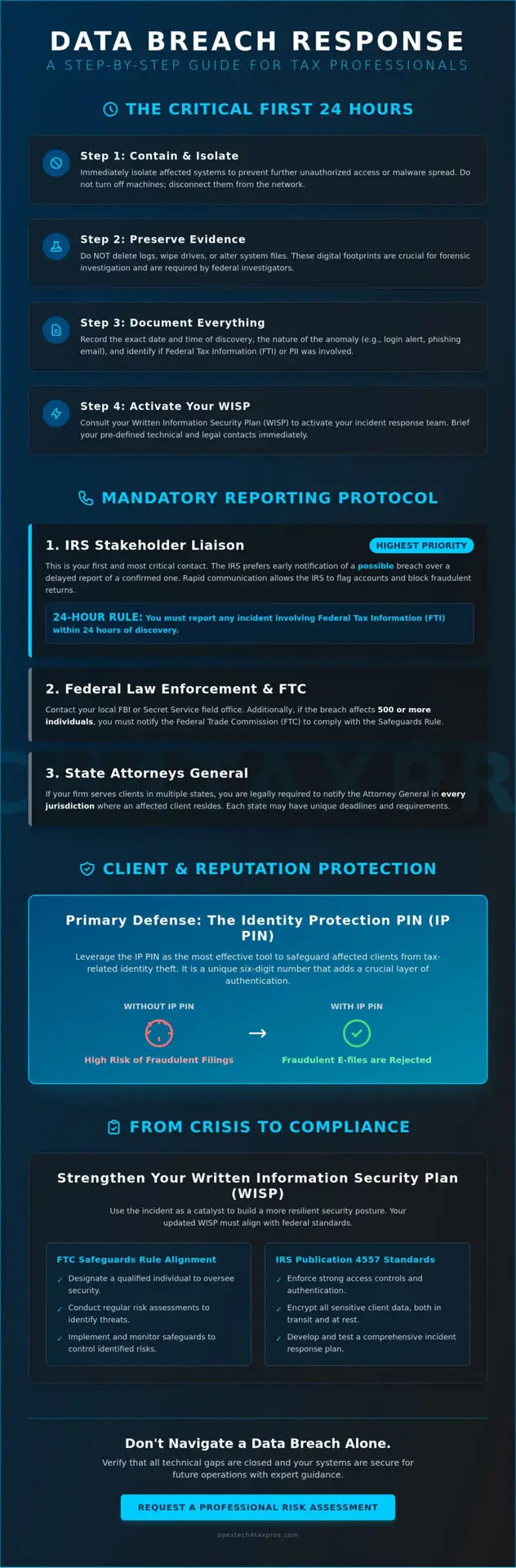
The first 24 hours following the discovery of a security incident determine the trajectory of your firm’s recovery. When you first suspect an intrusion, your priority shifts from tax preparation to forensic preservation. You must isolate affected systems immediately to stop the spread of malware or unauthorized access. However, it’s vital that you don’t delete logs or wipe drives. These digital footprints are the essential evidence required for investigators and will be necessary when you determine exactly how to report a data breach to the irs with a factual account of the event.
Precision is your greatest asset during this window. Document the exact date and time you discovered the anomaly. Whether it was an automated login alert or a staff member reporting a suspicious phishing email, this timestamp serves as the baseline for your regulatory timeline. You need to identify quickly if Federal Tax Information (FTI) or Personally Identifiable Information (PII) was accessed. Consult your Written Information Security Plan (WISP) to activate your pre-defined incident response team. If your plan is current, it will list the specific technical and legal contacts who need to be briefed within these first few hours.
The 24-Hour Rule for Federal Tax Information
The IRS maintains a strict expectation for speed. For any incident involving FTI, the window for initial reporting is just 24 hours. It’s a common misconception that you must wait for a final forensic report before making contact. The IRS differentiates between a “possible” breach and a “confirmed” one; they prefer early notification of a suspected issue over a delayed report of a confirmed disaster. Rapid communication allows the IRS to implement filters that block fraudulent tax returns before they are processed. This proactive stance is also a core requirement for staying compliant with various state and federal data breach notification laws that govern your professional practice.
Initial Triage: What to Tell Your Staff
Your staff is often the first to notice an issue, but they may hesitate to speak up if they fear consequences. Establish a no-blame culture immediately. If an employee realizes they’ve fallen for a phishing scam, they must feel secure reporting it so you can begin the remediation process. Restrict internal communication about the breach to essential personnel to maintain confidentiality and prevent the spread of misinformation. You should draft a brief, formal internal memo that stops all further data processing on compromised systems until they are professionally cleared. This controlled approach ensures that everyone knows how to report a data breach to the irs and other authorities without compromising the integrity of your internal investigation.
Navigating the Federal and State Reporting Requirements
Managing the regulatory fallout of a security incident requires a disciplined sequence of notifications. Many professionals feel paralyzed by the overlapping jurisdictions of federal and state agencies; however, the process becomes manageable when you follow a structured hierarchy. Understanding how to report a data breach to the irs begins with your regional Stakeholder Liaison, who serves as the vital link between your practice and the IRS Criminal Investigation division. While managing these notifications, you may need a professional risk assessment to verify that all technical gaps are closed and your systems are secure for future operations.
Beyond the IRS, your reporting obligations extend to law enforcement and state-level authorities. If your firm manages clients in multiple states, you are legally required to notify the Attorney General in every jurisdiction where data was compromised. For breaches affecting 500 or more individuals, you must also notify the Federal Trade Commission (FTC) to remain compliant with the Safeguards Rule. This federal mandate requires that tax professionals create and enact security plans to protect client data, ensuring that sensitive information remains shielded from unauthorized access.
The Role of the IRS Stakeholder Liaison
These specialized liaisons are your gateway to the Security Summit’s protective resources. They don’t just record the incident; they actively coordinate with the Electronic Tax Administration to flag your clients’ accounts against fraudulent filings. When you initiate this contact, have your EFIN, the total number of compromised records, and the specific nature of the theft prepared for review. When considering how to report a data breach to the irs, your primary goal is this immediate protection of taxpayer accounts to prevent the processing of fraudulent returns.
Filing with the FBI Internet Crime Complaint Center (IC3)
Submitting a report through the ic3.gov portal is a non-negotiable step for any modern tax firm. The process involves providing detailed information about the technical method used in the breach. Once submitted, you’ll receive a federal case number. This document is essential for your cybersecurity insurance provider and serves as a formal record of your firm’s adherence to professional standards. It transforms a chaotic event into a documented legal record of your firm’s due diligence and protects you from claims of negligence.
Protecting Your Clients and Your Firm’s Reputation
Once the technical triage is underway and you’ve understood the mechanics of how to report a data breach to the irs, your attention must turn to the most vulnerable element of your practice: the client relationship. Transparency is the only path forward. While the urge to delay notification until every fact is known is strong, your professional ethics and state laws require a timely, honest disclosure. This moment is a defining test of your firm’s character. By providing a clear, supportive response, you can transform a potential disaster into a demonstration of your commitment to client safety.
You should expect a surge of phone calls and emails the moment notifications are sent. To maintain operational stability, set up a dedicated communication channel, such as a specific email address or a temporary phone line, exclusively for breach-related inquiries. This keeps your standard business lines open for routine tax work while ensuring that affected clients receive the focused, empathetic attention they deserve. Providing a calm, expert presence during these conversations helps de-escalate anxiety and reinforces the idea that you’re an advocate for their protection.
Implementing the Identity Protection PIN (IP PIN)
The primary tool for neutralizing the threat of stolen Social Security numbers is the IRS Identity Protection PIN. This 6-digit code acts as a secondary layer of authentication that prevents identity thieves from filing fraudulent tax returns in your clients’ names. You should guide every affected individual to the “Get An IP PIN” tool on the official IRS website. When you position this recommendation as a proactive protective service rather than just a remedial chore, you demonstrate that your firm is actively working to restore their security. It’s the most effective way to move a client from a state of vulnerability to a state of “protected” status immediately.
Strategic Communication: The Notification Letter
In the United States, specific legal requirements dictate exactly how and when you must notify individuals that their personal data has been compromised. Your notification letter must be clinical, precise, and devoid of defensive language. You need to clearly state what happened, which specific data elements were accessed, and what concrete steps your firm is taking to resolve the issue. Avoid vague promises; instead, provide a clear timeline of your response. It’s also standard professional practice to offer at least one year of credit monitoring services. This gesture of accountability shows that you take the breach seriously and are willing to invest in your clients’ long-term financial health.
Forensic Remediation: Stopping the Bleeding and Finding the Source
While you’ve already addressed the immediate regulatory hurdles of how to report a data breach to the irs, the technical remediation phase requires a different level of precision. You shouldn’t attempt to self-diagnose a sophisticated intrusion. A professional cybersecurity expert must perform a thorough investigation to stop the active theft and identify the source. Whether the breach originated from a deceptive phishing link, a malware injection, or a rare insider threat, a root cause analysis is the only method to ensure the attacker’s access has been completely severed. You must harden your systems and apply critical patches before you can safely return to your normal tax preparation cycle.
System hardening involves more than just running an antivirus scan. It requires a methodical review of your entire digital perimeter. You’ll need to update all firmware, enforce multi-factor authentication across every entry point, and verify that your backups remain uncorrupted. This process ensures that once you close the door on an attacker, it stays locked. Identifying the specific vulnerability that was exploited allows you to implement targeted defenses. This technical discipline is what separates a temporary fix from a long-term security posture that protects your firm’s heritage and future growth.
Why Forensic Evidence Matters
Forensic evidence serves as your firm’s primary defense in the aftermath of an attack. It’s a common impulse to want to “clean” a laptop or server immediately to restore operations. However, doing so without a forensic image destroys the logs and artifacts that prove what actually happened. These reports are essential documentation when demonstrating your firm’s due diligence during an IRS audit or a state attorney general’s inquiry. Forensic analysis also reveals the “dwell time” of the intruder, helping you understand if they were monitoring your firm’s communications for days or months before the discovery. Without this data, you can’t be certain that the threat is truly neutralized.
Cyber Insurance and Legal Counsel
Your insurance policy is a critical component of your recovery roadmap. You should contact your carrier immediately after the IRS Stakeholder Liaison. Specialized cyber insurance differs significantly from general professional liability. It’s specifically designed to handle the high costs of forensic experts, legal counsel, and the credit monitoring services discussed in previous sections. Many policies provide access to “breach coaches” who are attorneys specializing in privacy law. These experts guide you through the complex legal requirements of multi-state reporting. To verify that your firm is currently meeting these rigorous security standards, it’s wise to perform a professional risk assessment to identify and close any remaining vulnerabilities.
From Crisis to Compliance: Building Your 2026 Written Information Security Plan (WISP)
A data breach is a definitive regulatory wake-up call. While you now understand the immediate mechanics of how to report a data breach to the irs and manage the initial fallout, your firm’s long-term survival depends on the structural changes you implement next. A breach effectively proves that your previous security measures were either outdated or improperly enforced. Under the FTC Safeguards Rule and current IRS guidelines, every tax professional is required to maintain a Written Information Security Plan (WISP) that serves as a functional framework for protection rather than a static binder on a shelf.
Your 2026 WISP must align with the rigorous standards detailed in IRS Publication 4557. This involves more than just listing your current software. It requires a documented process for identifying internal and external risks, implementing specific safeguards, and regularly testing those defenses. Annual risk assessments are no longer a suggestion. They are the primary method for identifying the next “weak link” in your infrastructure before a malicious actor can exploit it. By treating your security plan as a living document, you move your practice from a state of reactive crisis to one of proactive, secure compliance.
Customizing Your WISP for 2026 Standards
Many firms make the mistake of using generic templates that fail to account for the unique, high-stakes workflows of a tax practice. A truly effective plan integrates secure cloud backup and multi-factor authentication (MFA) into your daily operations. It also outlines the exact protocols for employee Cybersecurity Awareness Training. This training transforms your staff from a potential liability into a vigilant first line of defense. To begin this transition and evaluate your current posture, you can Download our Free WISP Template or contact our team to schedule a professional risk assessment today.
The Apex Tech 4 Tax Pros Approach to Recovery
We specialize in bridging the gap between high-level tax preparation and the technical requirements of modern IT security. Our mission is to ensure that financial practitioners don’t have to navigate these heavy regulatory burdens alone. We understand the nuances of how to report a data breach to the irs and, more importantly, how to prevent that report from ever being necessary again. From performing deep-dive risk assessments to delivering a fully customized security plan, we provide the technical expertise needed to restore your practice. You can Secure your firm with a customized WISP and meet federal security standards with total confidence in your firm’s resilience.
Restoring Resilience to Your Tax Practice
Navigating a security incident is a defining moment for any financial practitioner. By mastering the sequence of how to report a data breach to the irs, engaging with the Stakeholder Liaison, and implementing the Identity Protection PIN for your clients, you transform a crisis into a structured recovery. You’ve learned that immediate containment and forensic preservation are the foundations of a successful response. Now, the priority shifts toward ensuring this vulnerability never repeats. Our team brings decades of experience in high-stakes technical security to help you navigate these complex federal mandates.
We provide expert-led risk assessments for accounting firms specifically designed to ensure full IRS Publication 4557 compliance. You don’t have to manage these regulatory burdens alone while trying to maintain your client relationships. Secure your firm with a professional Written Information Security Plan (WISP) today to anchor your practice in a state of permanent, secure compliance. With the right roadmap and a dedicated partner, you can move forward with the confidence that your firm and your clients are fully protected.
Frequently Asked Questions
Do I have to report a data breach to the IRS if only one client was affected?
Yes, you must report any unauthorized access to Federal Tax Information (FTI) even if only a single client’s data is involved. The IRS requirement isn’t based on the quantity of stolen records but on the sensitive nature of the data compromised. Early reporting allows the IRS to flag that specific taxpayer’s account for fraudulent activity, preventing a potential identity theft claim before it begins.
How do I find my local IRS Stakeholder Liaison?
You can find your local IRS Stakeholder Liaison by visiting the IRS.gov website and searching for “Stakeholder Liaison Local Contacts.” The IRS maintains a directory organized by state and territory to ensure tax professionals have direct access to regional support. If you’re unsure which office to contact, the Practitioner Priority Service at 866-860-4259 can often provide the correct routing information for your specific jurisdiction.
Will the IRS fine me if I report a data breach?
No, the act of reporting a breach doesn’t automatically trigger an IRS fine. In fact, immediate reporting is viewed as a sign of professional compliance and due diligence. Penalties are typically reserved for firms that fail to maintain a Written Information Security Plan (WISP) or those that attempt to conceal a breach, which violates federal standards and practitioner ethics.
What is the difference between a WISP and an incident response plan?
A Written Information Security Plan (WISP) is a comprehensive strategy that outlines your firm’s ongoing security posture, while an incident response plan is a specific tactical subset of that document. Your WISP covers daily preventative measures like cloud backups and staff training. The incident response plan provides the step-by-step instructions for how to report a data breach to the irs and other authorities once an intrusion is detected.
Can my tax software provider be held liable for a data breach in my office?
Generally, your tax software provider isn’t liable for a breach that occurs within your own office environment. While providers are responsible for the security of their own cloud infrastructure, the IRS and FTC hold you accountable for “at-rest” data security on your local hardware. This includes ensuring your staff uses multi-factor authentication and that your office network is shielded by a robust, professional security protocol.
How long do I have to notify my clients after a breach occurs?
Client notification timelines vary by state law, but most jurisdictions require you to inform affected individuals “without unreasonable delay.” While you must report to the IRS within 24 hours of discovering an incident involving tax information, you should coordinate the timing of client letters with law enforcement. This ensures your notification doesn’t accidentally alert a hacker or impede an ongoing criminal investigation into the data theft.
What happens if I fail to report a data breach to the IRS?
Failing to report a data breach can result in the immediate suspension of your Electronic Filing Identification Number (EFIN) and severe civil penalties. Beyond federal sanctions, a failure to report leaves you vulnerable to private lawsuits from affected clients who suffer identity theft as a result of your silence. Understanding how to report a data breach to the irs is essential for protecting your professional license and your firm’s heritage.
Does the FTC Safeguards Rule apply to solo tax practitioners?
Yes, the FTC Safeguards Rule applies to all financial institutions, which explicitly includes solo tax practitioners and small accounting firms. There’s no minimum employee count for these security requirements. Every professional who handles sensitive client financial data must implement a Written Information Security Plan and perform regular risk assessments to remain compliant with federal law and protect their practice from unauthorized intrusions.