
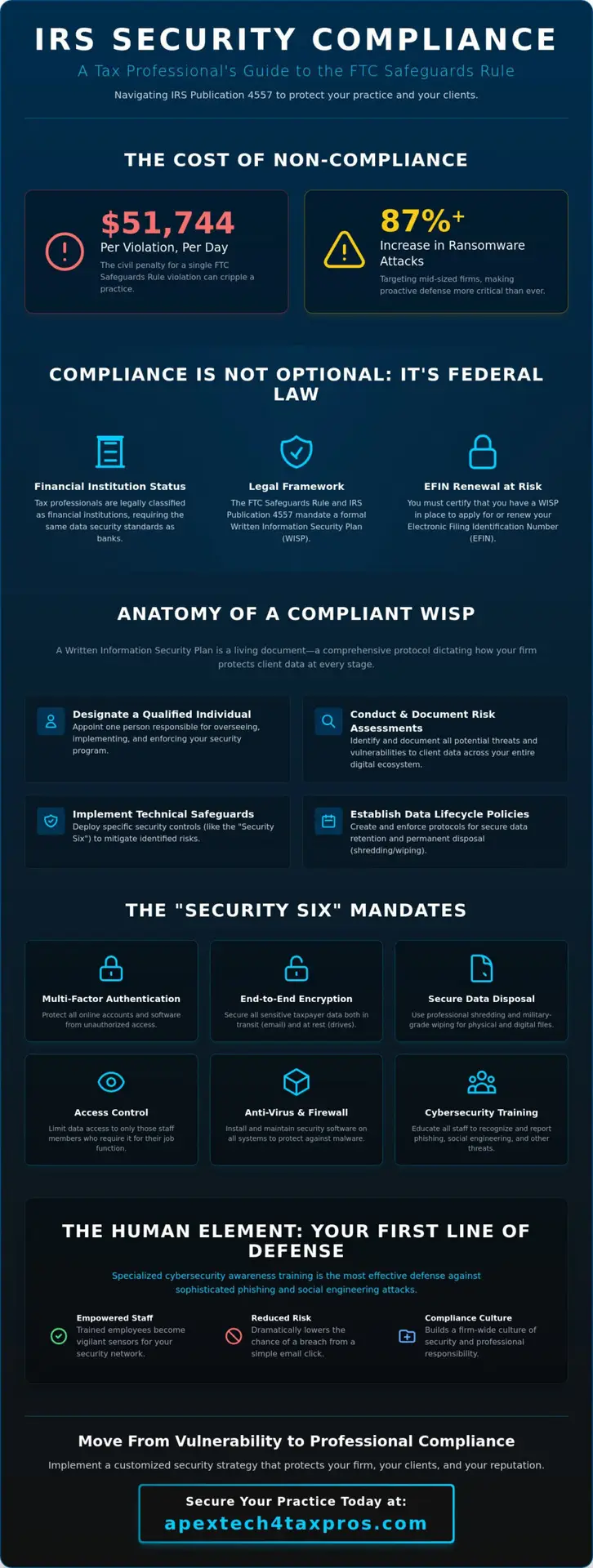
Non-compliance with the FTC Safeguards Rule carries a civil penalty of up to $51,744 per violation per day. For a growing firm, a single oversight isn’t just a technical glitch; it is a direct threat to your practice’s longevity and your clients’ trust. You likely feel the weight of this responsibility every time you open a new client file or read about the 87% increase in ransomware attacks targeting mid-sized practices. It’s natural to feel overwhelmed by the technical jargon in IRS Publication 4557, especially as you prepare for the 2026 filing season. Developing a robust tax preparer identity theft prevention plan shouldn’t feel like a guessing game where your professional reputation is the stakes.
This guide provides the pragmatic clarity you need to move from a state of vulnerability to secure compliance. We’ll outline a clear roadmap for WISP documentation, detail the mandatory Security Six measures, and show you how to implement a living system that secures your firm and satisfies IRS standards during any security audit. By the end of this article, you’ll have a professional strategy to protect your data and maintain the confidence of every taxpayer you serve.
Key Takeaways
- Understand how IRS Publication 4557 and the FTC Safeguards Rule mandate a formal Written Information Security Plan (WISP) for every professional practice.
- Learn the essential steps to build a robust tax preparer identity theft prevention plan that includes designated security oversight and documented risk assessments.
- Identify the specific technical controls, such as multi-factor authentication and end-to-end encryption, required to protect sensitive taxpayer data in transit and at rest.
- Discover why specialized cybersecurity awareness training is the most effective defense against the sophisticated phishing and social engineering tactics emerging in 2026.
- Move beyond static “set and forget” templates by implementing a customized security strategy that addresses the unique vulnerabilities of your firm’s digital ecosystem.
The IRS Mandate: Why Every Tax Preparer Needs a Formal Identity Theft Prevention Plan
Federal law now treats tax professionals as financial institutions. This classification carries significant weight. It means your firm must operate under the same stringent security standards as a bank or a credit union. The cornerstone of this compliance is a formal tax preparer identity theft prevention plan. Without it, you aren’t just risking a data breach; you are operating outside of federal law. This isn’t a suggestion from the IRS. It is a strict mandate that governs how you handle every taxpayer’s life’s work.
A Written Information Security Plan (WISP) serves as the foundation of your defense. It is not a static PDF to be filed away in a digital drawer. Instead, it is a comprehensive protocol that dictates how your firm handles every piece of sensitive data from the moment it enters your system. In 2026, the IRS has moved beyond simple recommendations to active enforcement. They expect your security plan to be a living system that evolves as quickly as the threats do.
The Legal Framework: FTC vs. IRS Requirements
Compliance requires understanding how the FTC Safeguards Rule and IRS Publication 4557 intersect. The FTC sets the broad regulatory standard for protecting consumer data, while the IRS provides the specific implementation guide for tax professionals. The Written Information Security Plan (WISP) is a mandatory requirement for all tax practitioners regardless of firm size. The IRS now monitors this through the EFIN application and renewal process. If you can’t certify that you have a WISP in place, your ability to e-file is at risk. Civil penalties for violations can reach $51,744 per day, making non-compliance a catastrophic financial risk for any practice.
The Business Case for Proactive Prevention
Beyond the threat of fines, a proactive approach protects your most valuable asset: your reputation. Tax-related identity theft can devastate a client’s life and permanently sever the bond of trust you’ve built over years of service. When you demonstrate a robust security posture, you transform compliance into a competitive advantage. Clients in 2026 are increasingly aware of digital threats. They want to know their data is in safe, capable hands. A formal plan reduces your legal liability by proving you took reasonable steps to protect data in the event of a sophisticated attack.
Security is no longer a seasonal concern. Cybercriminals target accounting firms during the off-season when they believe vigilance might be lower. Your prevention plan must be a year-round commitment to monitoring, training, and system updates. It’s about building a culture of security that persists long after the filing deadline has passed. Protecting client data is a mission-driven responsibility that requires constant discipline and professional oversight.
Core Components of an IRS-Compliant Written Information Security Plan (WISP)
A comprehensive tax preparer identity theft prevention plan is not a collection of vague ideas. It is a structured administrative framework designed to withstand federal scrutiny. The FTC Safeguards Rule requires your firm to designate a “qualified individual” to oversee your security program. This person is responsible for the plan’s implementation and ongoing maintenance. They act as the internal authority, ensuring that every staff member adheres to the established protocols and that your technical infrastructure remains resilient against emerging threats.
Beyond leadership, your WISP must include specific protocols for document retention and disposal. Sensitive taxpayer information should only be kept as long as legally necessary. Once that period ends, you need a verified method for destruction. This process involves professional shredding services for physical copies or military-grade wiping for old hard drives. Managing the lifecycle of data is a critical step in reducing the surface area available to cybercriminals.
The Professional Risk Assessment
A risk assessment is the diagnostic tool that identifies your firm’s unique vulnerabilities. You must document every touchpoint where client data is stored or transmitted. This includes evaluating whether data sits on local servers or in the cloud. It also requires a rigorous review of your software vendors. If a third-party application handles your client files, you are responsible for ensuring their security standards align with IRS Publication 4557. You should document potential threats ranging from physical office theft to sophisticated remote hacking attempts. If you find gaps during this process, a professional risk assessment can provide the technical depth needed to remediate those weaknesses before they are exploited.
Incident Response and Breach Notification
Even the most disciplined firms must prepare for the unexpected. Your WISP is incomplete without a clear incident response plan. This protocol dictates exactly how your team should react if a breach is suspected. In 2026, the FTC requires notification within 30 days if a breach involves the unencrypted information of 500 or more customers. You should have draft notification letters ready for clients, the IRS, and state authorities before an emergency happens. Speed is critical during a ransomware event. Your response plan should detail how to utilize secure cloud backups to restore operations without paying a ransom. A well-prepared response, integrated into your broader tax preparer identity theft prevention plan, demonstrates to both regulators and clients that you are a vigilant protector of their most sensitive information.
Technical Safeguards: Securing Data at Rest and in Transit
Establishing a robust tax preparer identity theft prevention plan requires more than just administrative signatures. It demands a technical architecture designed to withstand relentless intrusion attempts. Multi-factor authentication (MFA) is your first line of defense. It isn’t enough to secure your tax software; you must also apply MFA to every email account and cloud storage endpoint. This simple layer of verification stops the vast majority of automated attacks by requiring a second form of identity before granting access to sensitive data.
Encryption serves as the second pillar of a compliant technical strategy. The FTC Safeguards Rule makes it clear that firms must protect information throughout its entire lifecycle. Data at rest on hard drives must be as secure as data in transit across the web. If a device is stolen or an email is intercepted, encryption ensures the data remains unreadable and useless to the unauthorized party. This protective layer is a non-negotiable requirement for maintaining the integrity of taxpayer information.
Encryption Standards for 2026
Basic password protection is no longer sufficient for sensitive tax documents. Cybercriminals now use sophisticated brute-force tools that can crack simple passwords in seconds. You should transition away from sending encrypted email attachments, which often rely on weak shared secrets. Instead, utilize secure client portals where documents are uploaded directly into an encrypted environment. This keeps the data within your controlled ecosystem and provides a clear audit trail for compliance, which is vital during a security audit.
Secure Cloud Infrastructure
Relying on consumer-grade cloud storage is a significant risk for a professional firm. Professional-grade secure cloud backup solutions offer the data redundancy and versioning needed to survive a catastrophic hardware failure or a ransomware attack. These systems are specifically engineered for high-stakes environments and are vetted for IRS Publication 4557 compliance. They ensure that your data is not only backed up but also isolated from your primary network to prevent lateral infection during a cyberattack.
Physical security and remote work protocols complete your technical defense. A “clean desk” policy prevents unauthorized viewing of sensitive papers, while locked hardware ensures that physical machines cannot be easily tampered with. For hybrid teams, managing “Bring Your Own Device” (BYOD) risks is essential. You must implement mobile device management (MDM) to ensure that any personal phone or laptop used for work meets your firm’s rigorous security standards. This comprehensive approach ensures that your tax preparer identity theft prevention plan is resilient across all work environments.
The Human Element: Training Staff to Detect and Deflect Phishing
Even the most sophisticated technical safeguards are vulnerable to human error. Research indicates that 60% of all data breaches involve a human element. This reality makes staff education a critical pillar of your tax preparer identity theft prevention plan. Cybercriminals in 2026 no longer rely on generic, poorly spelled emails. They now utilize AI-powered phishing and social engineering to create highly convincing impersonations of IRS officials or software vendors. Without a disciplined workforce, your technical defenses can be bypassed by a single misplaced click.
Training should focus on deflecting these advanced tactics through rigorous skepticism. It is essential to establish a “Verification of Identity” protocol for every sensitive request. If a client or colleague asks for a password reset or a data transfer via email or phone, staff must verify the request through a secondary, trusted channel. This simple step ensures that a compromised account cannot be used to move laterally through your firm’s data. Vigilance must be a year-round habit rather than a seasonal checkbox.
Cybersecurity Awareness Training Programs
A culture of security begins on day one. Mandatory onboarding training for seasonal hires is vital, as these temporary staff members often lack familiarity with your specific security protocols. Your education efforts must be continuous, addressing evolving threats like “Spear Phishing” that target specific individuals within your practice. We recommend building a “no-blame” culture where employees feel empowered to report suspicious links or accidental errors immediately. Rapid reporting often makes the difference between a minor incident and a full-scale breach. To ensure your team is truly prepared, you can implement Cybersecurity Awareness Training that includes regular phishing simulations to test readiness in a controlled environment.
Access Control and Least Privilege
Beyond training, you must manage how staff interact with data through the principle of least privilege. This means limiting employee access to only the specific files and systems required for their roles. Unique login credentials for every team member are a non-negotiable requirement. They provide the accountability and audit trails necessary for compliance with federal standards. When a staff member leaves the firm, their access must be terminated immediately. Leaving an orphan account active for even a few hours creates a significant vulnerability that attackers can exploit. By strictly controlling access, you reduce the potential impact of a compromised credential and strengthen the overall integrity of your tax preparer identity theft prevention plan.
Implementing Your Plan: From Template to Professional Compliance
The transition from understanding regulatory requirements to active implementation is where many firms face their greatest challenge. A tax preparer identity theft prevention plan is only as effective as its execution within your specific digital environment. Many practitioners make the mistake of treating the Written Information Security Plan (WISP) as a one-time compliance hurdle. In reality, it is a living operational standard that must evolve alongside your firm’s technology and the increasingly sophisticated tactics used by cybercriminals. Moving beyond a “checkbox” mentality is essential for protecting your practice from the catastrophic financial and reputational costs of a data breach.
Professional implementation requires a bridge between tax industry knowledge and technical IT expertise. Generalist IT providers often lack the specialized understanding of IRS Publication 4557 or the nuances of the FTC Safeguards Rule. Partnering with a provider that specializes in the accounting niche ensures that your security controls are not only robust but also aligned with federal mandates. This collaborative approach allows you to focus on client service while seasoned experts manage the complex technical infrastructure required to keep your data secure.
Template Pitfalls vs. Customized Solutions
Generic WISP templates can be a helpful starting point, but they often create a false sense of security. A generic document may fail an IRS audit during a security review because it doesn’t accurately reflect your firm’s unique workflows, software integrations, or remote access protocols. If your documentation says you use specific encryption standards that aren’t actually active on your network, you are essentially documenting your own non-compliance. Expert-led plan development provides the depth needed for complex firm structures, ensuring that every data touchpoint is accounted for. For firms seeking a higher standard of protection, Customized WISP Solutions offer a tailored framework that meets the exact specifications of your practice.
Next Steps for Tax Professionals
Securing your firm for the 2026 filing season requires immediate, disciplined action. You should begin with a rigorous audit of your current security documentation to identify outdated protocols. Technology moves fast; a plan written two years ago likely doesn’t account for the rise of AI-driven social engineering or the latest cloud security standards. Establishing an annual review cycle is a mandatory requirement to keep your tax preparer identity theft prevention plan current and effective. We recommend the following steps to solidify your defense:
- Conduct an immediate internal audit of all hardware and software access points.
- Schedule a professional risk assessment to identify hidden vulnerabilities in your network.
- Update your staff training modules to include the latest phishing tactics.
- Verify that all third-party vendors meet current IRS data protection standards.
Your professional reputation and your clients’ financial lives depend on the vigilance you exercise today. Taking a proactive, expert-guided approach to security is the only way to ensure your firm remains resilient in a high-stakes digital landscape. Download our free WISP template or book a professional assessment today to begin your journey toward secure, professional compliance.
Securing Your Firm’s Future in a High-Stakes Regulatory Environment
The 2026 filing season demands more than just technical accuracy; it requires a disciplined commitment to data sovereignty. A robust tax preparer identity theft prevention plan is no longer a secondary administrative task. It is the primary shield that protects your clients’ sensitive information and your firm’s professional legacy. By prioritizing a customized Written Information Security Plan, implementing rigorous technical controls, and fostering a vigilant staff culture, you transform regulatory burden into a distinct competitive advantage.
Navigating the intersection of IRS Publication 4557 and complex IT infrastructure requires a specialized partner who understands the specific pressures of the tax industry. Our team specializes in bridging this gap, providing expert-led compliance strategies, comprehensive cybersecurity awareness training, and resilient secure cloud backup solutions. Don’t leave your practice vulnerable to evolving threats or federal penalties. Secure Your Firm with a Customized WISP and Professional Risk Assessment today. With the right systems in place, you can approach your next security audit with absolute confidence and peace of mind.
Frequently Asked Questions
Is a Written Information Security Plan (WISP) required for solo tax preparers?
Yes, every professional tax preparer is required to maintain a Written Information Security Plan regardless of firm size. Federal law classifies all tax professionals as financial institutions under the Gramm-Leach-Bliley Act. This means even solo practitioners must document their administrative, technical, and physical safeguards to protect client data. Failing to have a plan in place can result in the suspension of your Electronic Filing Identification Number (EFIN).
What are the penalties for not having an identity theft prevention plan?
The civil penalty for non-compliance with the FTC Safeguards Rule can be up to $51,744 per violation per day. Beyond these federal fines, the IRS can suspend your ability to e-file by revoking your EFIN. You also face significant legal liability if a breach occurs and you cannot prove you had a formal tax preparer identity theft prevention plan in place to protect sensitive taxpayer information.
How often should a tax firm update its WISP?
You should review and update your WISP at least once per year or whenever there is a significant change to your firm’s operations or technology. This includes adding new software, moving to a remote work model, or hiring seasonal staff. Regular updates ensure that your security protocols address the latest AI-driven threats and remain compliant with the most recent versions of IRS Publication 4557.
What does IRS Publication 4557 require regarding staff training?
IRS Publication 4557 requires all firms to provide cybersecurity awareness training to every employee with access to taxpayer information. This training must cover the identification of phishing attempts and the proper handling of sensitive data. You must also document that this training occurred to satisfy IRS audit requirements. Continuous education is necessary to ensure staff can deflect the sophisticated social engineering tactics targeting firms in 2026.
Can I use a free WISP template for my accounting firm?
You can use a free WISP template as a starting point, but it will not satisfy IRS requirements unless it is heavily customized to your specific firm. A generic document that does not reflect your actual network architecture or document disposal practices is essentially useless during a security audit. For complex practices, a customized plan developed by professionals is the only way to ensure every unique vulnerability is addressed.
How does the FTC Safeguards Rule affect small tax practices in 2026?
In 2026, the FTC Safeguards Rule requires small tax practices to implement the same core security measures as larger institutions. This includes designating a qualified individual to oversee security and conducting regular risk assessments of all data touchpoints. Small firms are no longer shielded by their size; they are expected to maintain a professional tax preparer identity theft prevention plan that meets federal data protection standards.
What is the first step if I suspect a client’s data has been compromised?
Your first step should be to contact your local IRS Stakeholder Liaison immediately to report the potential breach. This allows the IRS to take steps to protect your clients’ accounts from fraudulent filings. You must also follow your internal incident response plan, which should include notifying state tax agencies and the FTC if the breach involves the unencrypted information of 500 or more customers.
Does cloud software count as a secure identity theft prevention plan?
No, using cloud-based tax software does not constitute a complete security plan. While secure software is a critical technical safeguard, a WISP must also cover administrative protocols, physical office security, and staff training requirements. Your plan must explain how you use that software within a broader framework of data protection that includes secure cloud backup and documented risk management.