
In 2026, your EA license is only as secure as your digital perimeter. With the FTC now empowered to impose fines of up to $46,517 per violation, the stakes for your practice have never been higher. As a seasoned tax professional, you understand that failing to meet the latest enrolled agent data security requirements is no longer just a technical oversight; it’s a direct threat to your professional standing and your clients’ trust. We know you’ve spent years building your practice. The thought of an IRS audit or a license revocation due to a documentation gap is a weight no professional should carry alone.
You likely feel the pressure of managing complex encryption and mandatory WISPs while trying to run a busy firm. It’s a common struggle, but regulatory compliance doesn’t have to be a source of constant anxiety. This guide provides the clinical precision you need to master the complex web of IRS and FTC mandates. We will provide a clear checklist of mandatory security controls, a streamlined path to WISP completion, and the confidence required to pass an IRS compliance review. By the end of this article, you’ll have a roadmap to transform these daunting federal mandates into a robust shield for your firm’s future.
Key Takeaways
- Understand how the “Security Trinity” of IRS Publication 4557, FTC Safeguards, and Circular 230 creates a mandatory framework for your professional practice.
- Identify the specific enrolled agent data security requirements necessary to maintain your EFIN and avoid the severe financial penalties associated with non-compliance.
- Discover why a customized Written Information Security Plan (WISP) is more than just a template; it’s your primary defense during an IRS compliance review.
- Learn to implement immediate technical “quick wins,” such as multi-factor authentication and drive encryption, to secure your most critical taxpayer data.
- Transition from basic IT support to professional compliance management, turning your robust security posture into a distinct marketing advantage for your firm.
Navigating the 2026 Regulatory Landscape for Enrolled Agents
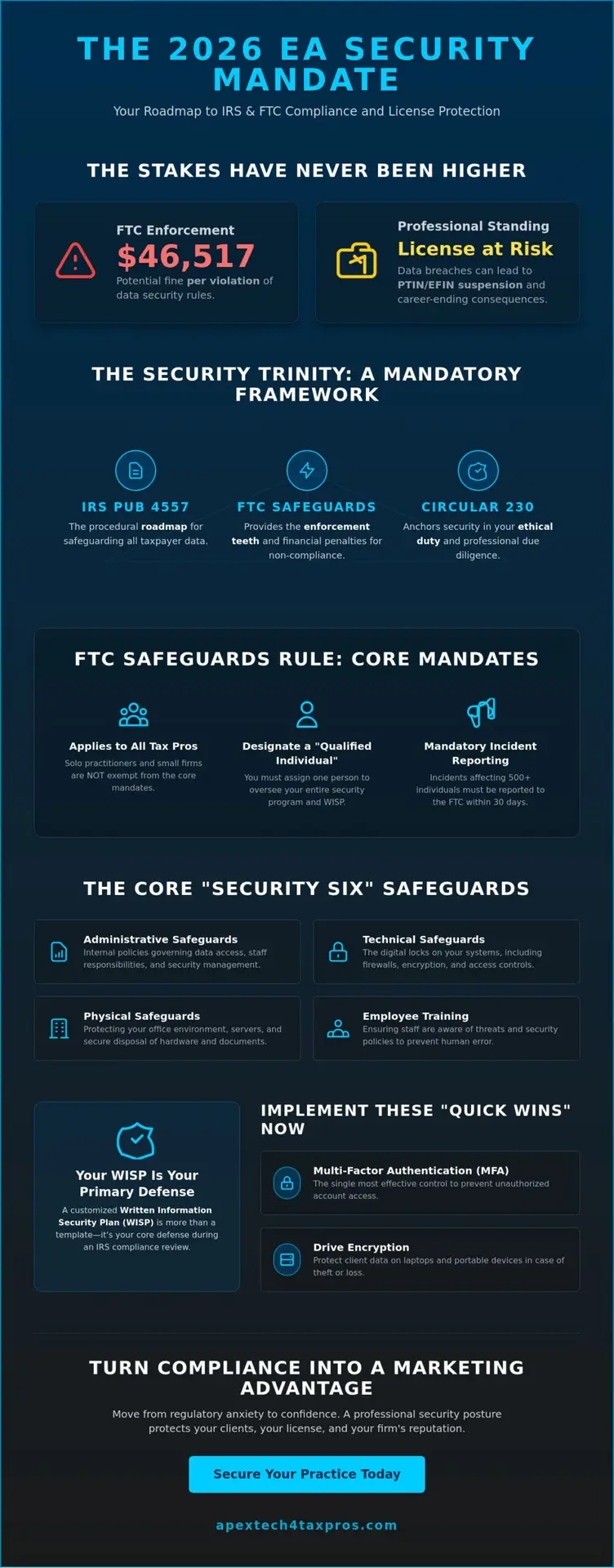
The regulatory environment for an Enrolled Agent has shifted from suggested guidelines to rigid, enforceable mandates. 2026 stands as a definitive turning point for federal enforcement. The IRS and FTC have moved beyond simple education, focusing instead on rigorous oversight of how financial data is handled. Meeting modern enrolled agent data security requirements is no longer a matter of best practices; it’s a matter of licensure survival. This oversight is anchored in what we call the “Security Trinity,” a powerful overlap between IRS Publication 4557, the FTC Safeguards Rule, and Treasury Department Circular 230.
While IRS Publication 4557 provides the procedural roadmap for safeguarding taxpayer data, the FTC Safeguards Rule provides the enforcement teeth. Circular 230 anchors these requirements in your ethical duty to your clients. Together, they protect “Taxpayer Information” as defined by the Gramm-Leach-Bliley Act (GLBA). This definition is broad, encompassing any personally identifiable financial information you collect while providing tax services. It’s not just social security numbers. It’s bank balances, investment histories, and even the mere fact that someone is your client. The consequences of a failure here are absolute. A single data breach can lead to the immediate suspension of your PTIN or EFIN, effectively ending your ability to practice.
The FTC Safeguards Rule: Mandatory for All Tax Pros
A common misconception is that solo practitioners or small firms are exempt from these regulations. This is incorrect. While firms handling data for 5,000 or more consumers face additional requirements like annual penetration testing, the core mandates apply to every Enrolled Agent. You’re required to designate a “Qualified Individual” to oversee your security program. This person is responsible for maintaining your Written Information Security Plan (WISP) and ensuring your safeguards remain effective. Additionally, 2026 reporting requirements are strict. If a security incident affects 500 or more individuals, you must notify the FTC within 30 days of discovery. Silence is not an option.
Circular 230 and the Ethics of Data Protection
Section 10.33 of Circular 230 outlines the best practices for tax advisors, emphasizing the duty of due diligence. In a digital-first economy, due diligence is inseparable from cybersecurity. Failing to secure client data is now viewed as a violation of professional ethical standards. There’s a direct, unbreakable link between client confidentiality and modern encryption standards. If you’re transmitting sensitive documents via unencrypted email, you aren’t just risking a leak; you’re failing your ethical obligation to provide competent service. Professional security management is the only way to align your technical infrastructure with the high standards of your EA license.
The Six Safeguards: Decoding IRS Publication 4557 Requirements
The IRS has transitioned from offering vague suggestions to enforcing a structured framework of six critical security measures. These measures, frequently referred to as the “Security Six,” form the operational core of IRS Publication 4557. For a seasoned practitioner, understanding these domains is the difference between a resilient practice and one vulnerable to federal scrutiny. Administrative safeguards involve the internal policies that dictate data access and staff responsibilities. Physical safeguards focus on your office environment and the secure disposal of hardware. Technical safeguards act as the digital locks on your systems. Finally, mandatory employee training ensures your staff doesn’t inadvertently bypass these protections.
In 2025, research indicated that over 70% of tax-related data breaches were linked to firms with inadequate security protocols. This statistic underscores why current enrolled agent data security requirements are so uncompromising. Protection isn’t achieved through a single software purchase. It requires a holistic approach that integrates technical controls with disciplined administrative oversight. It’s about creating a culture of security where every device and every interaction is accounted for within your firm’s infrastructure.
Technical Controls You Cannot Ignore
Multi-Factor Authentication (MFA) is your first line of defense. By 2026 standards, relying on SMS-based codes is no longer considered sufficient due to the prevalence of SIM-swapping attacks. You should utilize authenticator apps or physical hardware keys to secure all entry points. Encryption is equally vital, and you must understand the distinction between its two states. Encryption at rest protects the data residing on your hard drives, while encryption in transit secures information as it moves through emails or client portals. Implementing a Secure Cloud Backup solution is a pragmatic way to meet IRS data availability standards while ensuring your records remain encrypted and accessible even after a local hardware failure.
Physical and Administrative Security
Your security posture is only as strong as your weakest vendor. You have a professional obligation to ensure that software providers, such as Drake or QuickBooks, adhere to federal compliance standards. This oversight is part of a broader device management strategy that secures every laptop and mobile device used for tax preparation. Beyond hardware, you’re required to conduct an annual Risk Assessment to identify emerging vulnerabilities. The threat landscape evolves rapidly, especially with the rise of AI-driven spear phishing campaigns that specifically target the tax industry. Regular assessments allow you to update your defenses before a vulnerability is exploited.
The Written Information Security Plan (WISP): Moving Beyond Templates
A Written Information Security Plan (WISP) is the foundational document of your compliance architecture, and it’s essential for meeting current enrolled agent data security requirements. It’s no longer an optional best practice. The IRS now requires every tax professional to confirm they have a WISP in place when obtaining or renewing an Electronic Filing Identification Number (EFIN). While earlier sections detailed the technical controls you must implement, the WISP is where you document exactly how those controls function within your specific practice. It serves as the primary evidence of your adherence to the FTC Safeguards Rule during a regulatory review.
Many professionals fall into the trap of “Template Fatigue.” They download a generic, 50-page document, sign the last page, and consider the task finished. This approach is a significant liability. The IRS looks for implementation, not just documentation. If your WISP describes a complex server environment but you operate as a solo practitioner using cloud-based software, the document is clearly non-compliant. Your plan must be customized to align with your actual hardware, software, and staff size. It must be a living document that evolves alongside new 2026 threats.
Core Components of a Compliant WISP
A robust WISP requires more than just technical jargon. It must explicitly designate a program coordinator responsible for overseeing your security posture. This individual identifies internal and external risks to taxpayer data and documents the safeguards used to mitigate them. Your plan must also include a detailed incident response plan. This section outlines the exact steps your firm will take if a breach is detected. Finally, you must maintain a complete inventory of all systems and devices that store or transmit sensitive information. This inventory is the baseline for all other security decisions.
Why “DIY” WISPs Often Fail IRS Scrutiny
Self-authored plans frequently contain critical gaps that invite regulatory scrutiny. Common omissions include employee termination protocols and specific hardware disposal policies. If a staff member leaves, how is their access revoked? When a laptop is retired, how is the drive destroyed? A WISP is a dynamic operational framework rather than a static PDF. Failing to address these practical realities is often referred to as the “Check-the-Box” fallacy. The IRS expects to see that your policies are active and understood by everyone in your firm. Meeting enrolled agent data security requirements means proving that your written plan matches your daily digital actions.
Step-by-Step Implementation: Securing Your Tax Practice Today
Theory alone cannot protect a firm. Moving from regulatory understanding to technical resilience requires a disciplined, step-by-step approach. Adhering to enrolled agent data security requirements isn’t a weekend project; it’s a continuous operational cycle. By following a prioritized roadmap, you can address the most critical vulnerabilities first, ensuring your practice remains compliant and your clients’ data remains impenetrable.
- Step 1: Conduct a Baseline Risk Assessment. You cannot protect what you haven’t identified. Begin by auditing every point of data entry and storage. This clinical evaluation highlights where your current defenses fall short of IRS standards.
- Step 2: Deploy Technical “Quick Wins.” Implement multi-factor authentication (MFA) across all professional accounts. Enable full-disk encryption on every laptop and utilize a firm-wide password manager to eliminate the risks associated with weak or reused credentials.
- Step 3: Draft and Implement Your Customized WISP. Using the findings from your risk assessment, document your specific workflows. This plan must be more than a static document; it must guide your daily operations and be accessible to all staff.
- Step 4: Train Your Team. Technology is only as effective as the people using it. Educate your staff on the 2026 threat landscape, focusing on the sophisticated social engineering tactics that peak during filing season.
- Step 5: Establish a Continuous Monitoring Cycle. Compliance is not a “set it and forget it” task. Schedule an annual review to update your safeguards as new threats emerge and to ensure your “Qualified Individual” remains informed.
Priority 1: Hardening the Human Element
Staff training remains the most cost-effective security control available to a modern tax practice. Even the most advanced encryption can be bypassed by a single clicked link in a sophisticated phishing email. Attackers now use AI to generate highly convincing spear-phishing messages that mimic IRS correspondence or urgent client inquiries. Protecting your firm requires every team member to be vigilant and disciplined. Implementing Cybersecurity Awareness Training ensures that your staff can recognize these modern social engineering tactics before they lead to a breach. This proactive education transforms your team from a potential vulnerability into a robust line of defense.
Priority 2: Infrastructure and Continuity
Relying on local hardware for data storage is a significant risk to your practice’s continuity. A single hardware failure or ransomware attack can halt your operations and lead to the loss of irreplaceable taxpayer records. Transitioning to a Secure Cloud Backup solution eliminates these single points of failure. Additionally, you should replace unencrypted email attachments with a secure client portal. This change ends the dangerous practice of sending sensitive PDFs through insecure channels, ensuring that all data remains protected in transit and at rest. This ensures your infrastructure meets the latest enrolled agent data security requirements while providing a streamlined experience for your clients. To begin securing your infrastructure today, you can start with a professional Risk Assessment to pinpoint your firm’s specific needs.
Protecting Your EA Career with Professional Security Management
The role of an Enrolled Agent has fundamentally changed. You’re no longer just a tax expert; you’re a custodian of sensitive digital identities. This evolution marks a significant shift from traditional IT support to comprehensive compliance management. In the past, having a technician for basic troubleshooting was sufficient. Today, meeting enrolled agent data security requirements necessitates a sophisticated advisor who understands the intersection of tax law and cybersecurity infrastructure. Protecting your career means recognizing that technical vulnerabilities are now professional liabilities that can end a practice overnight.
A robust security posture serves as a powerful marketing advantage. Research indicates that over 85% of taxpayers now expect their firms to demonstrate rigorous data protection measures. When you can confidently explain your security protocols to a client, you aren’t just discussing software; you’re offering peace of mind. This transparency builds a level of trust that generic practices cannot match. By treating security as a core value rather than a regulatory burden, you distinguish your firm as a premier choice for high-net-worth individuals and corporate clients who prioritize confidentiality.
The Apex Tech 4 Tax Pros Advantage
We understand the unique pressures of the tax industry because we specialize exclusively in this niche. We speak both “Tax Pro” and “IT Security” fluently, allowing us to bridge the gap between complex federal mandates and your daily operations. Our process involves developing a Customized Written Information Security Plan (WISP) that satisfies the rigorous standards of both the IRS and the FTC. We provide the clinical precision required for annual Risk Assessments and Cybersecurity Awareness Training, ensuring you remain compliant year-round without sacrificing your billable hours to manage IT infrastructure.
Next Steps: Securing Your Future
Waiting for a breach or an IRS audit to occur is a high-risk strategy that could jeopardize your professional standing. Proactive management is the only way to ensure your practice remains resilient against modern threats like AI-driven phishing. Before your next filing season begins, review this final checklist to gauge your readiness for a 2026 security review:
- Have you designated a Qualified Individual to oversee your security program?
- Is your WISP customized to your specific hardware and current staff size?
- Is multi-factor authentication active on every professional account and device?
- Have you completed a comprehensive risk assessment within the last 12 months?
- Can you produce documentation proving your staff has received cybersecurity training?
If you’re unsure about any of these points, you should download our FREE WISP Download Template to see where your current plan stands. Don’t let technical overwhelm jeopardize the practice you’ve spent decades building. You’ve worked hard to earn your EA license; let us help you protect it. To ensure your firm meets every enrolled agent data security requirement, Schedule your professional Risk Assessment with Apex Tech today.
Securing Your Professional Legacy in a Digital Age
The transition from simple IT maintenance to rigorous compliance management is a defining moment for your practice. You now have the roadmap to navigate the “Security Trinity” and implement the six essential safeguards required for federal adherence. True resilience comes from moving beyond generic templates and adopting a customized Written Information Security Plan that reflects your actual daily workflows. Mastering enrolled agent data security requirements is not merely a box to check; it’s a commitment to protecting the trust your clients have placed in you for years.
Apex Tech offers a specialized path to total compliance. Our solutions are specifically engineered for tax and accounting professionals, ensuring every protocol is compliant with IRS Publication 4557 and the FTC Safeguards Rule. We provide expert-led risk assessments and staff training designed to mitigate the sophisticated threats of the 2026 landscape. Get Your Customized WISP and Compliance Plan from Apex Tech to secure your firm’s future today. You’ve built a career on precision and integrity; we’re here to ensure your digital infrastructure reflects those same high standards.
Frequently Asked Questions
Do solo Enrolled Agents really need a Written Information Security Plan (WISP)?
Yes, every professional tax preparer is required by federal law to maintain a WISP. This mandate is part of the Gramm-Leach-Bliley Act’s Safeguards Rule and is strictly enforced by the FTC and IRS. Whether you’re a solo practitioner working from a home office or a partner in a large firm, you must document your administrative, technical, and physical safeguards to protect taxpayer information.
What are the penalties for an EA failing to meet IRS data security requirements?
Non-compliance carries severe financial and professional consequences. The FTC can impose civil penalties of up to $46,517 per violation per day. Beyond these fines, the IRS has the authority to suspend your EFIN and PTIN, which effectively halts your ability to practice. Adhering to enrolled agent data security requirements is essential for maintaining your professional standing and avoiding these catastrophic outcomes.
Is a free WISP template enough to satisfy an IRS audit in 2026?
A free template is merely a starting point and is rarely sufficient on its own during a compliance review. The IRS looks for evidence of implementation and customization that reflects your firm’s specific hardware, software, and staff workflows. If your documentation doesn’t match your actual digital practices, it won’t satisfy the “Qualified Individual” oversight requirements mandated by the FTC Safeguards Rule.
What does the FTC Safeguards Rule require specifically for small tax firms?
Small firms must designate a specific individual to coordinate their security program and perform regular risk assessments. While firms with fewer than 5,000 consumers are exempt from certain written reporting and annual penetration testing requirements, they’re still required to implement core protections. These include encryption, multi-factor authentication, and a formal incident response plan to handle potential data breaches.
How often must an Enrolled Agent update their security risk assessment?
You should review and update your risk assessment at least once per year. However, you’re also required to perform an update whenever there’s a significant change to your business operations or the digital threat landscape. This ensures your enrolled agent data security requirements are met as you adopt new tax software, hire new staff, or transition to different cloud storage solutions.
Does the IRS require multi-factor authentication (MFA) for all tax software?
Yes, the IRS and the Security Summit strongly mandate MFA for all software used to access taxpayer data. Standard passwords are no longer considered sufficient protection against modern phishing and credential harvesting attacks. For 2026 compliance, you should move beyond SMS-based codes and utilize more secure methods like authenticator apps or physical hardware security keys.
What should an EA do immediately if they suspect a data breach?
Your first step is to contact your local IRS Stakeholder Liaison to report the incident. This allows the IRS to take steps to protect your clients’ accounts from fraudulent filings. You must also follow your documented incident response plan, which includes securing your systems and notifying the FTC if the breach affects 500 or more individuals. Prompt action is critical to mitigating professional liability.
Can I use a standard cloud storage service like Dropbox for client tax files?
Standard consumer cloud services are often insufficient for professional tax practice. You may only use these services if they offer a signed Business Associate Agreement (BAA) and provide high-level encryption that meets IRS Publication 4557 standards. Most practitioners find that specialized, secure client portals are a more reliable way to ensure data remains protected both in transit and at rest.