
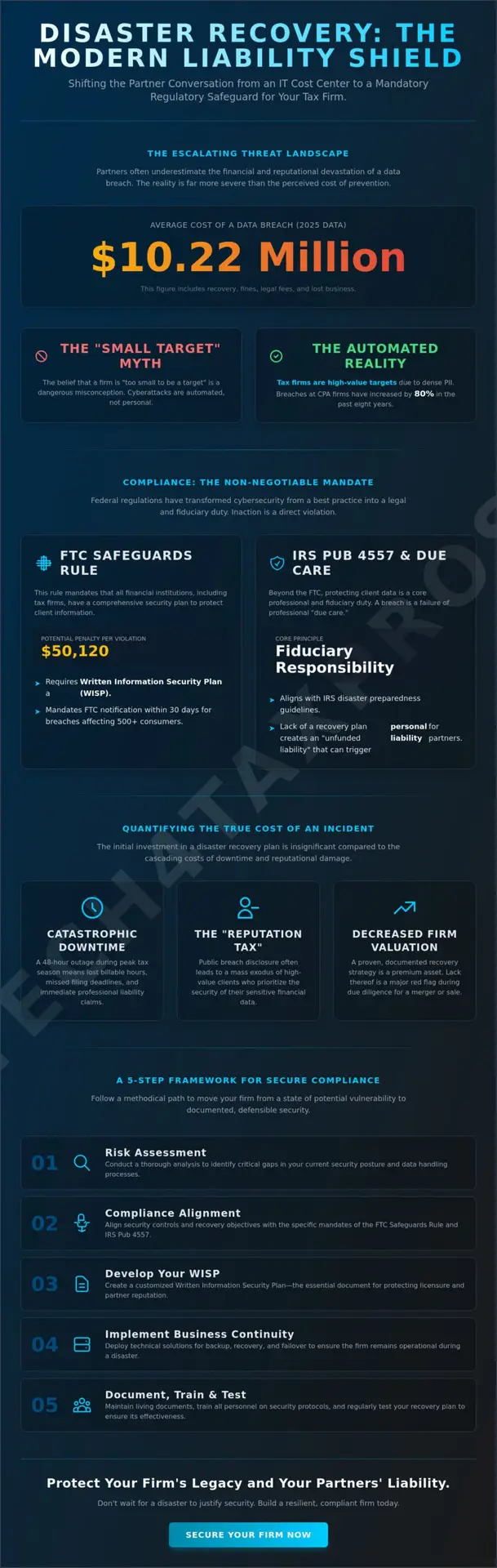
In the modern tax profession, a disaster recovery plan is not an optional IT expense; it’s a mandatory regulatory shield that protects a partner’s personal liability and professional licensure. You likely understand the frustration of presenting technical needs to partners who view IT as a necessary evil or a bottomless cost center. It’s difficult to be the messenger of implementation costs when you’re simply trying to prevent a breach that could cost your firm an average of $10.22 million, according to 2025 data.
We’ll show you how to translate technical risks into the specific language of professional liability to secure partner buy-in. You’ll learn how to frame a disaster recovery plan for accounting firm requirements through the lens of the FTC Safeguards Rule and IRS Publication 4557. This guide provides a methodical path to move your firm from a state of potential vulnerability to secure, documented compliance. We’ll examine how to explain the $50,120 per-violation penalty and why a Written Information Security Plan (WISP) is the most critical asset for protecting the firm’s heritage and future.
Key Takeaways
- Learn to shift the partner conversation from technical overhead to professional liability by framing security as a mandatory regulatory requirement.
- Understand how to align a disaster recovery plan for accounting firm operations with the strict mandates of the FTC Safeguards Rule and IRS Publication 4557.
- Discover how to calculate potential downtime costs during peak tax season to demonstrate the clear ROI of proactive business continuity.
- Follow a strategic five-step framework to present risk assessment findings that highlight critical gaps in your current security posture.
- Explore why a customized Written Information Security Plan (WISP) is essential for protecting a firm’s long-term licensure and partner reputation.
The High Stakes of Tax Firm Security: Why Partners Hesitate
For decades, many firm partners have viewed IT infrastructure as a necessary evil. It’s a line item that often feels like it eats into the partner draw without providing a visible return on investment. This “cost-center” stigma has historically led to a reactive posture where investments are only made after a failure occurs. However, the regulatory environment of 2026 has fundamentally shifted the equation. What was once considered a best practice is now a matter of strict federal mandate. A disaster recovery plan for accounting firm operations is no longer a technical luxury; it’s a foundational requirement for maintaining your professional standing and protecting the firm’s most valuable asset: client trust.
Partners often face psychological barriers like tech-fatigue or the belief that their firm is simply too small to be noticed. These hesitations are understandable but dangerous. This shift requires a deeper understanding of business continuity planning, which ensures that a firm can remain operational even when faced with significant technical disruptions. By reframing security as a protective shield rather than an expense, you can help partners see that a disaster recovery plan is actually a safeguard for their own professional legacy.
Debunking the ‘Small Target’ Myth
Many partners believe their firm is too small to attract the attention of global hacking syndicates. This is a dangerous misconception. Modern cyberattacks are rarely personal or targeted by hand. Instead, they’re automated scripts that scan the internet for specific vulnerabilities. Tax firms are high-value targets because they possess a high density of Social Security numbers and financial records. While a large corporation might have more total data, a mid-sized accounting firm often has weaker defenses, making it a more efficient target for ransomware. In fact, data breaches at CPA firms have increased by 80 percent over the past eight years. A bot doesn’t care about your firm’s local reputation; it only cares about the quality of the data it can steal.
Cybersecurity as a Fiduciary Duty
Protecting client data is an extension of the fiduciary duty that CPAs and Enrolled Agents owe to their clients. A data breach isn’t just a technical glitch; it’s a failure of professional “due care.” When a firm lacks a robust recovery strategy, it creates an “unfunded liability” that could trigger personal liability for the partners. With the FTC Safeguards Rule now carrying penalties of up to $50,120 per violation, the financial risk of inaction far outweighs the investment in protection. Implementing a comprehensive strategy isn’t just about IT; it’s about fulfilling your ethical obligations to the people who trust you with their most sensitive information.
Quantifying the Unseen: Translating Disaster Recovery into Firm Profitability
When discussing a disaster recovery plan for accounting firm partners, the conversation often stalls at the initial investment. To move past this, you must pivot from the “Cost of Protection” to the “Cost of Incident.” In the accounting world, time is the primary currency. If a ransomware attack or hardware failure occurs in the middle of March, the loss isn’t just data; it’s a catastrophic drain on billable hours. A firm that remains offline for even 48 hours during peak tax season faces an insurmountable backlog that threatens filing deadlines and triggers immediate professional liability. By aligning your strategy with IRS guidelines on disaster preparedness, you position the plan as a tool for revenue preservation rather than a drain on capital.
There is also the “Reputation Tax” to consider. Under the amended FTC Safeguards Rule, firms must notify the Federal Trade Commission of a breach involving 500 or more consumers within 30 days of discovery. This public disclosure often leads to a mass exodus of high-value clients who prioritize security above all else. Conversely, a firm that can prove its resilience through a documented recovery strategy increases its valuation. Whether you’re looking at a future merger or an outright sale, a sophisticated technical infrastructure is a premium asset that savvy buyers look for during due diligence.
The Real Price of a Data Breach in 2026
The financial impact of a breach goes far beyond simple data recovery. In 2025, the average cost of a data breach in the financial services sector reached $6.08 million. This figure includes forensic investigations to identify the entry point, legal fees for regulatory defense, and the high cost of mandatory victim notification services. For US organizations across all sectors, the average total cost reached a record $10.22 million. When you calculate “Cyber ROI,” you’re looking at the delta between a controlled mitigation expense and the multi-million dollar recovery cost of an unmanaged incident. It’s a pragmatic calculation that every partner can respect.
Efficiency Gains Through Managed Recovery
A proactive approach also yields immediate operational benefits. Implementing secure cloud backup solutions eliminates the “lost file” syndrome that often plagues administrative staff using legacy systems. When data is indexed and protected, recovery is nearly instantaneous, allowing the firm to maintain its workflow without interruption. Automated risk assessments further streamline the process by identifying vulnerabilities before they’re exploited, which simplifies annual compliance audits. Positioning your firm as a “Secure Practice” isn’t just a defensive move; it’s a powerful marketing advantage that attracts high-net-worth clients who demand the highest standards of data integrity.
The Compliance Lever: Leveraging IRS and FTC Mandates
While profitability is a strong motivator, the threat of regulatory enforcement often provides the necessary urgency for partner approval. The Written Information Security Plan (WISP) is now a non-negotiable federal requirement for every tax professional in the United States. Under the amended FTC Safeguards Rule, accounting firms are legally classified as “non-bank financial institutions.” This classification carries heavy burdens; failing to maintain a documented disaster recovery plan for accounting firm operations can result in penalties of up to $50,120 per violation as of January 2025. This isn’t just about technical safety; it’s about maintaining your legal right to practice.
Federal authorities have moved beyond simple suggestions. They now demand proof of resilience. Utilizing official resources for disaster preparedness for businesses is a prudent step, but for tax professionals, the requirements are even more granular. A robust recovery plan acts as the partners’ legal shield. If a breach occurs, the first question from the IRS or FTC won’t be about your intent; it will be about your documentation. Without a WISP and a tested recovery strategy, partners face personal liability and the potential loss of their Preparer Tax Identification Number (PTIN).
IRS Publication 4557 Compliance
IRS Publication 4557 outlines specific technical and administrative safeguards that every tax professional must follow. Many partners assume their current consumer-grade cloud storage or basic antivirus software is sufficient. In reality, these setups usually fail an IRS security review because they lack the required audit trails and documented response protocols. Compliance is a personal responsibility under federal law. A professional recovery plan ensures that the “Security Six” controls are not just implemented but are also recoverable after a system failure. It bridges the gap between basic IT and the specialized demands of federal tax administration.
The Gramm-Leach-Bliley Act (GLBA) and Tax Professionals
Under the GLBA, your firm is held to the same data security standards as a regional bank. This includes the mandatory appointment of a “Data Security Coordinator” to oversee all technical safeguards. The 2026 updates to the Safeguards Rule have also solidified the mandate for multi-factor authentication (MFA) across all systems containing taxpayer data, including tax software and business email. A comprehensive disaster recovery plan for accounting firm requirements incorporates these MFA protocols into the restoration process. This ensures that security is never bypassed for the sake of speed during a crisis, keeping the firm in full alignment with the Gramm-Leach-Bliley Act.
A Strategic Pitch: 5 Steps to Presenting to Firm Partners
Securing a budget for a disaster recovery plan for accounting firm partners requires moving beyond technical specifications. You are presenting a business case for resilience. Partners respond to risk mitigation and the preservation of firm equity. To succeed, your presentation must follow a methodical structure that mirrors the due diligence they apply to their own work. By following these five steps, you can transform a complex IT request into a clear-cut decision for the firm’s leadership.
- Step 1: Lead with the Regulatory Mandate. Open by highlighting the specific licensure risks associated with the FTC Safeguards Rule and IRS Publication 4557. Frame the discussion around the partners’ personal liability and the risk to their PTINs.
- Step 2: Identify the Gaps. Present the data from a preliminary Risk Assessment. Show where the firm’s current defenses fail to meet federal standards rather than just pointing out technical flaws.
- Step 3: Propose the Standard of Care. Offer a solution that includes a customized Written Information Security Plan (WISP) and Secure Cloud Backup. These are the industry-recognized benchmarks for professional due care.
- Step 4: Quantify the Impact. Contrast the cost of the plan against the loss of billable hours during tax season. Remind them that the average lifecycle of a breach in 2025 was 241 days, which is nearly two full tax cycles of disruption.
- Step 5: Define the Path Forward. Explain why professional implementation is safer and more cost-effective than a DIY approach. Emphasize that a managed transition ensures compliance without distracting the staff from client work.
Framing the Conversation for Accountants
Avoid technical jargon like “heuristics” or “zero-trust” during the initial presentation. These terms often cause partners to tune out or view the project as overly complex. Instead, use analogies that resonate with their professional background. Explain that a recovery plan is the firm’s ultimate insurance policy. It’s a “contingent asset” that only activates during a crisis but provides immense value by ensuring business continuity. Focus on the outcome of a “Secure Firm” rather than the bits and bytes of the infrastructure.
Handling Common Objections
You will likely encounter the “survivorship bias” objection, where partners claim the firm has never been hacked and therefore doesn’t need a plan. Remind them that as of 2025, the average time to detect a breach is 181 days; the firm might already be compromised without knowing it. When faced with “it’s too expensive,” pivot to the logic of tax-deductible IT spend and the $50,120 per-violation penalty. Finally, clarify that while a FREE WISP Download Template is a great starting point for research, it lacks the customization required to satisfy a formal IRS audit or provide real protection in court.
The Path to Secure Compliance: Implementing Your WISP
Once partners have approved the necessary budget, the transition from conceptual risk to operational resilience begins. A professional disaster recovery plan for accounting firm requirements is built upon the foundation of a customized Written Information Security Plan (WISP). While it’s tempting to use a generic template to save time, these static documents often fail to address the specific administrative and physical safeguards required by IRS Publication 4557. A professionally developed WISP is an active defense strategy that aligns your technical infrastructure with your legal obligations. It serves as your primary evidence of due care should the FTC ever request a formal compliance audit.
Technology alone cannot protect a firm from modern threats. Human error remains a primary cause of data breaches, which makes ongoing Cybersecurity Awareness Training a critical component of your recovery strategy. By educating your staff on AI-powered phishing and personalized social engineering, you reduce the likelihood of a system-wide compromise. Should a hardware failure or natural disaster occur, a Secure Cloud Backup ensures that your firm’s data remains accessible and intact. This multi-layered approach provides the protective reassurance that your sensitive data is in safe hands, regardless of the external threat environment.
Why Apex Tech 4 Tax Pros?
Apex Tech 4 Tax Pros stands apart by focusing exclusively on the niche needs of tax and accounting professionals. We don’t provide generic IT services; we engineer solutions specifically for the regulatory burdens you face daily. Our deep connection to IRS Publication 4557 and FTC standards allows us to offer a “Done-For-You” approach to mandatory compliance documentation. This removes the technical burden from your staff, allowing them to focus on high-value client work while we manage the clinical precision of your technical security and data protection protocols.
Your 90-Day Security Roadmap
We recommend a methodical 90-day roadmap to move your firm from potential vulnerability to secure compliance. This process begins with a professional Risk Assessment to establish a firm-wide baseline and identify immediate gaps in your security posture. Following this, we move through three distinct phases:
- Phase 1: Comprehensive Risk Assessment and Vulnerability Scanning to uncover hidden technical weaknesses.
- Phase 2: Custom WISP Development and Implementation to satisfy federal documentation mandates.
- Phase 3: Staff Training and the establishment of ongoing security monitoring to maintain your firm’s vigilance.
Taking these steps today protects your partners from personal liability and secures the firm’s professional legacy. Secure your firm’s future with a customized WISP from Apex Tech.
Securing Your Firm’s Legacy Through Proactive Compliance
Securing partner buy-in is a matter of reframing technical needs as a protective shield for the firm’s professional licensure. You’ve seen how a disaster recovery plan for accounting firm operations acts as a mandatory regulatory requirement under the FTC Safeguards Rule. By moving away from the “cost-center” mindset and focusing on the $50,120 per-violation penalty, you provide partners with a pragmatic reason to invest. Protecting client data is no longer just about IT; it’s a fiduciary duty that safeguards the firm’s heritage and future valuation.
At Apex Tech 4 Tax Pros, we specialize in translating these complex federal mandates into actionable security frameworks. Our specialized expertise in IRS Publication 4557 and our proven track record in FTC compliance ensure your firm meets the highest standards of professional due care. You don’t have to navigate these requirements alone. Taking the first step towards documented security is the most effective way to mitigate personal liability and ensure business continuity. Download your FREE WISP Template and start the conversation today. Your firm’s resilience is a strategic asset that will serve you and your clients for decades to come.
Frequently Asked Questions
Is a Written Information Security Plan (WISP) actually required by the IRS?
Yes, a WISP is a mandatory federal requirement under IRS Publication 4557. Every tax professional who handles taxpayer data must maintain a documented plan that outlines administrative, technical, and physical safeguards. This requirement is reinforced by the FTC Safeguards Rule, which classifies accounting firms as financial institutions. Failure to produce this document during an audit can lead to significant regulatory consequences and professional liability.
How much does a professional cybersecurity risk assessment typically cost for a small firm?
The investment for a professional assessment varies based on the firm’s complexity, the number of endpoints, and the specific regulatory requirements involved. Because these assessments are highly customized to the niche needs of the tax profession, you should consult with a specialized provider to get an accurate quote for your specific environment. Establishing this baseline allows your firm to prioritize security spending where it’s needed most for compliance.
Can we just use a free WISP template for compliance?
A free template can serve as an educational starting point, but it’s rarely sufficient for full regulatory compliance. The IRS and FTC require WISPs to be tailored to your firm’s specific operations and risk profile. Using a generic document without customization often leaves critical gaps in your defense. This may be viewed as a failure of professional due care during a formal security review or federal audit.
What are the specific penalties for tax firms that fail an IRS security audit?
Firms that fail to meet the standards of the FTC Safeguards Rule can face civil penalties of up to $50,120 per violation as of January 2025. Beyond financial fines, the IRS can also suspend or revoke a professional’s Preparer Tax Identification Number (PTIN). These penalties are designed to enforce the “Security Six” controls and ensure that client data remains protected under federal law at all times.
How often should our firm conduct cybersecurity awareness training for staff?
Ongoing training is essential because the threats facing the tax profession evolve rapidly. While some firms conduct annual sessions, the high volume of AI-powered phishing attacks suggests that quarterly updates are more effective. Regular training helps build a firm-wide culture of compliance. It ensures that employees remain vigilant against the social engineering tactics that often precede a major ransomware incident or data breach.
Does our current professional liability insurance cover data breaches?
Standard professional liability policies often exclude data breaches or provide very limited coverage for cyber incidents. Most firms require a dedicated cyber liability insurance rider to cover forensic costs, legal fees, and mandatory notification requirements. You should review your policy details carefully; many insurers now require proof of a disaster recovery plan for accounting firm operations before they will issue or renew coverage.
What is the most common way accounting firms get hacked?
Phishing and social engineering remain the most common entry points for cyberattacks against tax professionals. Hackers often leverage the high-pressure environment of tax season to trick employees into clicking malicious links or revealing credentials. Once an attacker gains access to one workstation, they can move laterally through the network to encrypt sensitive client data or steal Social Security numbers for identity theft and fraudulent filings.
How do I explain “Cloud Backup” security to partners who are afraid of the cloud?
Frame the discussion around encryption and redundancy rather than just the location of the data. Explain that a secure cloud backup stores encrypted data in multiple geographically diverse locations, which is far safer than a single physical server in the office. This approach satisfies the IRS mandate for off-site data protection. It ensures that the firm can recover quickly from local hardware failures or natural disasters without losing client records.