
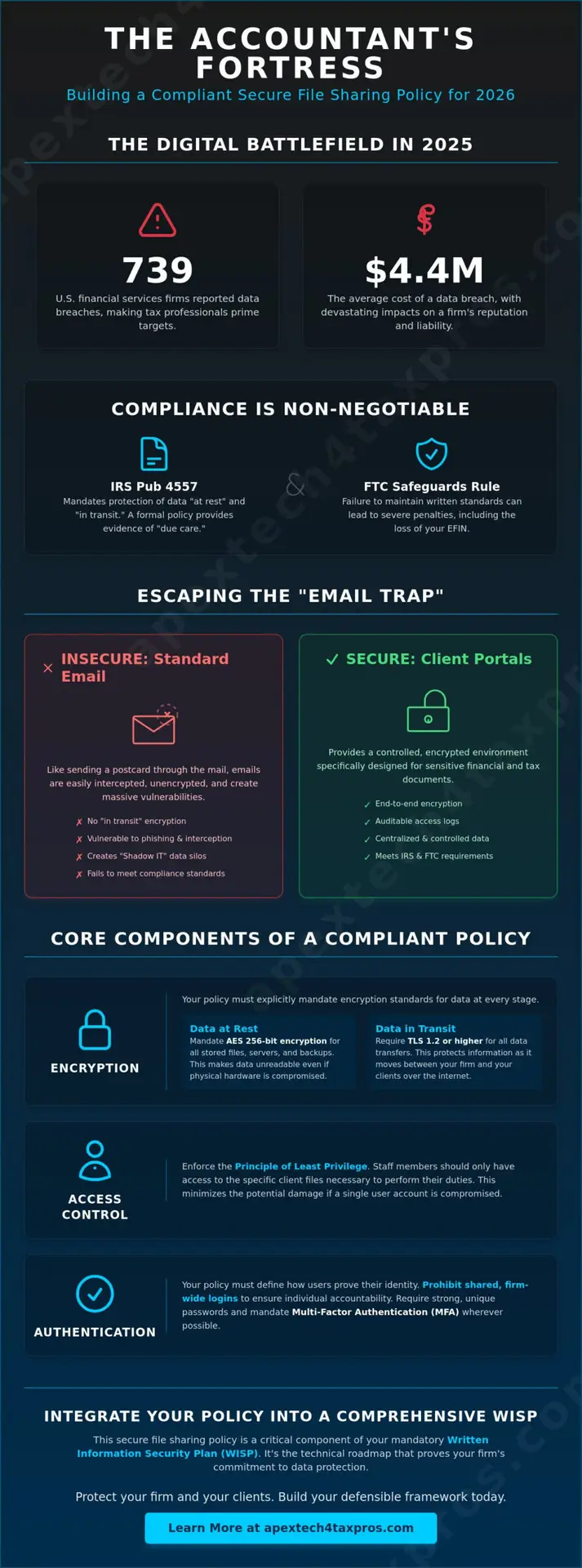
In 2025, 739 U.S. financial services firms reported data breaches, proving that even sophisticated practices remain primary targets for cybercriminals. You likely recognize that a simple link isn’t enough to protect sensitive taxpayer data, yet the constant stream of updates to the FTC Safeguards Rule can feel overwhelming. It’s understandable to worry about professional liability claims when clients resist complex portals or revert to the “email trap.”
Establishing a formal secure file sharing policy for accountants isn’t just about choosing the right software; it’s about building a defensible framework for your firm. This guide provides the clarity you need to draft a policy that satisfies the latest IRS Publication 4557 mandates and protects your practice from devastating identity theft claims. We’ll examine the technical standards required for 2026 compliance, such as AES-256 encryption, and provide a roadmap for integrating these protocols into your mandatory Written Information Security Plan (WISP) without sacrificing client collaboration.
Key Takeaways
- Identify why a formal secure file sharing policy for accountants is a mandatory administrative safeguard under IRS Publication 4557 and the FTC Safeguards Rule.
- Master the technical standards necessary for 2026 compliance, including the implementation of AES 256-bit encryption and the Principle of Least Privilege.
- Learn professional strategies to transition clients away from insecure email practices while maintaining a streamlined and collaborative firm workflow.
- Discover the step-by-step process for inventorying data transfer methods and integrating these protocols into your firm’s Written Information Security Plan (WISP).
Why Accountants Need a Formal Secure File Sharing Policy in 2026
For years, many accounting firms viewed digital security as a technical afterthought. That era ended with the 2023 enforcement of the FTC Safeguards Rule and subsequent 2024 amendments. A formal secure file sharing policy for accountants is now classified as a critical administrative safeguard. It’s the governing framework that dictates how your firm handles sensitive taxpayer information. This policy isn’t just a suggestion; it’s a mandatory requirement for all EFIN holders who wish to remain in good standing with the IRS.
Without a documented policy, firms often fall victim to “shadow IT.” This happens when well-meaning staff use unauthorized personal cloud storage or unencrypted messaging apps to move files quickly during tax season. These fragmented workflows create invisible vulnerabilities that bypass your firm’s security perimeter. A centralized, written policy eliminates this ambiguity. It ensures every team member follows the same rigorous standards for data protection, which is essential for maintaining professional integrity.
The Regulatory Framework: IRS Pub 4557 and the FTC
The IRS Publication 4557 (Revision 6-2024) is explicit about your responsibilities as a tax professional. You must protect data both “at rest” on your storage systems and “in transit” during the sharing process. Documenting these specific procedures provides vital evidence of “due care” during an IRS audit or a security review. By adhering to foundational Information security principles, you demonstrate that your firm takes its fiduciary duties seriously. The stakes are high. Under the FTC Safeguards Rule, failing to maintain these written standards can lead to severe penalties. This includes the potential suspension or permanent loss of your Electronic Filing Identification Number (EFIN), which would effectively shut down your ability to practice.
Protecting Your Firm from Identity Theft and Ransomware
Cybercriminals target accounting firms because a single breach offers a treasure trove of Social Security numbers and financial details. Insecure file sharing remains a primary entry point for these attacks. If a staff member sends a K-1 or 1040 via standard email, they’re essentially sending a postcard through the open mail. It’s easily intercepted and read by unauthorized parties. In 2025, the average cost of a data breach globally reached $4.4 million. For a specialized firm, the financial impact is often secondary to the devastating loss of professional reputation. A client data breach frequently triggers professional liability claims that can jeopardize your practice’s future. Implementing a secure file sharing policy for accountants is the most effective way to close these gaps and provide the protective reassurance your clients expect.
Core Components of a Compliant File Sharing Policy
A comprehensive secure file sharing policy for accountants serves as the technical backbone of your firm’s data protection strategy. It moves beyond simply selecting a software provider. It defines exactly how that software must be configured and used by your team. To remain compliant with modern standards, your policy must address four primary areas: encryption, access control, authentication, and data lifecycle management.
Encryption Standards: At Rest vs. In Transit
The IRS requires tax professionals to protect data at every stage of its journey. Your policy should explicitly mandate AES 256-bit encryption for all data at rest. This ensures that even if a server is physically compromised, the stored files remain unreadable. For data in transit, the current industry standard is Transport Layer Security (TLS) 1.2 or higher.
Many practitioners mistakenly believe that password-protected PDFs satisfy these requirements. In reality, security experts consider these insufficient because they are vulnerable to automated brute-force attacks. A compliant policy favors secure client portals over standard cloud storage. These portals provide a controlled environment specifically designed for high-stakes financial documentation and sensitive tax records.
User Access and Identity Management
Your policy must enforce the “Principle of Least Privilege.” This means staff members only have access to the specific client files necessary for their current assignments. Implementing this rule minimizes the potential impact if a single account is compromised. It ensures that a breach in one department doesn’t grant a hacker access to your entire client database.
Accountability is another cornerstone of the FTC Safeguards Rule. Your policy should strictly prohibit shared firm-wide logins. Every employee requires unique credentials to ensure that audit logs accurately track who accessed, downloaded, or uploaded a file. The policy must also outline a protocol for the immediate termination of access for former employees or contractors. This prevents “orphaned accounts” from becoming easy targets for malicious actors.
Your framework should require Multi-Factor Authentication (MFA) for every user. This single control is one of the most effective ways to stop unauthorized access. To ensure these rules are documented correctly within your larger compliance framework, you might consider starting with a free WISP download template to see how these components fit together.
Retention and Disposal
Data that no longer serves a business purpose is a liability. Your policy should define how long files remain in the active sharing environment before being moved to secure long-term backup or permanently deleted. Maintaining a “clean” sharing environment reduces your firm’s digital footprint. It also simplifies your response during a security review because you have less data to account for.
The “Email Trap”: Addressing the Biggest Policy Violation
The “Email Trap” is the single most common point of failure in any secure file sharing policy for accountants. While email feels instantaneous and familiar, it was never designed for the secure transmission of personally identifiable information (PII). Relying on it for K-1s or tax returns creates a significant compliance gap that auditors and cybercriminals alike can easily exploit. It’s the path of least resistance, but it’s also your firm’s greatest liability.
Why Standard Email Fails IRS Security Standards
Standard email operates much like a postcard. It passes through multiple unencrypted servers before reaching its destination. This leaves data vulnerable to interception at every hop. Once an email is sent, you lose all control over that data. There is no reliable “recall” function if a sensitive document is sent to the wrong recipient, a mistake that happens more often than most firms care to admit. Additionally, email attachments remain the primary delivery mechanism for ransomware. Attachments train staff and clients to engage in high-risk behavior. This can compromise your entire network and lead to a devastating professional liability claim.
Transitioning Clients to Secure Portals
Moving long-term clients away from email requires a blend of firm boundary-setting and empathetic education. Many clients resist change because they perceive secure portals as an added layer of friction. To counter this, you must frame security as a premium value-add. Emphasize that your firm’s refusal to use email is a direct measure taken to protect their financial identity. You aren’t making their lives harder; you’re making their data safer.
Consulting the AICPA cybersecurity checklist can help you identify specific talking points to share with clients who remain skeptical. It’s helpful to explain that your firm’s policy isn’t just a personal preference but a professional standard designed to meet federal mandates. For non-tech-savvy clients, a simple onboarding session or a “first-time login” guide can alleviate much of the initial frustration. Setting these boundaries early establishes that your firm protects data, even when it’s inconvenient.
Implementing a Zero-Attachment Policy
A robust secure file sharing policy for accountants must include a strict Zero-Attachment rule. Under this mandate, no staff member is permitted to send or receive sensitive documents via email. If a client sends an attachment, the file should be moved to the secure portal immediately and the email deleted. To help your team enforce this, provide them with a standardized response script:
“Dear [Client Name], thank you for sending these documents. To ensure your Social Security number and financial data remain protected under the latest IRS security mandates, our firm no longer accepts documents via email. I have securely uploaded your file to our portal. Please use the link below for all future uploads so we can keep your data safe.”
This clear, supportive approach reinforces your role as a multi-disciplinary protector of their assets. It demonstrates that you value their security more than the temporary convenience of an attachment. By codifying this in your WISP, you ensure every team member acts with the same level of professional vigilance.
Step-by-Step: Drafting Your Secure File Sharing Policy
Drafting a secure file sharing policy for accountants requires a methodical approach that prioritizes procedural documentation over mere software features. While selecting the right tool is vital, the IRS and FTC require you to document how that tool is managed within your firm’s operational workflow. This process transforms your security practices from a set of habits into a defensible administrative safeguard. It ensures that every team member, from senior partners to seasonal contractors, understands their specific role in protecting taxpayer data.
Your first step is to conduct a comprehensive inventory of all current data transfer methods. You must identify every platform where client data currently resides or travels. This includes firm-sanctioned cloud storage, legacy physical media, and any “shadow IT” accounts staff might use for convenience. Once the inventory is complete, you must select a compliant technology partner that agrees to sign a Business Associate Agreement (BAA). This document is a legal necessity. It confirms the provider maintains the technical controls, such as AES 256-bit encryption, required to satisfy federal mandates.
Documenting the “Who, What, and How”
A compliant policy must be granular. Your “Authorized Users” section should define access based on the Principle of Least Privilege, ensuring staff only see the files necessary for their specific assignments. You must also implement a clear Data Classification system. This distinguishes between general correspondence and documents containing sensitive PII, such as Social Security numbers or bank details, which must never leave the secure portal environment.
The May 2024 amendment to the FTC Safeguards Rule underscores the need for a robust Incident Response section. If a file is shared incorrectly or a breach is discovered involving 500 or more consumers, you must notify the FTC within 30 days. Your policy should outline the immediate steps for containment and reporting to ensure you remain within these legal timelines. To ensure your documentation meets these rigorous standards, you can start with a Customized Written Information Security Plan (WISP) that integrates these file-sharing rules into a comprehensive firm-wide strategy.
Staff Training and Policy Acknowledgement
Technology alone cannot prevent human error. Every employee must participate in regular Cybersecurity Awareness Training and sign an Acceptable Use agreement. This agreement should include a single, binding mandate: “All staff must exclusively use firm-approved, MFA-enabled portals for the transmission of any document containing unencrypted taxpayer PII.” By requiring a signature, you establish a culture of personal accountability. This documented training serves as critical evidence of compliance during a security review. Finally, establish a formal review cycle to update your policy at least annually, or whenever regulatory changes occur, to ensure your firm remains a disciplined protector of client trust.
Integrating Your Policy into a Comprehensive WISP
A secure file sharing policy for accountants does not exist in a vacuum. Under IRS Publication 4557 (Rev. 6-2024), this policy serves as a specific administrative safeguard that must be integrated into your firm’s broader Written Information Security Plan (WISP). While a secure portal provides the technical means to move data, your WISP provides the legal and procedural context for why and how those tools are used. Failing to connect these documents creates a “compliance gap” that can leave your firm vulnerable during an IRS audit or a professional liability review.
Apex Tech 4 Tax Pros specializes in bridging this gap by automating the documentation of these complex requirements. We understand that tax professionals are already burdened by seasonal deadlines and evolving regulations. Our process ensures that your file sharing protocols are naturally aligned with the other “Security Six” controls, such as multi-factor authentication and encrypted backups. By treating your security framework as a unified system, you move from a state of reactive troubleshooting to a state of proactive, defensible compliance.
Beyond the Portal: The Holistic Security View
True data protection requires a multi-layered approach. Your secure file sharing policy for accountants should be supported by a robust Secure Cloud Backup strategy. This ensures that even if a file is successfully shared, a copy remains protected and recoverable in the event of local hardware failure or a ransomware incident. Additionally, your digital policies must mirror your physical office security. There is little value in an encrypted portal if sensitive tax documents are left sitting on a communal printer or an unlocked workstation.
Compliance is a continuous process, not a one-time event. Your WISP must be a “living document” that evolves alongside new threats and regulatory amendments, such as the May 2026 updates to IRS safeguarding standards. Regular updates ensure that your firm’s protective measures remain relevant and effective. To simplify this journey, you can ensure your firm meets IRS standards with a custom WISP that scales with your practice.
Expert Assistance for Tax Practice Compliance
Navigating the intersection of federal tax law and information technology requires specialized expertise. Apex Tech 4 Tax Pros provides the disciplined, vigilant support necessary to protect your firm’s heritage and client trust. We don’t just provide tools; we provide a framework for personal accountability and professional success. A critical part of this framework is the performance of professional Risk Assessments. These reviews identify hidden sharing gaps and technical vulnerabilities that a standard checklist might overlook.
Validating your policy through expert review provides the peace of mind you need to focus on your clients. It demonstrates a commitment to “due care” that is invaluable during a security review. If you’re ready to secure your firm’s future, schedule your 2026 security risk assessment today. Whether you choose to start with our FREE WISP Download Template or a customized consultation, taking action now is the most effective way to safeguard your practice from the devastating impact of a data breach.
Securing Your Firm’s Future and Client Trust
The regulatory landscape of 2026 requires more than just high-quality tax advice; it demands a rigorous commitment to data protection. Implementing a formal secure file sharing policy for accountants ensures that your firm moves beyond the vulnerabilities of standard email and satisfies the strict mandates of IRS Publication 4557. By codifying these technical standards and training your staff to avoid the “email trap,” you build a defensible framework that protects your professional reputation and your clients’ sensitive information.
Apex Tech 4 Tax Pros provides the specialized expertise needed to navigate these high-stakes environments. Our IRS Publication 4557 compliant frameworks and expert-led cybersecurity risk assessments are engineered specifically for the unique needs of tax and accounting firms. You don’t have to manage these technical requirements alone. Our mission is to provide the supportive guidance necessary to keep your sensitive data in safe, capable hands while you focus on serving your clients.
Download Your Free WISP Template for Tax Professionals to begin documenting your safeguards today. Taking this proactive step provides the protective reassurance your clients deserve while securing the longevity and compliance of your practice. You have the tools to stay secure, and we are here to help you implement them with confidence.
Frequently Asked Questions
Is Google Drive or Dropbox secure enough for accountants?
Consumer versions of Google Drive or Dropbox are typically insufficient for tax professionals. These platforms often lack the necessary administrative controls and signed Business Associate Agreements (BAAs) required for federal compliance. A professional secure file sharing policy for accountants mandates tools that provide granular access control and AES 256-bit encryption. Using non-specialized cloud storage can lead to “shadow IT” risks that bypass your firm’s security perimeter.
Does the IRS require a written file sharing policy?
Yes, the IRS and the FTC both require a documented security plan. IRS Publication 4557 mandates that all professional tax preparers create and implement a Written Information Security Plan (WISP). Your file sharing policy is a critical administrative safeguard within this plan. Documenting these procedures serves as essential evidence of “due care” during an IRS audit or a regulatory security review.
What is the difference between a client portal and an encrypted email?
A client portal offers a centralized, secure environment that your firm fully controls. Unlike encrypted email, portals provide detailed audit logs and require multi-factor authentication (MFA) for every access attempt. Encrypted email still places data in a recipient’s inbox, where you lose visibility and control. Portals ensure that sensitive taxpayer information remains within your secure ecosystem throughout the entire document lifecycle.
How do I handle clients who refuse to use a secure file sharing portal?
You should handle client resistance through empathetic education and firm boundaries. Explain that your refusal to use insecure methods is a measure taken to protect their financial identity. Most clients value security once they understand the risks of identity theft. You might offer a brief onboarding session to help them navigate the portal, emphasizing that protecting their data is your highest professional priority.
What are the penalties for sharing tax documents via standard email?
Sharing unencrypted tax documents via standard email can result in the suspension or loss of your EFIN. This effectively ends your ability to practice as a tax professional. Beyond regulatory penalties, you face the risk of professional liability claims if a client’s data is compromised. In 2025, the average cost of a data breach reached $4.4 million globally, making the “convenience” of email a devastating financial gamble.
Does a secure file sharing policy apply to remote or seasonal staff?
Every individual who handles client data must adhere to your security protocols. This includes all remote employees and seasonal contractors. Your secure file sharing policy for accountants should be a non-negotiable part of their onboarding process. This prevents temporary staff from using unauthorized personal accounts, ensuring that your firm’s security standards remain consistent regardless of where or when the work is performed.
How often should I update my firm’s file sharing policy?
You must review and update your policy at least annually. IRS Publication 4557 and the FTC Safeguards Rule both require periodic assessments of your security plan to address new threats. You should also conduct a review whenever your firm adopts new technology or if there are changes to federal regulations. Maintaining a “living document” approach ensures your firm stays ahead of evolving cybercriminal tactics.
What should I do if a staff member accidentally sends a file to the wrong client?
You should immediately trigger your firm’s documented Incident Response plan. This involves attempting to recall the file, notifying the unintended recipient to delete the data, and informing the affected client of the exposure. Under the May 2024 FTC update, if the breach involves the unencrypted information of 500 or more consumers, you must notify the FTC within 30 days. Documentation of your response is vital for legal defense.