
What if the biggest threat to your tax firm isn’t your own password, but the cloud software you trust to store your clients’ most sensitive data? With data breaches at CPA firms increasing by 80 percent over the last eight years, the government is no longer letting “I didn’t know” slide as an excuse. We understand that you’re a tax expert, not a software engineer, and trying to handle cybersecurity vendor due diligence for accounting firms while managing a busy practice can feel like an impossible weight.
You already know that keeping your data safe is the right thing to do, but the technical jargon in federal mandates can be exhausting. We’re here to help you vet your third-party providers to meet IRS Publication 4557 and FTC Safeguards Rule requirements with total confidence. You’ll learn exactly how to verify your vendors’ security measures and how to integrate that proof into a Written Information Security Plan (WISP) that actually works. We’ll walk through the specific questions to ask your IT partners so you can stop worrying about $53,088 FTC penalties and get back to serving your clients.
Key Takeaways
- Understand your legal obligations under the FTC Safeguards Rule to oversee any third-party service providers that handle sensitive taxpayer information.
- Learn how to implement a structured process for cybersecurity vendor due diligence for accounting firms to verify that your software partners protect data as strictly as you do.
- Identify the specific technical questions to ask vendors about encryption and multi-factor authentication to ensure they meet IRS Publication 4557 standards.
- Discover a simple method to inventory and tier your service providers by risk level, allowing you to focus your energy where it matters most.
- See how your Written Information Security Plan (WISP) serves as the central hub for documenting your compliance efforts and providing peace of mind during audits.
Why is cybersecurity vendor due diligence mandatory for accounting firms in 2026?
Vendor due diligence is the process of verifying that your service providers protect taxpayer data as strictly as you do. In 2026, performing cybersecurity vendor due diligence for accounting firms is a core requirement for staying in business. It’s the foundation of third-party risk management, ensuring there are no weak links in your data chain. Think of this as a shield for your license rather than a corporate hurdle. You work too hard for your PTIN to let a software provider’s oversight put your reputation at risk.
How does the FTC Safeguards Rule define vendor oversight?
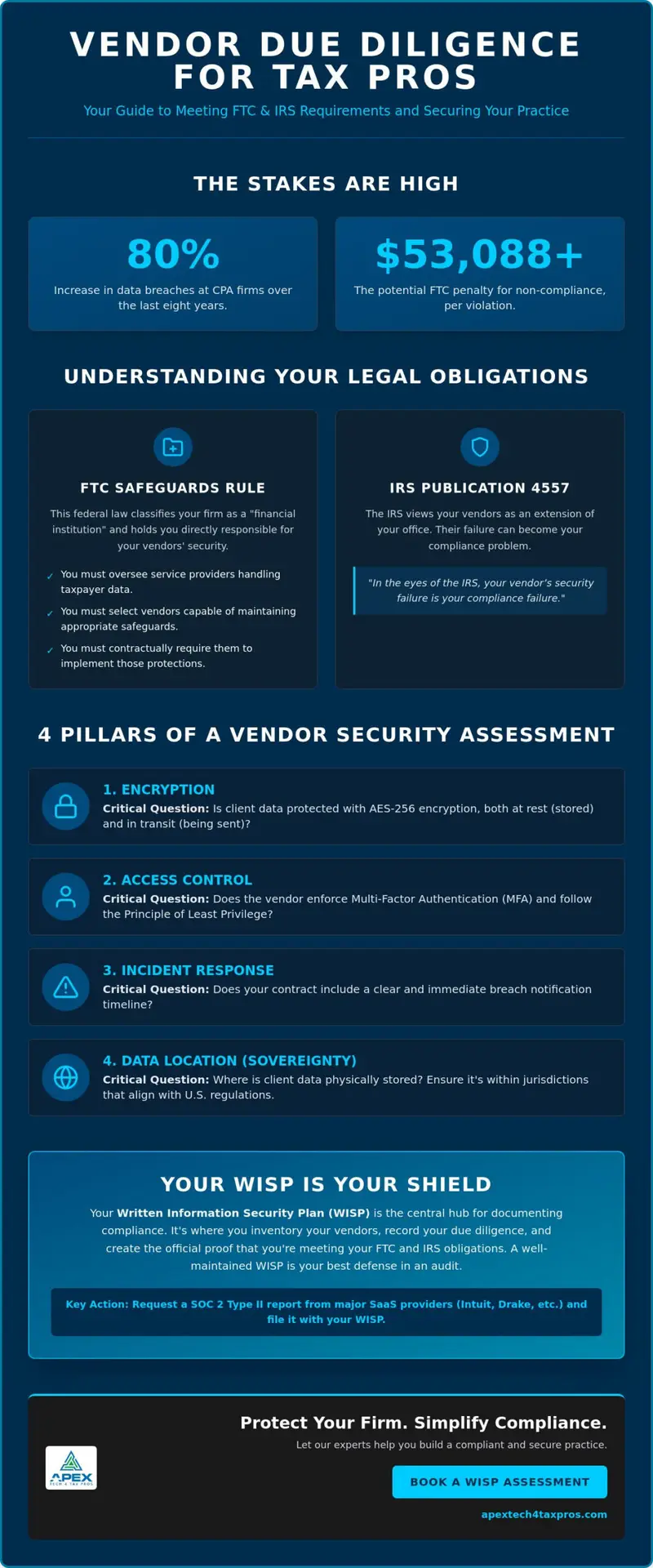
The FTC Safeguards Rule (16 CFR Part 314) classifies your firm as a financial institution. This status requires you to designate a Qualified Individual to manage your security program. This person must ensure you only select providers capable of maintaining appropriate safeguards. You must also contractually obligate these vendors to implement those protections. It’s about creating a chain of accountability. Just as global enterprises rely on Computer Market Research to maintain visibility and compliance across their partner networks, your firm must ensure every vendor link is secure. If your software partner doesn’t meet these standards, the responsibility falls back on your office.
IRS Publication 4557 and your PTIN
IRS Publication 4557 treats external service providers as an extension of your office. If a vendor suffers a breach, the IRS may look at your firm to see if you followed the mandated guidelines. Your Written Information Security Plan (WISP) should serve as your primary evidence of compliance. It needs to link directly to your list of vetted vendors. As we often tell our clients, “In the eyes of the IRS, your vendor’s security failure is your compliance failure.” Documenting your vendor reviews protects you if an investigation ever lands on your desk. This isn’t about being an IT expert; it’s about being a diligent professional.
What should be included in a vendor security assessment for tax professionals?
When performing cybersecurity vendor due diligence for accounting firms, your assessment must focus on four critical pillars: encryption, access, response, and location. Start by asking if the provider utilizes AES-256 encryption for data both at rest and in transit. This standard is the benchmark for protecting sensitive financial information. Next, verify that they support Multi-Factor Authentication (MFA) and strictly follow the principle of Least Privilege access. You also need a defined breach notification timeline in your contract. If a vendor experiences a security incident, you shouldn’t find out about it on the evening news weeks later. Finally, confirm where your data is physically stored. Data sovereignty is vital because you want your clients’ sensitive details kept within jurisdictions that align with your regulatory obligations.
Vetting your SaaS and Cloud providers
Whether you rely on Intuit, Drake, or Thomson Reuters, don’t assume their market size automatically guarantees your compliance. Request their SOC 2 Type II report. This document confirms that an independent auditor has verified their security controls over a specific period. You don’t need to be an IT expert to read these; simply check the “Opinion” section to ensure they received a clean audit. Even when using reputable providers, secure cloud backup is your last line of defense if a vendor’s service becomes unavailable or compromised.
Physical and administrative safeguards
Technical tools are only half the battle. You must ensure your vendors provide regular cybersecurity training for their own employees. This is a primary expectation under the FTC Safeguards Rule. Be wary of using casual “IT helpers” who don’t offer a formal Business Associate Agreement (BAA) or a similar professional contract. A signed agreement ensures the vendor is legally committed to your data protection standards. If these technical requirements feel like a heavy lift during tax season, a professional risk assessment can clarify your vendor landscape and provide the peace of mind you need to focus on your clients.
How do I perform a vendor due diligence review without an IT department?
Performing cybersecurity vendor due diligence for accounting firms doesn’t require a degree in computer science. It requires a methodical process that you can manage between client meetings. Your first move is to inventory every service provider that touches taxpayer information. IRS Publication 4557 defines this information broadly, so include your cloud storage, tax prep software, and even your email provider. Once your list is ready, tier them by risk level. A cloud software provider is “High Risk” because they store actual returns. Your office supply vendor is “Low Risk.” This prioritization allows you to focus your limited time on the partners that matter most.
For your high-risk vendors, send a simplified security questionnaire based on NIST standards. You don’t need to write this from scratch; focus on asking for their encryption protocols and backup frequency. Finally, document every interaction. If you reviewed a SOC 2 report or received a security whitepaper, save it. This evidence proves your “good faith” effort to comply with federal mandates.
Using a WISP template for vendor management
A Customized WISP serves as the central repository for these checks. Integrating cybersecurity vendor due diligence for accounting firms into your WISP ensures that your compliance is documented and repeatable. Instead of keeping loose files, you can integrate your vendor list directly into your security plan. Tip: Keep a simple log of your vendor reviews to show a ‘good faith’ effort during an audit. This turns a complex requirement into a manageable routine. If you’re ready to get organized, you can Download our free WISP template to start your inventory today.
Red flags to watch for in vendor responses
Pay close attention to how a vendor responds to your inquiries. Vague answers about data encryption or backup locations are major red flags. If a provider refuses to sign a security addendum in your contract, they may not be prepared to protect your clients. A lack of a clear point of contact for security issues is another sign of a company that doesn’t prioritize data safety. If a vendor feels “off,” trust your professional judgment. Your firm’s reputation is worth more than any specific software feature. If you want to ensure your office is fully protected, Book a WISP Assessment with our team today.
How can a Written Information Security Plan (WISP) simplify vendor management?
A Written Information Security Plan (WISP) acts as the central hub for your entire compliance ecosystem. Rather than scattering vendor contracts, SOC 2 reports, and security questionnaires across multiple folders, your WISP organizes this evidence into a single, cohesive framework. This structure simplifies cybersecurity vendor due diligence for accounting firms by providing a clear roadmap for what to check and how to document it. When you transition from a reactive approach to a structured WISP, the burden of compliance shifts into a sense of professional relief. You’ll know that if an IRS auditor requests your documentation, you have a verified process ready to present.
Our Dallas-based team brings over 20 years of combined experience in both the tax industry and technical security. We understand the specific pressures of tax season, which is why we’ve designed our subscriptions to handle the heavy lifting for you. Our Seasonal plan ($649.99) and Yearly plan ($1,099.99) both include a free customized WISP to ensure your firm meets federal mandates without the typical corporate jargon. We bridge the gap between complex IT requirements and the practical needs of a busy tax office.
Professional help vs. DIY compliance
While a free template is a helpful starting point, a generic document often fails to reflect the actual operations of your firm. A customized plan is what truly survives an audit because it details your specific vendors and internal controls. If you’re looking for holistic support, our sister company, APEX Tax Solutions, provides additional practice management guidance. You don’t have to navigate these federal requirements alone. You can Book a WISP Assessment for professional peace of mind and ensure your office is fully protected before the next filing deadline.
Your 2026 Compliance Action Plan
To ensure your firm is ready for the 2026 season, follow this final checklist:
- Complete a full inventory of every vendor that accesses taxpayer data.
- Request and review security documentation for all “High Risk” cloud providers.
- Update your WISP to include your vendor vetting procedures.
- Schedule a risk assessment to identify any remaining security gaps.
Don’t let vendor risk jeopardize your hard work or your professional license. Reach out to our team at info@at4tp.com today to secure your practice.
Legal Disclaimer: This guide is for informational purposes and does not constitute legal advice. Please consult with a legal professional to confirm the specific requirements for your firm.
Protecting Your Practice for the 2026 Filing Season
At Apex Tech 4 Tax Pros, we bring over 20 years of combined tax and IT experience to your office. Our solutions are fully compliant with IRS Publication 4557, and our seasonal or yearly subscription plans include a free customized WISP to handle the heavy lifting for you. We understand the high stakes of your environment and are here to provide the protective reassurance you deserve.
Secure your practice today; Book a WISP Assessment with the experts at Apex Tech 4 Tax Pros
You have the expertise to navigate complex tax codes. Let us provide the technical shield that keeps your data safe and your compliance effortless.
Frequently Asked Questions
Is vendor due diligence required for small tax offices with only one employee?
Yes, the federal requirement for vendor oversight applies to every tax professional, including solo practitioners and small offices. The FTC Safeguards Rule doesn’t offer exemptions based on employee count for the core duty of protecting taxpayer data. You’re still responsible for performing cybersecurity vendor due diligence for accounting firms to ensure your software partners are as secure as your own internal systems. Compliance is about the data you handle, not the size of your staff.
What is the difference between a WISP and the FTC Safeguards Rule?
The FTC Safeguards Rule is the federal law that sets the security standards for financial institutions, including tax offices. A Written Information Security Plan (WISP) is the actual document required by the IRS and FTC to prove you’re following those standards. While the Rule tells you what is required, the WISP is your firm’s specific roadmap for how you protect data and manage your third-party providers. One is the regulation; the other is your plan for following it.
How often should I review my software vendors for security compliance?
You should conduct a formal review of your high-risk vendors at least once a year. It’s also best practice to perform a quick check whenever a provider updates their terms of service or privacy policy. Consistent, documented reviews show the IRS that you’re taking an active role in data protection. Keeping a simple log of these annual assessments within your WISP is an excellent way to demonstrate ongoing compliance and professional diligence.
Does the IRS provide a list of approved ‘secure’ software vendors?
The IRS does not maintain a list of approved or certified software vendors. They provide the security framework through Publication 4557, but the duty to vet individual providers falls entirely on the tax professional. You must verify that your software partners use industry-standard protections like AES-256 encryption. If you’re unsure what to look for, our risk assessments can help you evaluate your current software stack against the specific federal requirements for our industry.
What happens if a vendor I use suffers a data breach?
If a vendor suffers a breach, you are often the one legally responsible for notifying your affected clients. This is why your WISP must include a clear incident response plan that covers third-party failures. Performing cybersecurity vendor due diligence for accounting firms helps you secure contracts that require vendors to notify you immediately of any security events. This early warning gives you the time needed to protect your firm’s reputation and your clients’ identities.