
In 2026, cyber insurance is no longer a standalone product; it’s a “compliance reward” that’s only valid if your firm strictly adheres to documented IRS security standards. You’ve likely noticed that simply filling out a questionnaire isn’t enough to secure a policy anymore. Carriers now demand rigorous technical proof and behavioral audits before they’ll even consider a renewal. Understanding the specific cybersecurity insurance requirements for accountants is the only way to avoid a coverage denial that could leave your practice exposed to $46,517 daily fines from the FTC.
We understand that the link between IRS Publication 4557 and your insurance policy often feels like a moving target. It’s frustrating to face rising premiums when you’re already working hard to manage complex federal mandates. This guide details the exact security standards and documentation you must maintain to satisfy both federal regulators and insurance underwriters. You’ll discover how a robust Written Information Security Plan (WISP), immutable backups, and technical risk assessments can help you qualify for the best rates and ensure your firm remains resilient against modern threats.
Key Takeaways
- Learn why insurance carriers have transitioned from simple questionnaires to rigorous technical audits that require verifiable evidence of your firm’s security controls.
- Understand the mandatory role of Multi-Factor Authentication (MFA) and Endpoint Detection and Response (EDR) in meeting modern cybersecurity insurance requirements for accountants.
- Discover how alignment with the FTC Safeguards Rule and IRS Publication 4557 serves as the primary blueprint for successful policy renewal and premium management.
- Identify the specific documentation, such as training logs and backup verification reports, you’ll need to satisfy an underwriter’s risk assessment process.
- Recognize why a professionally customized Written Information Security Plan (WISP) is now essential to prove your firm meets the “reasonable security” standards required for coverage.
The Evolving Landscape of Cyber Insurance for Accountants in 2026
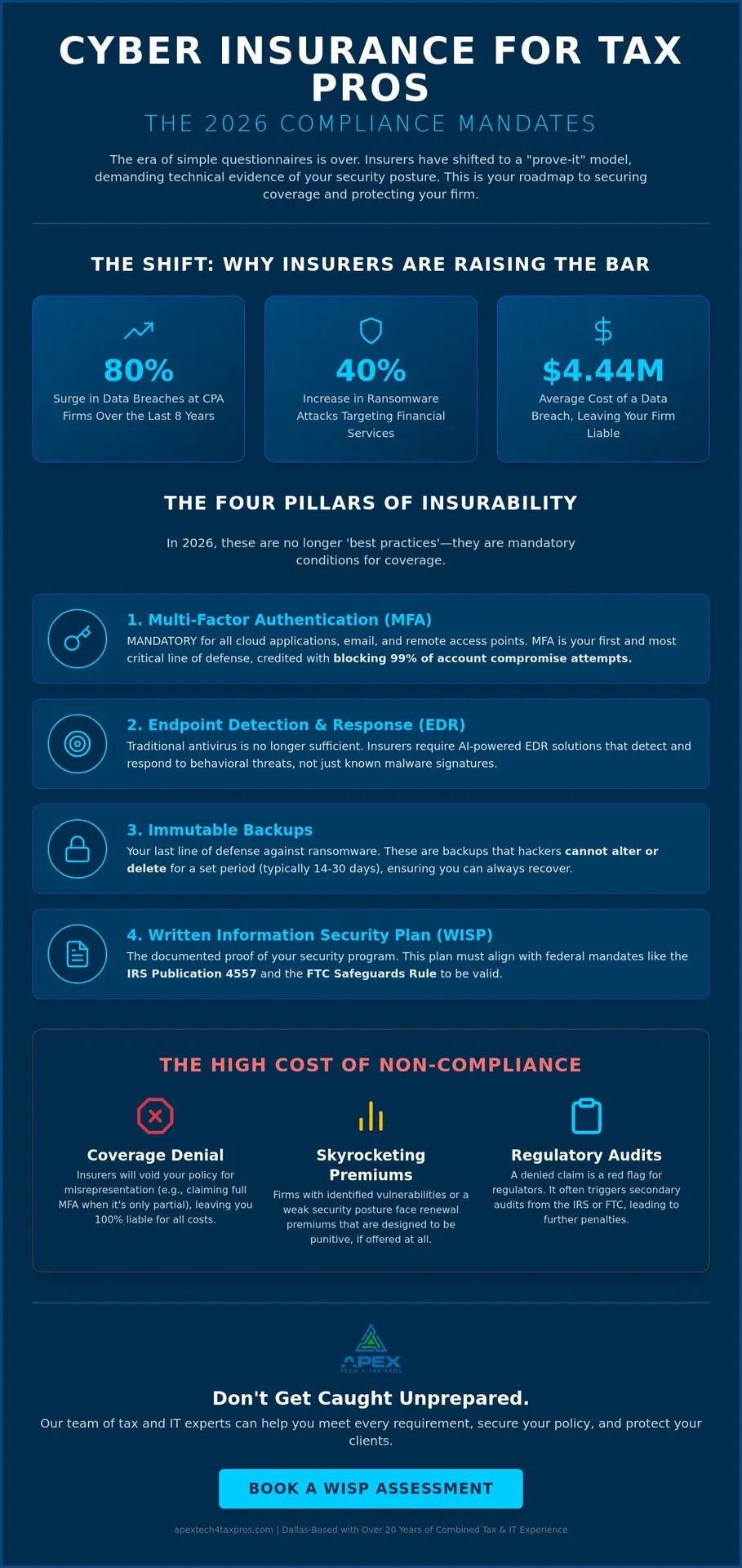
For years, accounting firms navigated a relatively “soft” insurance market where coverage was broad and premiums remained predictable. That era has officially ended. As ransomware attacks against financial professionals surged, carriers faced unprecedented losses, leading to the hardened market we see today. In 2026, meeting cybersecurity insurance requirements for accountants is no longer a matter of simply signing a form. Underwriters have shifted from “check-the-box” applications to rigorous “prove-it” audits. They require documented evidence that your firm isn’t just aware of security protocols but is actively enforcing them every day.
Carriers now employ sophisticated external scanning tools to evaluate your firm’s digital perimeter before they even provide a quote. These automated systems search for open ports, unpatched software, and leaked credentials associated with your domain. If these scans reveal vulnerabilities, you may face immediate denial or exorbitant premium hikes. It’s vital to understand the distinction between holding a policy and having a valid claim. A policy is merely a contract; its validity during a breach depends entirely on whether your firm was actually maintaining the security posture you claimed to have during the application process.
First-Party vs. Third-Party Coverage for Tax Pros
Accounting firms must distinguish between two primary types of protection. First-party coverage addresses your firm’s direct losses, including data recovery costs, ransom payments, and the financial impact of business interruption. Third-party coverage protects you against claims from clients who suffer financial harm due to a breach of their sensitive data. This includes legal defense costs and settlement fees. Relying on “Silent Cyber” coverage, which refers to cyber risks buried within a standard general liability policy, is a dangerous gamble in 2026. Most modern general liability policies now explicitly exclude cyber events, making a dedicated policy essential for survival. For a deeper look at these structures, this Cyber insurance overview provides foundational context on how these risk transfer models have matured.
The Consequences of Misrepresentation
We are seeing a significant rise in “application rescission,” a process where carriers void a policy after a breach occurs because the firm misrepresented its security controls. If you claim to have Multi-Factor Authentication (MFA) active on all accounts but a forensic investigator discovers it was disabled for “convenience,” your carrier can legally walk away from the claim. This leaves your practice solely responsible for the recovery costs and legal liabilities. Furthermore, a failed insurance claim often triggers secondary scrutiny from the IRS and FTC. When an insurer determines your security was inadequate, federal regulators will likely reach the same conclusion, leading to the heavy fines and PTIN suspensions we’ve discussed previously. Honest, technical attestation is the only path to a secure renewal.
Core Technical and Administrative Requirements for Coverage
The “prove-it” era of underwriting has arrived. In 2026, insurance carriers use a specific set of non-negotiable controls to filter out high-risk applicants. Multi-Factor Authentication (MFA) is the most critical of these benchmarks. Underwriters now require MFA for every entry point into your firm’s digital ecosystem, including email accounts, remote access tools, and administrative logins. If your firm hasn’t implemented MFA across these vectors, your application for cybersecurity insurance requirements for accountants will likely be rejected before it reaches a human reviewer.
Endpoint Detection and Response (EDR) has effectively replaced legacy antivirus software in the eyes of most underwriters. Traditional antivirus relies on known signatures, but modern ransomware uses behavioral anomalies to bypass those defenses. Carriers now mandate EDR or Extended Detection and Response (XDR) solutions that utilize artificial intelligence to identify and isolate threats in real time. Securing your practice requires this shift toward proactive monitoring. You can begin assessing your firm’s readiness by utilizing a FREE WISP Download Template to see how your current technical controls measure up against industry standards.
Data recovery is another primary concern for insurers. They no longer accept standard cloud sync services as a valid backup strategy. To qualify for coverage, your firm must demonstrate the use of encrypted and immutable backups. These are “air-gapped” or write-protected copies of your data that cannot be deleted or altered by a ransomware “wiper” attack. Without proof of an immutable recovery point, carriers assume a total loss of data is inevitable, which often leads to a denial of coverage or a significant increase in your premium.
The administrative foundation that ties these technical tools together is the Written Information Security Plan (WISP). This document is more than a policy manual; it’s a legal requirement under the IRS Safeguards Rule. Insurance carriers use your WISP as a blueprint to verify that your firm has a disciplined approach to data protection. It serves as the primary evidence that your security posture is a deliberate business process rather than a collection of random software tools.
Mandatory Technical Controls for Small Firms
Small firms are often targeted because they lack enterprise-level resources. To mitigate this risk, carriers now look for “Zero Trust” architectures, even in remote tax environments. This means verifying every user and device every time they attempt to access your network. Additionally, automated patch management is essential. If an underwriter’s scan reveals that your firm is running outdated software with known vulnerabilities, your risk score will plummet, making coverage far more expensive.
Administrative and Training Requirements
Human error remains the leading cause of successful breaches. Most policies now include a condition of coverage that requires annual cybersecurity awareness training for all staff members. You must also maintain a documented incident response plan that outlines exactly what happens in the first 24 hours of a breach. Finally, vendor risk management has become a priority. Carriers want to ensure that your third-party software providers maintain the same rigorous standards you do to prevent supply-chain vulnerabilities.
The IRS Safeguards Rule and Your Insurance Eligibility
Many tax professionals view federal regulations and insurance applications as separate hurdles. In reality, they’re inextricably linked. The FTC Safeguards Rule establishes the legal baseline for what constitutes “reasonable security” in the financial sector. If your practice doesn’t meet this baseline, you’re not just failing a government audit; you’re effectively uninsurable. Insurance carriers use these mandates to define the cybersecurity insurance requirements for accountants, ensuring that any firm they cover has already met the minimum legal standards for data protection. A Written Information Security Plan (WISP) is the essential regulatory document that functions as the primary proof of eligibility for professional cyber liability coverage.
Compliance with these rules is also a critical factor in establishing your “Duty of Care.” In the event of a lawsuit following a data breach, your adherence to IRS and FTC mandates determines whether your actions were professional or “grossly negligent.” If a court or an insurer finds that you ignored federal security requirements, your professional liability coverage may not apply. We help firms bridge this gap by aligning their technical infrastructure with the specific documentation insurers demand during the underwriting process.
IRS Publication 4557: The Insurance Blueprint
Underwriters frequently model their assessment questionnaires after the standards found in IRS Publication 4557. This document outlines seven critical areas of security, ranging from management leadership to physical safeguards. When an insurer asks about your data disposal policies or your encryption standards, they’re checking for compliance with this specific IRS guidance. A missing or incomplete WISP is often a “hard decline” for specialized carriers because it signals a lack of foundational governance. Documenting your adherence to these rules doesn’t just satisfy the IRS; it creates a defensive shield against claims of negligence during a professional liability dispute.
The FTC Safeguards Rule Update
Recent updates to the FTC Safeguards Rule, specifically those enforced through 2024 and 2025, have introduced stricter requirements for incident reporting and oversight. Firms must now designate a qualified individual as their Security Program Coordinator to oversee all technical and administrative protections. These regulatory shifts directly impact your policy’s breach notification coverage. If your firm hasn’t updated its internal protocols to reflect these new reporting timelines, your insurer may argue that you failed to mitigate damages effectively, potentially limiting your payout. Maintaining a current WISP ensures that your firm stays aligned with both federal law and the evolving expectations of the insurance market.
Preparing Your Firm for a Cybersecurity Insurance Audit
The underwriting process for accounting firms has evolved into a comprehensive technical audit. Gone are the days of receiving a quote in minutes based on a five-question form. Today, carriers scrutinize your operational reality to ensure you meet the specific cybersecurity insurance requirements for accountants. Before you submit your next renewal or application, you must conduct a thorough pre-application risk assessment. This internal review allows you to identify “red flag” vulnerabilities, such as dormant user accounts or unencrypted local drives, before an insurance scanner flags them as reasons for denial.
A successful audit depends on the quality of your evidence. You should begin gathering your documentation at least 60 days before your policy expiration. This bundle must include your current Written Information Security Plan (WISP), detailed staff training logs, and successful backup verification reports. Underwriters want to see that your security isn’t just theoretical; they want proof of consistent execution. If you are unsure if your current documentation is sufficient, you can schedule a professional Risk Assessment to identify gaps in your compliance posture.
Finally, we strongly advise a “dry run” with an IT professional before submitting your final application. Technical attestations are legally binding. If you inadvertently misrepresent your encryption standards or the frequency of your backup testing, you risk a future claim denial. Reviewing your volume of sensitive records, specifically Social Security Numbers (SSNs), is also essential. This data volume directly dictates your required limits of liability and helps you avoid being underinsured during a catastrophic event.
The 5-Step Pre-Renewal Checklist
- Step 1: Audit remote access. Ensure every VPN and remote desktop connection requires MFA without exception.
- Step 2: Update your WISP. Carriers often reject plans that haven’t been reviewed and signed within the last 12 months.
- Step 3: Test data restoration. Don’t just verify that backups exist; perform a full restoration from your secure cloud backup to prove recovery is possible.
- Step 4: Document training. Collate completion certificates from your annual cybersecurity awareness training to prove staff readiness.
- Step 5: Review patch status. Confirm that all critical security patches for your tax software and operating systems are current.
Evaluating Policy Limits and Sub-limits
Many firms default to a standard $1M aggregate limit, but this may be insufficient if you store thousands of client records. The cost of forensic investigations, credit monitoring, and legal defense can quickly exhaust a basic policy during a total ransomware event. Pay close attention to sub-limits for social engineering and wire transfer fraud, as these are often capped at much lower amounts than the aggregate total. We also recommend negotiating “prior acts” coverage to protect your firm against breaches that may have occurred before the policy period but remain undetected.
Securing Your Practice and Your Policy with a Professional WISP
A Written Information Security Plan (WISP) is the heartbeat of your firm’s compliance. While many firms attempt to satisfy cybersecurity insurance requirements for accountants by downloading a generic PDF, this approach often fails under the scrutiny of a modern audit. Underwriters and IRS auditors look for evidence that your plan is tailored to your specific operations. A generic document doesn’t account for your unique software stack or the specific ways data flows through your practice. By investing in a professionally developed WISP, you transition from a state of vulnerability to a position of strength. This documentation proves to your carrier that you’re a disciplined, low-risk client, which is the most effective way to secure lower premiums and better policy terms.
Continuous risk assessment is the glue that keeps your policy valid throughout the year. Your security posture isn’t a static achievement. It’s a living process that must evolve as new threats emerge. When you demonstrate to an insurer that you perform regular technical reviews, you provide the reassurance they need to maintain your coverage. This proactive stance separates seasoned professionals from those who treat security as an afterthought. We’ve seen that firms with active, documented oversight are far less likely to face application rescission after a breach occurs.
Beyond the Template: Customizing Your Security Plan
Effective security plans must identify specific data flows and the exact software utilized in your tax practice. At Apex Tech 4 Tax Pros, we build “Audit-Ready” security plans by linking your WISP directly to your Secure Cloud Backup and Cybersecurity Awareness Training protocols. This integration ensures that if an underwriter asks how you verify your data integrity, you have a documented, technical answer ready. We focus on the intersection of your professional obligations and the technical controls required to meet them, ensuring your plan reflects your actual daily operations.
Next Steps: Bridging the Gap Between IT and Insurance
Your IT provider and your insurance agent should never work in silos. In the 2026 market, these two roles must be perfectly aligned. Your IT team provides the technical proof, while your agent ensures that proof meets the carrier’s specific mandates. A professional Risk Assessment serves as the bridge between these disciplines, identifying any remaining gaps before they become liabilities. To begin this process, you can Download our Free WISP Template or schedule a professional risk assessment to ensure your practice remains both compliant and fully covered.
Future-Proofing Your Firm’s Coverage and Compliance
The shift toward rigorous underwriting in 2026 means your firm’s security posture is constantly under the microscope. Successfully meeting cybersecurity insurance requirements for accountants requires a disciplined alignment between your technical infrastructure and the federal mandates of the IRS Safeguards Rule. We’ve seen that firms who move beyond generic templates and implement specialized documentation are the ones who secure the most favorable terms. It’s not just about having a policy; it’s about ensuring that policy remains valid when you need it most.
Apex Tech 4 Tax Pros specializes in helping tax professionals bridge the gap between complex IT requirements and insurance eligibility. Our team is deeply versed in IRS Publication 4557 compliance and has a proven track record of helping tax pros pass insurance audits through expert-led Written Information Security Plans (WISP). You don’t have to navigate these regulatory burdens alone. By taking proactive steps today, you ensure your sensitive client data remains protected and your practice stays resilient against evolving digital threats.
Get Your Audit-Ready WISP and Secure Your Firm
Frequently Asked Questions
Is cyber insurance legally required for accountants by the IRS?
The IRS doesn’t explicitly mandate that you carry a cyber insurance policy, but it strictly requires the security infrastructure that makes coverage possible. Under IRS Publication 4557, you must have a Written Information Security Plan (WISP) and specific safeguards in place. While the insurance itself is a business decision, the underlying security controls are a legal necessity for every tax professional.
What is the most common reason cyber insurance applications are denied for tax pros?
The most frequent cause for denial is the absence of Multi-Factor Authentication (MFA) across all remote and administrative access points. Carriers also routinely reject firms that cannot provide an updated, signed WISP. These gaps signal to underwriters that a firm hasn’t met the basic cybersecurity insurance requirements for accountants, making them a high-risk liability that insurers aren’t willing to touch.
Does a standard professional liability (E&O) policy cover data breaches?
Standard professional liability or Errors and Omissions (E&O) policies typically exclude data breach events through specific cyber exclusions. While E&O protects you against work-product errors, it doesn’t cover the forensic investigations, notification costs, or regulatory fines associated with a hack. You need a dedicated cyber liability policy to address the unique financial risks of a data compromise.
How much does cybersecurity insurance for an accounting firm cost in 2026?
For 2026, cyber liability premiums for accounting firms generally range from $300 to $2,000 annually, depending on your firm’s size and the volume of sensitive data you store. These costs are rising by 15% to 20% each year. Firms with a strong security posture and a customized WISP often qualify for lower rates within this range compared to those with technical gaps.
Can I use a free WISP template to satisfy my insurance carrier’s requirements?
A free template can serve as a foundational starting point, but it rarely satisfies a carrier’s “prove-it” audit requirements. Carriers and the IRS both mandate that your security plan be customized to your firm’s specific software, data flows, and hardware. A generic document doesn’t reflect your actual operational reality, which can lead to coverage denial or claim disputes later on.
What happens if I have a breach but didn’t follow my WISP protocols?
If a forensic investigation reveals that you failed to follow the protocols outlined in your WISP, your insurance carrier may rescind your policy or deny the claim. This is known as misrepresentation of risk. When you attest to having specific controls in place during the application process, you’re making a legally binding statement that must match your daily technical operations.
Does cyber insurance cover the cost of notifying the IRS about a data breach?
Yes, most comprehensive policies include coverage for breach notification and crisis management. This covers the legal fees for determining your notification obligations to the IRS, state agencies, and affected clients. It also covers the logistical costs of sending those notices and providing credit monitoring services to victims, which is essential for maintaining your professional reputation.
What is the difference between first-party and third-party cyber liability?
First-party coverage addresses the direct financial impact on your own firm, such as data restoration, ransom payments, and business interruption losses. Third-party coverage protects you against the legal consequences of the breach, including client lawsuits and defense costs. Accounting firms need both to ensure they can recover their own systems while also defending against claims from compromised clients.