
What if the greatest risk to your practice isn’t a shadowy hacker, but a staff member bypassing protocols to save time during the April rush? To get your team to care about protection without losing speed, you must transform security from a chore into a shared mindset. Learning how to create a culture of security in an accounting firm requires shifting from technical checklists to an environment where every employee acts as a professional data custodian. This proactive approach ensures IRS compliance while protecting your firm’s reputation.
It’s about making security second nature so federal requirements become a relief rather than a burden. In this 2026 guide, we’ll show you how to build a team that’s vigilant by default. You’ll learn to implement a Written Information Security Plan (WISP) that staff actually follow, meeting strict federal standards without sacrificing productivity. Let’s look at how you can secure your firm’s legacy and build lasting trust with every taxpayer you serve.
¿Qué pasaría si el mayor riesgo para su despacho no fuera un hacker, sino un empleado que ignora los protocolos para ahorrar tiempo en plena temporada de impuestos? Para lograr que su equipo se preocupe por la protección sin perder velocidad, debe transformar la seguridad de una tarea tediosa a una mentalidad compartida. Aprender cómo crear una cultura de seguridad en una firma de contabilidad requiere pasar de las listas de verificación técnicas a un entorno donde cada empleado actúe como un custodio profesional de datos. Este enfoque proactivo garantiza el cumplimiento con el IRS mientras protege la reputación de su firma.
Se trata de hacer que la seguridad sea algo natural para que los requisitos federales sean un alivio y no una carga. En esta guía de 2026, le mostraremos cómo construir un equipo vigilante por defecto. Aprenderá a implementar un Plan de Seguridad de la Información por Escrito (WISP) que el personal realmente siga, cumpliendo con los estándares federales sin sacrificar la productividad. Veamos cómo puede asegurar el legado de su firma y generar una confianza duradera con cada contribuyente al que sirve.
Key Takeaways
- Transform cybersecurity from a technical chore into a proactive human defense where data protection is woven into every client interaction.
- Navigate the legal mandates of the FTC Safeguards Rule and IRS Publication 4557 by turning regulatory requirements into standard operating procedures.
- Master how to create a culture of security in an accounting firm by integrating “Seamless Security” protocols that protect data without slowing down tax preparation workflows.
- Establish a firm-wide commitment to your Written Information Security Plan (WISP) through top-down leadership and consistent, habit-forming staff participation.
- Strengthen your firm’s resilience against advanced 2026 threats like AI voice cloning and deepfake scams by updating your verbal verification protocols.
Defining a Cybersecurity-First Culture for Modern Accounting
A security culture isn’t a piece of software you install on your server; it’s the collective set of values and behaviors your team practices every day. In 2026, the shift from reactive IT to proactive human defense is no longer optional. With accounting firms facing an average of 300 cyberattacks per week according to recent research, relying solely on a technician to fix things after they break is a recipe for disaster. When you’re looking at how to create a culture of security in an accounting firm, you’re really looking at how to make data protection a core part of your brand’s DNA.
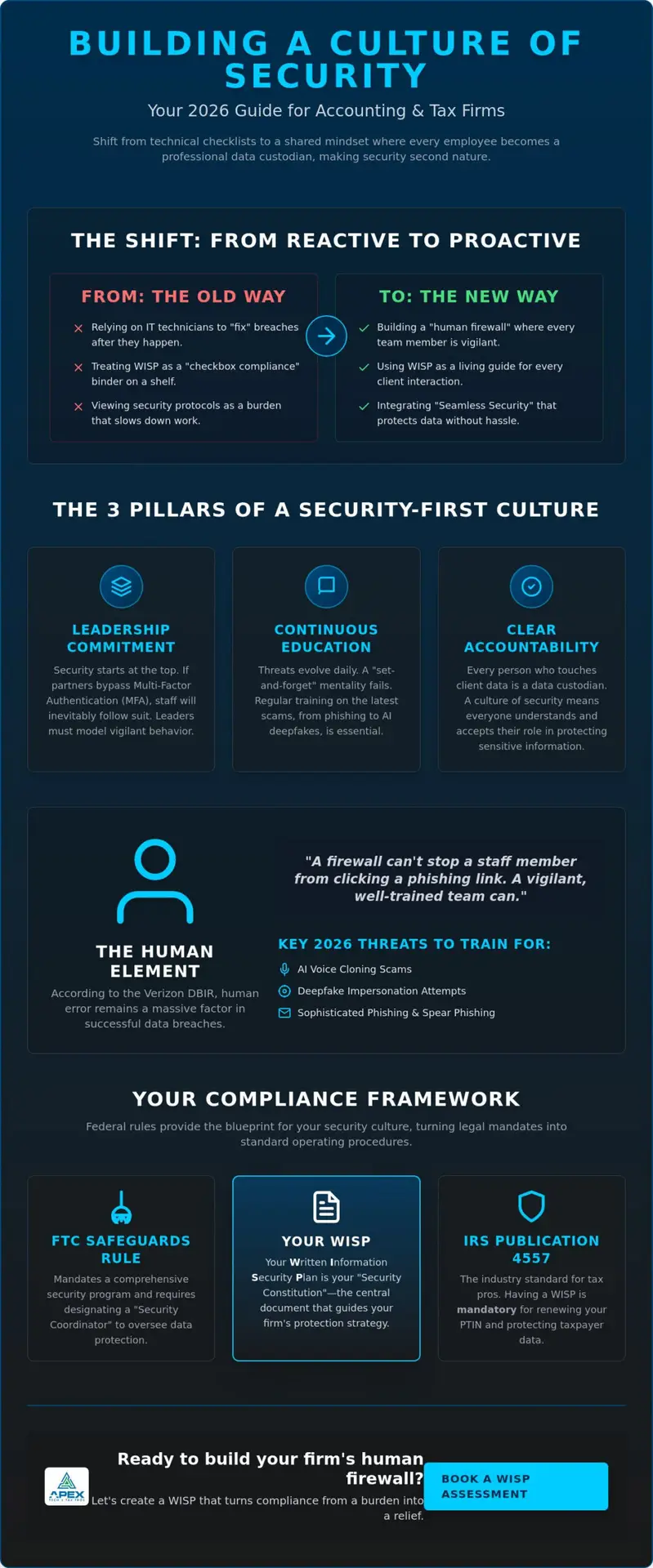
This transformation relies on three specific pillars. First, leadership must lead by example. If partners ignore multi-factor authentication (MFA) because it feels like a hassle, the staff will inevitably follow suit. Second, you need continuous education that evolves with new threats. Third, there must be clear accountability for every person who touches client data. A “checkbox compliance” firm treats their Written Information Security Plan (WISP) as a dusty binder on a shelf. A security-first firm treats that same document as a living guide for every client interaction.
The Accountant as a Data Custodian
Why Traditional IT Support Is Not Enough
You can have the most expensive firewall in the world, but it won’t stop a staff member from giving away credentials to a convincing phishing email. Since Information security awareness is often the missing link, software alone can’t save a firm from simple human error. The 2025 Verizon Data Breach Investigations Report shows that human elements still play a massive role in successful attacks. A “set-and-forget” mentality doesn’t work when threats evolve daily. You need a team that’s as vigilant as your firewall to truly protect your practice.
Aligning Firm Culture with IRS Publication 4557 and FTC Safeguards
Compliance isn’t just about passing an audit; it’s the framework for your firm’s professional integrity. While many view the FTC Safeguards Rule as a list of hardware requirements, it actually mandates a comprehensive, documented information security program. This includes designating a “Security Coordinator” to oversee your safeguards. This role is a legal requirement, but culturally, this person serves as the steward of your firm’s data protection efforts, ensuring that policies aren’t just written but are actually lived by every staff member.
IRS Publication 4557 serves as the definitive industry standard, outlining the specific steps tax pros must take to protect taxpayer data. For 2026, all tax professionals renewing their PTIN must confirm they have a Written Information Security Plan (WISP) in place. When you’re deciding how to create a culture of security in an accounting firm, these federal guidelines provide the necessary boundaries. Your WISP acts as your “Security Constitution,” translating abstract laws into the daily habits that define your office environment.
The WISP as a Cultural Blueprint
Documenting your procedures forces your team to have honest conversations about risk. A generic template might check a box for PTIN renewal, but it rarely changes actual behavior because it doesn’t account for your specific office layout or team structure. A customized WISP reflects your unique workflows, making it much easier for staff to adopt and follow. Regular reviews of this document ensure your culture stays current with the latest 2026 threats. If you aren’t sure where your documentation stands, starting with a professional WISP assessment can clarify your path forward.
Federal Compliance as a Competitive Advantage
You can choose to view compliance as a marketing asset rather than a regulatory burden. High-net-worth clients and business owners are increasingly savvy about data privacy. Being able to demonstrate that you strictly adhere to IRS and FTC standards is a powerful differentiator. It signals that you value their identity as much as their financial success. Beyond the marketing benefit, having professional documentation reduces your liability during an audit. Since FTC penalties as of 2025 can reach $50,120 per violation, a robust security culture is your firm’s best financial defense.
Overcoming the Productivity vs. Protection Barrier
We’ve all heard the objection before: “These security steps are killing my billable hours.” During the peak of tax season, when you have fifty returns on your desk and a line of clients out the door, an extra login step can feel like a roadblock. However, the perceived friction of security is often much smaller than the catastrophic friction of a data breach. Understanding how to create a culture of security in an accounting firm involves moving past the idea that protection and productivity are enemies. Instead, we aim for “Seamless Security,” where safeguards are woven so tightly into your existing workflows that they eventually become invisible.
The psychological impact of “Security Fatigue” is real. When staff members are bombarded with constant alerts and complex password rotations, they naturally look for shortcuts. This is where the risk lives. It’s helpful to remind your team of the stakes. According to a 2023 IBM report, the average cost of a data breach has reached $4.45 million. When you compare that multi-million dollar risk to the thirty seconds it takes to approve a multi-factor authentication (MFA) prompt, the trade-off becomes clear. Security isn’t a burden; it’s the armor that allows your firm to operate without the constant fear of a business-ending event.
Managing Security During Peak Tax Season
Vigilance often drops as exhaustion rises. To combat this, your “Pre-Season” should always include an intensive session of Cybersecurity Awareness Training. By handling the heavy lifting of education before the January rush, you ensure that secure habits are already on autopilot when the pressure mounts. You can also use automated tools, such as secure cloud backups and password managers, to reduce the cognitive load on your staff. When the system handles the complexity, your team can focus on the tax law.
Eliminating the “Shadow IT” Temptation
Staff members usually turn to unapproved apps or personal email accounts because they’re trying to solve a productivity gap. If your firm’s approved file-sharing method is clunky, someone will eventually try to use a personal Dropbox account just to get the job done. You can eliminate this “Shadow IT” temptation by providing secure alternatives that are just as easy to use as consumer tools. Establishing clear boundaries for personal devices is also essential. A firm-wide policy should dictate that client data stays within your protected environment, never on a personal phone or an unmanaged home laptop.
Building the Framework: From WISP Documentation to Staff Habits
Transitioning from a static policy to a vibrant security culture is where many firms struggle. It’s one thing to have a manual; it’s another to have a team that instinctively locks their screens when they stand up. The secret is top-down participation. Partners and senior managers must be the most visible adherents to every rule. If leadership takes shortcuts, the rest of the staff will assume security is just a suggestion. This is a fundamental step in how to create a culture of security in an accounting firm.
Step 1: Formalize with a Customized WISP
You can’t protect what you haven’t identified. Before writing a single word, you must map out your firm’s specific data flows. Generic templates often overlook the nuances of how your specific team handles client files. At Apex Tech 4 Tax Pros, we focus on creating personalized plans that reflect your actual operations. This ensures that your IRS Publication 4557 compliance checklist isn’t just a list of chores, but a practical guide for your specific office.
Step 2: Implement Ongoing Awareness Training
The “once-a-year” training video is a relic of the past. To keep security top-of-mind, you need monthly micro-learning sessions that take five minutes or less. Simulated phishing campaigns are also incredibly effective. They provide a safe environment for staff to learn what a modern threat looks like without the risk of a real breach. Training must be relevant to specific tax-firm roles; a receptionist needs different security cues than a senior tax preparer.
Step 3: Verification and Risk Assessment
You need an outside perspective to find your blind spots. Professional Cybersecurity Awareness Training and Risk Assessments should happen at least once a year. These reviews aren’t just about checking your firewall settings. They help identify cultural gaps, such as whether staff feel comfortable reporting a suspicious link they accidentally clicked. A “No-Blame” post-mortem on near-misses is essential. If someone reports a mistake, thank them for their honesty and use it as a learning moment for the whole team.
Designating “Security Champions” in different departments can also help. These are peer-level staff members who advocate for best practices in their daily work. They make security feel like a team effort rather than a management mandate. Empowering your team this way is the most effective method for how to create a culture of security in an accounting firm that lasts beyond the tax season. If you’re ready to move from theory to action, book a WISP assessment today or email us at info@at4tp.com.
Sustaining the Culture: 2026 Threats and Advanced Defense
Building a security culture isn’t a one-time event; it’s a commitment to staying ahead of attackers who are constantly refining their methods. By 2026, the threat landscape has shifted dramatically with the rise of AI-driven social engineering. We’ve seen a rise in AI voice cloning and deepfake video scams that can perfectly impersonate a partner or a high-value client. Understanding how to create a culture of security in an accounting firm now means training your team to trust their instincts and follow strict verification protocols, even when a request sounds exactly like a trusted voice.
Updating your Standard Operating Procedures (SOPs) is a critical part of this defense. Every wire transfer or significant data move should require verbal verification through a known, secondary channel. This isn’t about a lack of trust; it’s about professional discipline. Secure cloud backup also plays a vital role in cultural peace of mind. Knowing that your data is recoverable in the event of a ransomware attack allows your team to work with confidence rather than fear. It turns a potential catastrophe into a manageable recovery process.
Training for the AI Era
Your staff needs to be empowered to question “Urgent” requests that arrive via unusual channels. If a partner supposedly sends a text message asking for a quick transfer while they’re in a meeting, the staff should know that a safe word or a direct phone call is the mandatory next step. This human-centric approach to how to create a culture of security in an accounting firm ensures that technology doesn’t become a tool for deception. Additionally, you must evaluate your third-party vendors for their own security culture. Your firm is only as secure as the weakest link in your software supply chain.
Partnering for Professional Oversight
Maintaining this level of vigilance is difficult to do alone. A specialized managed service provider should be a cultural partner that understands the specific pressures of the tax industry, not just a help desk you call when the printer breaks. An outside perspective is invaluable for identifying blind spots in firm behavior that you might miss during the daily grind. As regulatory scrutiny from the IRS and FTC continues to intensify beyond 2026, having a documented history of proactive defense will be your greatest asset. It’s time to move from reactive fixes to a sustained, professional posture. Secure your firm’s future with a professional Risk Assessment today to ensure your team is ready for whatever comes next.
Securing Your Firm’s Future and Reputation
Building a resilient practice means recognizing that your team is your strongest defense. We’ve explored how a customized WISP provides the essential blueprint your staff needs to navigate 2026 threats like AI voice cloning. By integrating these protocols into your daily workflows, you remove the friction between productivity and protection. Mastering how to create a culture of security in an accounting firm transforms compliance from a seasonal headache into a year-round competitive advantage that builds lasting client trust.
Our Dallas-based team brings over 20 years of combined IT and tax professional experience to help you meet the rigorous standards of IRS Publication 4557. We specialize in comprehensive WISP development and staff training specifically designed for the unique environment of a tax office. It’s time to shift the weight of data protection from your shoulders to a structured, firm-wide system. Download your FREE WISP Template or schedule a Risk Assessment today. You’ve worked hard to build your practice; let’s work together to protect it.
Frequently Asked Questions
What is the most important element of a security culture?
Leadership commitment is the most vital component. When partners prioritize data protection, it sets a professional standard for the entire office. This top-down approach is essential when learning how to create a culture of security in an accounting firm. It ensures that security isn’t seen as an optional IT task, but as a core responsibility for every member of the team.
Does the IRS require a Written Information Security Plan (WISP) for all firms?
Yes, it’s a federal requirement for any professional handling taxpayer data. IRS Publication 4557 and the FTC Safeguards Rule mandate that you have a documented plan in place. You’re now required to confirm the existence of your WISP when renewing your PTIN. Failing to maintain this document puts your practice at risk for both data breaches and federal non-compliance penalties.
How often should accounting firms conduct cybersecurity training?
You should aim for monthly micro-learning sessions rather than one annual video. The threat landscape of 2026 moves too fast for yearly training to be effective. Short, monthly updates keep your team vigilant against new threats like AI-driven phishing. Regular reinforcement ensures that secure habits stay fresh in everyone’s mind, especially during the high-pressure environment of tax season.
How do I handle a staff member who refuses to follow security protocols?
You should treat security protocols like any other professional standard, such as accurate data entry or client confidentiality. If a staff member bypasses a safeguard, it’s a performance issue that requires a direct conversation. Remind them that their actions affect the entire firm’s legal liability. Accountability is a cornerstone of how to create a culture of security in an accounting firm.
Can a small accounting firm really be a target for major cyberattacks?
Small firms are actually primary targets for many cybercriminals. A Verizon report found that 43% of cyberattacks target small businesses. Hackers often assume that smaller offices have less sophisticated defenses but still hold high-value data like social security numbers. You aren’t too small to be noticed; you’re often seen as a “softer” target with valuable client information.
What are the penalties for non-compliance with the FTC Safeguards Rule?
The financial stakes are significant for any practice. As of January 2025, the FTC can levy penalties of up to $50,120 per violation. These fines can compound quickly if an audit reveals multiple instances of non-compliance. Beyond the government fines, you also face the immense cost of client notifications and the potential loss of your professional reputation after a breach.
Is a free WISP template enough to meet IRS standards?
A template is only a starting point. The IRS and FTC require your WISP to be tailored to your firm’s specific risks, office layout, and workflows. Simply having a generic document in a drawer isn’t enough if you haven’t implemented the specific safeguards it describes. To meet federal standards, your plan must be a living document that reflects your actual daily office practices.
How do I verify a “partner” email that seems suspicious but looks real?
Always use a separate communication channel for verification. If an email looks unusual, don’t reply to it or click any links. Instead, pick up the phone or use your internal office chat to ask the partner directly if they sent the request. This “out-of-band” verification is your best defense against modern impersonation scams that use AI to mimic trusted voices.