
Could your current data storage routine survive a surprise IRS audit, or would it lead directly to a permanent EFIN suspension? You likely feel the mounting pressure of overlapping mandates from the FTC Safeguards Rule and IRS Publication 4557, especially since the May 13, 2024, requirement to report breaches involving 500 or more consumers within just 30 days. It’s exhausting to balance peak season with the technical demands of data integrity. You deserve to know that your secure cloud backup for tax firms IRS compliance strategy is robust enough to withstand both ransomware and regulatory scrutiny.
We understand the high stakes of your profession because we’ve spent decades bridging the gap between specialized IT security and the tax industry. This guide provides a clear roadmap to implement a backup system that protects your clients’ sensitive information while fulfilling your mandatory Written Information Security Plan (WISP) requirements. You’ll gain the confidence that your firm is fully protected against audits and the human errors that, according to the 2024 Verizon report, cause a significant percentage of modern data breaches. Let’s secure your practice for 2026 and beyond.
Key Takeaways
- Understand the transition of cloud storage from a best practice to a mandatory requirement for Federal Tax Information (FTI) under the updated FTC Safeguards Rule.
- Identify why SOC 2 Type II verification and U.S.-based data residency are the essential benchmarks for evaluating any cloud provider’s security integrity.
- Implement a secure cloud backup for tax firms IRS compliance strategy using the 3-2-1 rule to ensure your firm can resume operations immediately after a data event.
- Learn how to document your backup and recovery protocols within your Written Information Security Plan (WISP) to satisfy IRS Publication 4557 mandates.
- Bridge the gap between technical IT requirements and tax preparation with a tailored solution that protects both your professional credentials and your clients’ sensitive data.
Why Secure Cloud Backup is Non-Negotiable for IRS Compliance
A secure cloud backup for tax firms IRS compliance isn’t merely a convenience; it’s a specialized, encrypted repository for Federal Tax Information (FTI) stored in a secure, off-site facility. While many practitioners once viewed off-site storage as a best practice for disaster recovery, the regulatory landscape shifted dramatically on May 13, 2024. The updated FTC Safeguards Rule transformed data protection from a recommendation into a rigid mandate for any business classified as a financial institution. Today, tax professionals must adopt the mindset of an IT security specialist, moving beyond simple file saving to a comprehensive strategy of Cloud computing security and data integrity.
Relying on consumer-grade cloud applications often leads to shadow IT, where sensitive taxpayer data is stored in environments that lack the granular access controls required by federal standards. These generic platforms don’t offer the audit trails or encryption levels necessary to satisfy an IRS review. For the modern firm, a tailored solution isn’t just about storage; it’s about maintaining a documented, defensible chain of custody for every byte of client data you handle.
The High Stakes of Non-Compliance
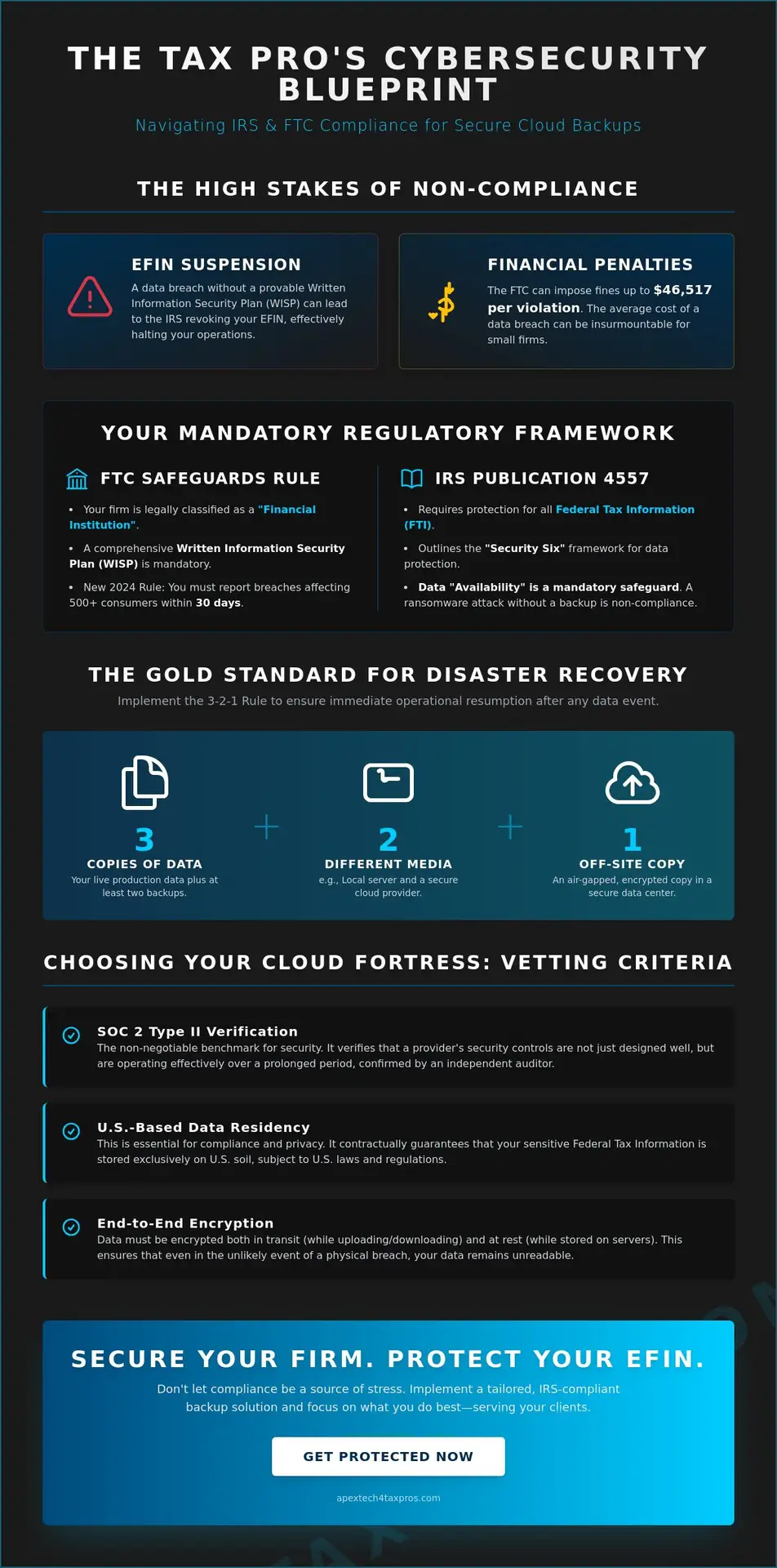
The consequences of failing to implement a professional backup strategy are severe. If a firm suffers a breach and cannot prove it maintained a Written Information Security Plan (WISP) with adequate safeguards, the IRS may suspend its Electronic Filing Identification Number (EFIN). This effectively shuts down the business. Beyond regulatory action, the financial burden is staggering. According to a 2024 IBM report, the average cost of a data breach continues to rise. For a small firm, the combination of FTC penalties and recovery costs can be insurmountable. Lost data isn’t just a technical glitch; it’s a breach of the professional bond you’ve built with your clients.
Bridging the Gap Between Tax Prep and IT
We believe in the role of the Dual-Expert Guardian, a professional who understands that protecting numbers is inseparable from protecting data. Implementing a tailored backup solution reduces the significant mental load that firm owners carry during high-pressure tax seasons. When you know your data is safeguarded by systems engineered specifically for the tax industry, you can focus on your core competency. This level of vigilance doesn’t just prevent disasters; it builds a foundation of professional authority. It signals to your clients that their sensitive information is in safe, capable hands, fostering a level of trust that generic IT providers cannot offer.
Mandatory Standards: IRS Publication 4557 and the FTC Safeguards Rule
The regulatory burden on tax professionals has evolved into a complex web of requirements. As a tax firm, you are legally classified as a financial institution under the Gramm-Leach-Bliley Act. This designation means you must adhere to the rigorous standards set by the FTC Safeguards Rule and IRS Publication 4557. While these documents can feel clinical, their core mission is clear: you must ensure the security, confidentiality, and availability of taxpayer data. In the eyes of the IRS, availability isn’t a convenience; it’s a mandatory safeguard. If a ransomware attack locks your local server and you can’t access client files, you are technically out of compliance. This is where a secure cloud backup for tax firms IRS compliance strategy becomes your most critical defense.
The FTC has significantly increased the pressure on firms to maintain audit readiness. As of May 2026, larger firms, particularly those with 5,000 or more customers, must conduct annual cybersecurity audits, a trend that is rapidly spreading to other jurisdictions. Failure to meet these standards carries a heavy price. FTC penalties can reach up to $46,517 per violation, a figure that can easily bankrupt a small practice. We help you avoid these pitfalls by ensuring your backup system is a living part of your security protocol, rather than a “set it and forget it” tool.
The “Security Six” and Data Integrity
IRS Publication 4557 outlines the “Security Six,” a framework requiring practitioners to protect client data through specific technical controls. A professional backup solution directly supports the mandate to protect taxpayer information by creating a redundant, off-site shield. You must also maintain a comprehensive inventory of all hardware and software that handles Federal Tax Information (FTI). In this context, data integrity is the assurance that taxpayer information remains accurate, complete, and unaltered throughout its entire lifecycle. If you haven’t recently audited your storage systems, you might consider starting with a professional Risk Assessment to identify potential vulnerabilities.
Encryption Standards for 2026
By 2026, standard encryption is no longer sufficient to meet federal guidelines. The FTC Safeguards Rule requires robust encryption for all non-public personal information. This involves using AES-256 for data at rest and TLS 1.3 for data in transit. We prioritize “zero-knowledge” architecture, a standard where the backup provider has no access to your encryption keys. This ensures that even if the provider’s servers were compromised, your client data remains unreadable. End-to-end encryption is a non-negotiable benchmark because it prevents unauthorized access at every stage of the data transfer. Audit readiness in 2026 demands that you can produce logs proving these encryption standards were active and monitored continuously.
Evaluating Cloud Providers: Encryption, SOC 2, and Data Residency
Selecting a vendor for your secure cloud backup for tax firms IRS compliance requires a level of scrutiny that goes far beyond a simple feature comparison. In our experience as dual-experts in both IT and tax regulations, we’ve found that many practitioners inadvertently accept significant risks by trusting marketing claims without verifying technical attestations. Your choice of a cloud provider is a direct extension of your firm’s security posture. If the provider fails an audit, your firm’s compliance is compromised. You must demand transparency regarding their internal controls, data handling practices, and long term business stability.
Enforcement of Multi-Factor Authentication (MFA) is the absolute prerequisite for any vendor consideration. If a provider offers MFA as an optional setting rather than a mandatory requirement for all users, they aren’t prepared for the 2026 regulatory environment. We also emphasize the importance of vendor longevity. Tax data must often be retained for seven years or more, so you need a partner with the financial stability to ensure your data remains accessible and protected throughout that entire lifecycle.
SOC 2 Type II: The Gold Standard for Tax Firms
When you evaluate a provider, you’ll likely see mentions of SOC 2. However, there’s a critical distinction between a SOC 3 report and a SOC 2 Type II attestation. A SOC 3 is essentially a marketing brochure; it’s a high level summary intended for general public consumption. A SOC 2 Type II report is a detailed, confidential document that proves a provider’s controls were tested and effective over a specific period, usually six to twelve months. It’s the only way to verify their claims regarding security, availability, and confidentiality.
Don’t be misled by vendors who claim they are compliant because they use a “SOC 2 platform” like AWS or Azure. While the underlying data center may be secure, the backup service itself must undergo its own independent audit. You should always request the vendor’s security questionnaire and review their latest audit results. This level of due diligence ensures that the software layer where your client data actually resides meets the same rigorous standards as the physical hardware.
Data Residency and Federal Jurisdiction
Data residency refers to the physical location where your client data is stored. For tax firms, this isn’t just a technical detail; it’s a legal requirement. IRS Publication 1075 provides strict guidance for protecting Federal Tax Information (FTI), and storing this data on offshore servers can lead to severe jurisdictional complications. You must have contractual guarantees that your data, including all redundant copies, stays on U.S. soil. This ensures that the data remains subject to U.S. privacy laws and simplifies your compliance reporting.
Multi-tenant public cloud environments often commingle data from thousands of different businesses. This creates a risk of “data bleed” or accidental exposure if the provider’s logical isolation isn’t perfectly maintained. A professional backup solution tailored for the tax industry provides more than just storage; it offers the assurance that your data is handled within a controlled, U.S. based environment that understands the specific sensitivity of tax documents. Verifying the physical locations of a provider’s data centers is a vital step in bridging the gap between basic IT and a truly compliant tax practice.
Building Your Disaster Recovery Plan: Beyond Simple File Storage
Many tax professionals mistake simple data storage for a comprehensive recovery strategy. While storing files in the cloud is a vital first step, a true disaster recovery plan focuses on the speed and reliability of resuming operations after a catastrophic event. A secure cloud backup for tax firms IRS compliance is the engine of this strategy, but it requires a structured framework to be effective. You don’t just need your data back; you need it back in a state that allows your firm to meet filing deadlines without missing a beat. This distinction between “backup” and “business continuity” is what separates resilient firms from those that struggle to recover after a breach.
Ransomware remains a primary threat to data availability. In 2026, hackers don’t just encrypt your primary server; they actively seek out and delete connected backup files to increase their leverage. To counter this, we implement immutable backups. This technology ensures that once data is written to the cloud, it cannot be altered or deleted for a set period, even if an attacker gains administrative access to your network. This level of protection is a core component of our Secure Cloud Backup service, providing the “fail-safe” required by modern regulatory standards.
The 3-2-1 Rule for Tax Professionals
We advocate for the 3-2-1 backup rule as the foundational standard for any tax practice. This methodical approach ensures that no single point of failure can destroy your client records. The process involves three distinct layers of protection:
- Step 1: Local Backup. Maintain a primary copy of your data on a local device for the near-instant recovery of individual files or folders.
- Step 2: Cloud Backup. Sync your data to a secure, off-site repository to ensure geographic redundancy and protection against physical disasters like fire or theft.
- Step 3: Verification. Implement automated protocols to regularly verify that your backups are not corrupted and are ready for immediate deployment.
Ransomware Resilience and Versioning
Effective resilience depends on sophisticated versioning. This feature allows you to roll back your entire database to a specific point in time before a ransomware infection occurred. By maintaining multiple historical versions of your files, you can bypass the encrypted data and restore your system to a clean state. We also emphasize the use of air-gapped storage, which keeps a copy of your data entirely disconnected from your main network to prevent lateral movement by malware. Recovery Point Objective (RPO) defines the maximum age of files that must be recovered from backup storage for operations to resume successfully after a data loss event. Testing your recovery process is the only way to ensure these objectives are met. An untested backup is merely a hope; a tested recovery plan is a professional safeguard.
Bridging the Gap: Integrating Cloud Backup into Your WISP
A backup system is only as strong as the policy that governs it. While the technical specifications of your storage are vital, the IRS requires that these tools be documented within your Written Information Security Plan (WISP). Without this documentation, even the most sophisticated secure cloud backup for tax firms IRS compliance strategy remains an island of technology rather than a compliant safeguard. Integrating your backup protocols into your WISP transforms your data protection from a simple IT task into a comprehensive legal defense that satisfies the high standards of 2026 regulatory mandates.
We’ve spent 20 years helping tax professionals navigate the intersection of federal regulations and information technology. Our family-owned roots mean we don’t just see you as a client; we see you as a peer in a high-stakes industry. We understand that your goal isn’t just to store data, but to maintain a practice that is resilient, trustworthy, and fully audit-ready. By bridging the gap between your tax software and your security infrastructure, we provide the protective reassurance you need to focus on your clients during the busiest months of the year.
Documenting Your Cloud Strategy for the IRS
Your WISP must provide a clear, narrative explanation of how you protect taxpayer information. This includes documenting your use of AES-256 encryption and TLS 1.3 protocols, as well as your specific data residency guarantees. During an IRS compliance review, this document serves as your primary shield. It proves you’ve done the due diligence required by IRS Publication 4557. You must also assign specific security roles within your firm, identifying exactly who is responsible for managing and verifying backups. Clearly defining these roles ensures that data integrity doesn’t fall through the cracks of a busy tax season.
The Apex Tech 4 Tax Pros Solution
Our mission is to provide a unified solution that covers both the “Plan” and the “Protection.” We don’t believe in generic IT services; we offer a Customized Written Information Security Plan (WISP) that is specifically engineered for the tax industry. Our secure cloud backup integrates seamlessly with this plan, ensuring that every technical safeguard you implement is backed by the necessary regulatory documentation. This holistic approach removes the mental load of compliance and prevents the fragmentation that often leads to security gaps.
Moving from a state of potential vulnerability to secure compliance doesn’t have to be an overwhelming process. You can start today by downloading our FREE WISP Download Template to assess your current standing. From there, our team of dual-experts is ready to help you implement a tailored strategy that protects your EFIN, your reputation, and your clients’ sensitive data for the long term.
Protecting Your Practice for the 2026 Regulatory Landscape
Your firm’s resilience in the 2026 tax season depends on more than just high-quality preparation; it requires a sophisticated defense against data loss and regulatory scrutiny. By prioritizing U.S.-based data residency and SOC 2 Type II verification, you ensure your client files remain under federal jurisdiction and meet the highest security benchmarks. Integrating these technical controls into a tailored Written Information Security Plan (WISP) transforms your storage into a powerful legal safeguard.
Implementing a secure cloud backup for tax firms IRS compliance strategy is the most effective way to protect your EFIN and maintain the trust of your clients. At Apex Tech 4 Tax Pros, we bring 20+ years of experience in high-stakes IT compliance to every partnership. As a family-owned firm, we have a specialized focus on IRS Publication 4557 and the FTC Safeguards Rule. We’re dedicated to bridging the gap between your technical requirements and your professional success.
Secure Your Firm’s Future-Get Your Customized WISP and Cloud Backup Plan
You’ve worked hard to build your practice. We’re here to ensure it stays protected and compliant for years to come.
Frequently Asked Questions
Is Google Drive or Dropbox considered IRS-compliant for tax firms?
Standard consumer versions of Google Drive or Dropbox are generally not compliant because they lack the specific administrative controls and audit trails required by IRS Publication 4557. While these platforms offer basic encryption, they don’t provide the zero-knowledge architecture or the granular data residency guarantees necessary for Federal Tax Information (FTI). A tailored secure cloud backup for tax firms IRS compliance solution ensures that your storage environment meets every federal mandate rather than just providing simple file hosting.
How often should a tax firm back up its client data to the cloud?
You should automate your backups to occur at least daily, though many firms prefer real-time or hourly syncing during peak season. Frequent intervals reduce your Recovery Point Objective (RPO), ensuring that a system failure doesn’t result in the loss of more than a few hours of work. Regularity is a core component of data integrity, as it prevents the significant gaps in record-keeping that often draw scrutiny during a regulatory review.
What happens if I lose client data and don’t have a compliant backup?
Losing client data without a compliant backup often leads to immediate EFIN suspension and significant financial penalties from the FTC. You also face legal exposure under state data privacy laws, which have been enacted in 20 U.S. states as of early 2026. Beyond the legal risks, the loss of sensitive taxpayer information causes irreparable reputational damage that can end a professional practice overnight.
Does the FTC Safeguards Rule require me to encrypt my cloud backups?
Yes, the FTC Safeguards Rule explicitly mandates the encryption of all non-public personal information both at rest and in transit. This means your client data must be encrypted while it’s stored on the cloud server and while it’s being transferred over the internet. Professional solutions use AES-256 and TLS 1.3 encryption to satisfy these requirements. If your current backup method doesn’t use these specific standards, it’s considered a direct violation of federal law.
Can I store tax data on a cloud server located outside of the United States?
You should exclusively use U.S.-based servers to avoid the jurisdictional and compliance complications outlined in IRS Publication 1075. Storing FTI on offshore servers can compromise your ability to meet federal data residency standards and complicates your legal standing in the event of a breach. Always verify that your provider provides contractual guarantees that all data copies remain physically located within the United States.
What is the difference between a WISP and a cloud backup solution?
A Written Information Security Plan (WISP) is the mandatory document that outlines your firm’s security policies, while a cloud backup is the technical tool that helps fulfill those policies. Think of the WISP as your regulatory blueprint and the secure cloud backup for tax firms IRS compliance as the actual shield protecting your data. You cannot have a compliant practice without both a documented plan and the technical safeguards to back it up.
Do I need a separate backup for my tax preparation software?
Your backup strategy must include the specific database files generated by software like Drake, Lacerte, or UltraTax. These proprietary files contain the essential FTI required to resume your operations after a disaster. A professional backup solution is configured to recognize these databases and ensure they’re fully captured, allowing you to restore your entire workflow rather than just individual PDF documents.
How do I prove my cloud backup is secure during an IRS audit?
You prove security by presenting your WISP alongside a SOC 2 Type II attestation report from your backup provider. These documents provide the “Dual-Expert” verification that your controls are not only in place but have been independently tested for effectiveness. Maintaining automated logs of successful backup completions also serves as concrete evidence that you are actively monitoring your firm’s data integrity safeguards.